
Which specialties use two tiers
Six specialties split their signals in the 2027 ERAS season: anesthesiology (5 gold, 10 silver), child neurology (3 gold, 6 silver), dermatology (3 gold, 25 silver), internal medicine (3 gold, 12 silver), diagnostic radiology (6 gold, 9 silver) and vascular surgery (3 gold, 12 silver). Every other specialty in the AAMC's 2027 report uses a single type of signal. The full list is in our signal limits by specialty table.
The point of having two tiers is to make gold a deliberate choice. With three gold signals in internal medicine you cannot spread them across the field, so programs can read a gold signal as real interest. The rest of this page is about how programs responded, using the AAMC's 2026 signal and interview report.
Interview rates by tier
These are medians of program-level interview rates, not the chance that one applicant gets an interview. For MD applicants the order was gold, then silver, then no signal in all four of the large two-tier specialties.
| Specialty | Applicant type | Gold | Silver | No signal |
|---|---|---|---|---|
| Anesthesiology | MD | 67% | 43% | 1% |
| Anesthesiology | DO | 59% | 25% | 0% |
| Anesthesiology | IMG | 15% | 3% | 0% |
| Internal Medicine | MD | 62% | 50% | 11% |
| Internal Medicine | DO | 60% | 45% | 8% |
| Internal Medicine | IMG | 24% | 9% | 1% |
| Diagnostic Radiology | MD | 71% | 50% | 5% |
| Diagnostic Radiology | DO | 50% | 28% | 1% |
| Dermatology | MD | 61% | 14% | 0% |
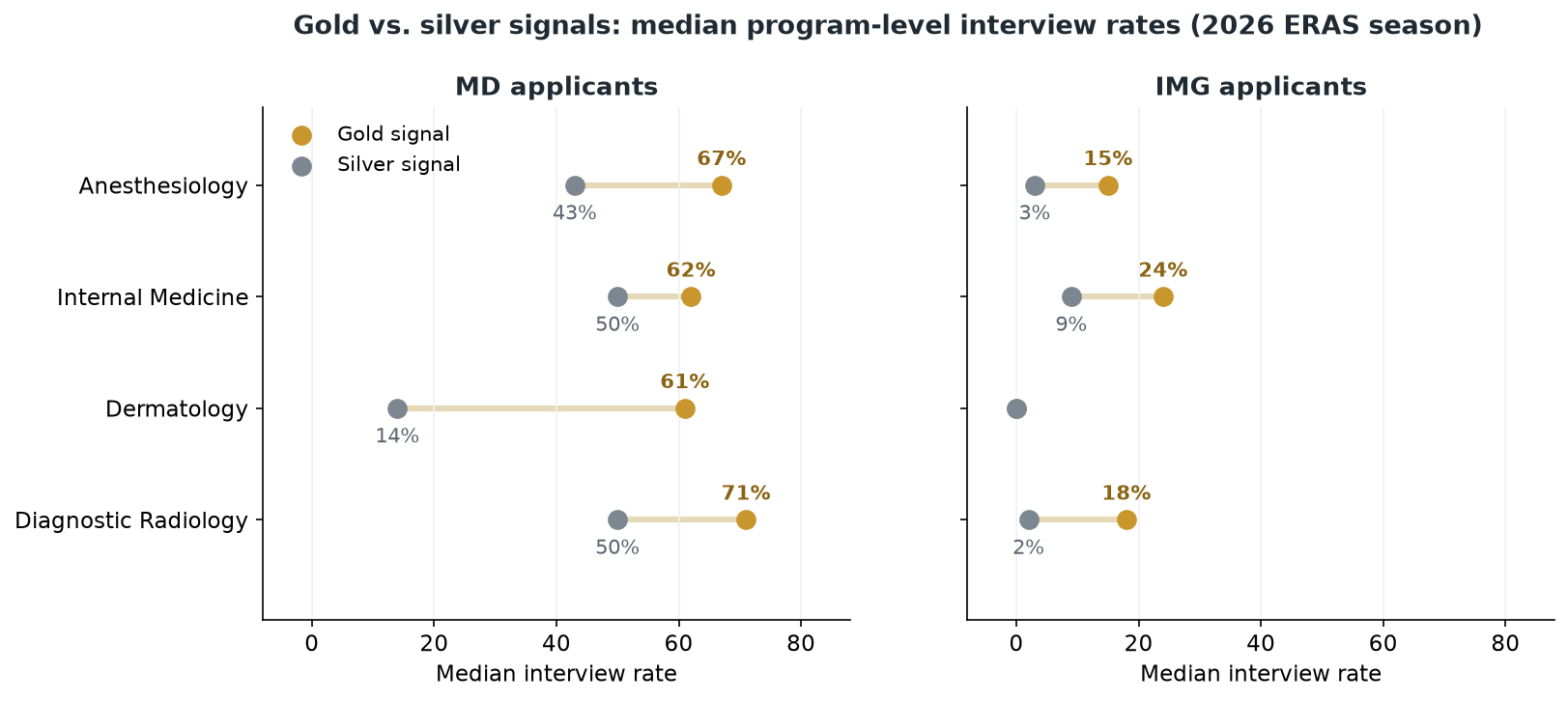
Dermatology has the widest MD gap by far, 61% with gold against 14% with silver. Anesthesiology comes next for MD applicants at 24 points, and its DO gap of 34 points (59% against 25%) is the widest DO difference in this table. Internal medicine has the narrowest gap, which makes a silver signal worth more there than in the other two-tier specialties.
The gap for IMG applicants
IMG gold medians were 15% in anesthesiology, 24% in internal medicine and 18% in diagnostic radiology. The silver medians were 3%, 9% and 2%. Both tiers beat no signal, but gold is several times higher than silver, so for IMGs most of the measured advantage sits with the gold signals. There is more on this group in our IMG guide to program signals.
What happens when geography lines up
The AAMC also looked at tiers together with geographic preferences, using 2026 invitations. In anesthesiology, applicants who signaled a program in a division they had listed had a median of 59% with gold and 38% with silver. Gold at a program outside their listed divisions was 26%. In internal medicine the numbers were 45% aligned against 21% not aligned for gold, and in diagnostic radiology 62% against 26%.
So a gold signal inside your listed regions went with about double the median of a gold signal outside them. That is the one part you still control after the allocations are fixed. The full numbers are in our page on geographic preferences and interview rates.
How to use gold and silver
The AAMC's guide for the 2027 season tells applicants that gold signals carry higher interview rates than silver, and that silver improves your chances compared with no signal. The numbers above add one thing: silver is not filler. In internal medicine and diagnostic radiology the MD silver median is 50%.
Our reading of the data, not an AAMC recommendation: put gold on programs you want and where your application clearly passes their screening, and put silver on the wider group of programs you would be glad to attend. Gold sent to a program that screens you out on scores, graduation year or visa status is unlikely to help. Check each program's screening before you pick a tier. The specialty pages list programs with IMG share and visa sponsorship, which covers a good part of that check.
For the one-tier specialties and the overall comparison with no signal, see Do residency program signals get you interviews?