What the section is
In MyERAS you can mark the US geographic divisions where you want to train, or say you have no preference. Programs that take part can see your answer. The AAMC compared interview invitation rates across three situations: aligned (you signaled a program in a division you listed), no preference (you chose that option) and not aligned (you signaled a program in a division you did not list).
The sample only includes programs that took part in signaling, made geographic preferences viewable by September 28, 2025 and invited at least 10 applicants through Thalamus Core. In internal medicine that was 370 of 684 programs. In urology it was 26 of 150. The percentages are medians of program-level invitation rates.
Aligned, no preference and not aligned
| Specialty | Aligned | No preference | Not aligned |
|---|---|---|---|
| Anesthesiology (gold) | 59% | 25% | 26% |
| Anesthesiology (silver) | 38% | 17% | 18% |
| Child Neurology | 60% | 26% | 0% |
| Family Medicine | 50% | 16% | 14% |
| Internal Medicine (gold) | 45% | 24% | 21% |
| Internal Medicine (silver) | 30% | 11% | 13% |
| Neurology | 39% | 15% | 20% |
| Pathology | 45% | 14% | 22% |
| Pediatrics | 63% | 30% | 26% |
| Psychiatry | 48% | 14% | 20% |
| Radiology-Diagnostic (gold) | 62% | 29% | 26% |
| Surgery | 31% | 16% | 14% |
| Transitional Year | 34% | 22% | 14% |
| Urology | 47% | 37% | 23% |
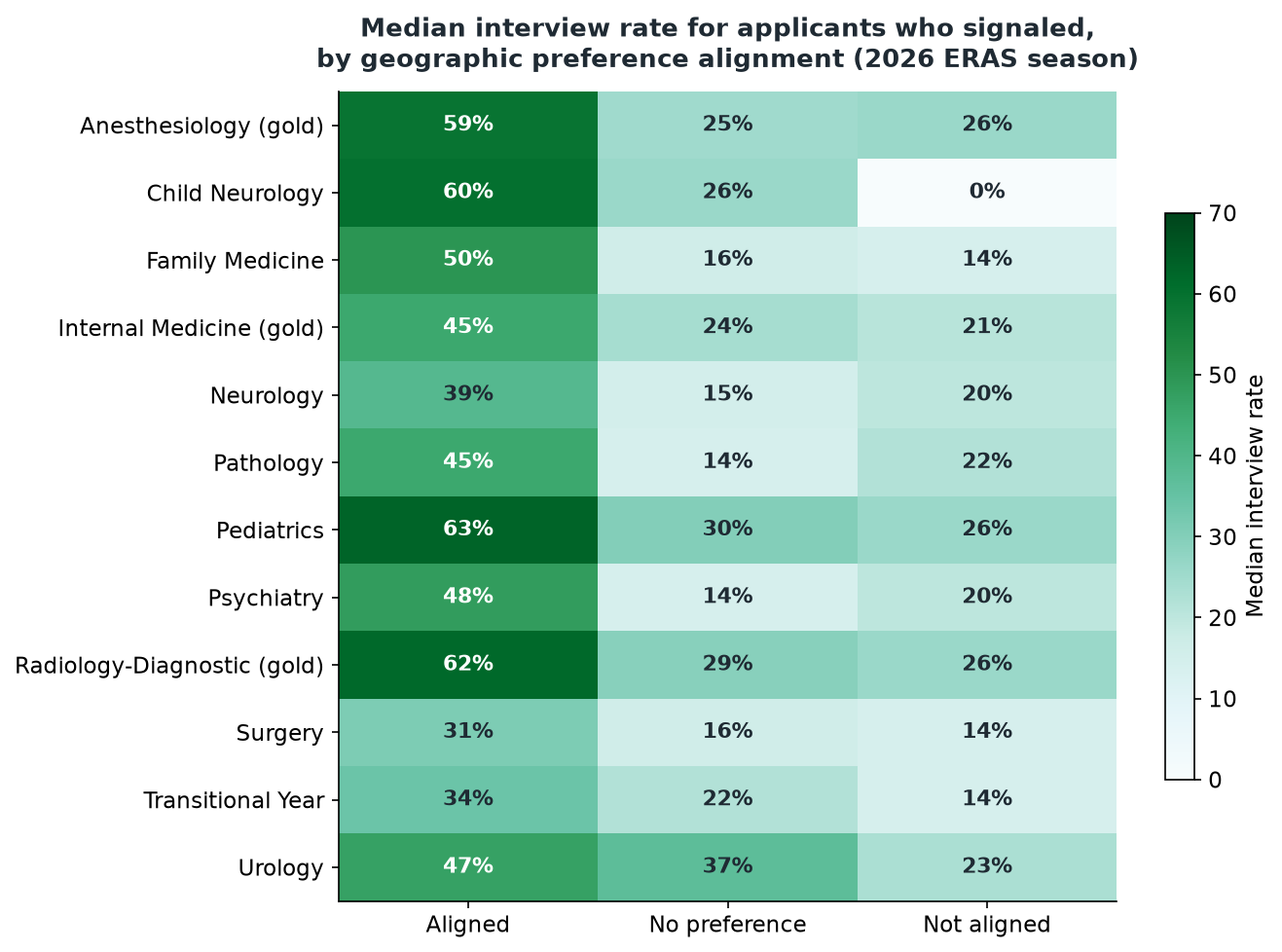
Comparing the last two columns, no preference was higher than not aligned in some specialties (child neurology, transitional year, urology), lower in others (pathology, psychiatry, neurology, internal medicine silver) and about the same in the rest.
A signal and alignment together
The AAMC's main finding is that the two go together. Rates were generally highest for applicants who signaled and were aligned, and within each alignment group signalers did better than non-signalers. The other direction is just as useful: applicants who did not signal had low rates everywhere, and alignment did little to rescue them. In family medicine, aligned applicants without a signal had a 27% median, against 50% for aligned applicants who signaled.
If location matters to you, signals inside your preferred regions do most of the work. The preference list alone does not.
Where the pattern breaks
Four specialties do not follow the general order, and anyone applying to them should look at their own row.
- Neurological surgery: among applicants who signaled, the no preference median (33%) was higher than the aligned median (24%), and not aligned was 15%. The report gives no reason.
- Thoracic surgery: among applicants who did not signal, no preference (30%) was higher than aligned (24%).
- Plastic surgery: among signalers, no preference (36%) was higher than aligned (33%).
- Radiation oncology: applicants who signaled outside their listed regions had a 0% median, while aligned applicants without a signal were at 40%. Child neurology also shows 0% for not aligned.
The AAMC's explanation is that programs and specialties use alignment differently. Take that at face value. The same ERAS section can be read in different ways by different specialties, and the pattern in your own specialty is the best guide you have.
What to do with it
The AAMC warns that these analyses do not control for everything programs consider, and that geographic preferences are one part of a holistic review. Treat the numbers as a direction, not a rule. With that in mind, three practical points:
- List only the divisions where you would actually train. Programs can see your selections, and a signal outside them was associated with lower medians in most specialties.
- If you are truly open to anywhere, no preference is a reasonable answer. The data does not show it as an advantage, but it does not show a clear penalty either.
- If you have a firm region, put your signals inside it. That combination did best most consistently.
That needs a list of programs by location before you assign anything. Every specialty page lets you browse programs by state, so you can see what sits inside the regions you are considering. For how gold and silver signals interact with this, read gold vs. silver signals. For the signal basics, see Do residency program signals get you interviews?
Sources