

Do Residency Program Signals Get You Interviews?
What the AAMC's 2026 data says about interview rates with and without a program signal, for MD, DO and IMG applicants, and where the numbers should not be over-read.

The short version: in almost every specialty the AAMC analyzed, applicants who sent a program a signal had a higher median interview rate at that program than applicants who did not. In family medicine, MD applicants who signaled had a median of 78% against 49% for those who did not. In internal medicine, a gold signal went with a 62% median for MD applicants against 11% with no signal. For IMGs the rates are far lower, but the gap is still there: 24% with an internal medicine gold signal, 1% without.
These are medians across programs, not personal odds, and the AAMC did not adjust for how strong the applicants were. A signal goes with more interviews. It does not stand in for a competitive application.
What the AAMC measured
The numbers here come from the AAMC's ERAS Program Signal and Interview Invitation report for the 2026 residency cycle, with data through October 1, 2026. The analysis covered programs that took part in signaling, sent at least 10 interview invitations and reported interview data through Thalamus Core. Coverage was good but not complete. For internal medicine, 618 of 686 programs made the sample. For urology it was 63 of 150.
Two definitions matter before you read any table. First, the percentages are medians of program-level interview rates. The AAMC worked out each program's interview rate for its signaled and non-signaled applicants, then took the median across programs. It is not the rate for an individual applicant. Second, applicant groups with fewer than 50 people were suppressed, so some cells are blank on purpose.
Single-tier specialties: signal vs. no signal
Most specialties that use signals give every applicant one type of signal, between 2 and 30 of them. In these specialties the gap between signaling and not signaling is large and consistent.
| Specialty | MD, signaled | MD, no signal | DO, signaled | DO, no signal | IMG, signaled | IMG, no signal |
|---|---|---|---|---|---|---|
| Family Medicine | 78% | 49% | 75% | 45% | 12% | 4% |
| Pediatrics | 86% | 59% | 83% | 35% | 24% | 6% |
| Neurology | 64% | 20% | 50% | 7% | 13% | 2% |
| Psychiatry | 58% | 10% | 46% | 4% | 14% | 1% |
| Pathology | 62% | 24% | 54% | 13% | 20% | 3% |
| Surgery | 35% | 9% | 21% | 2% | 5% | 0% |
| Physical Medicine and Rehabilitation | 43% | 1% | 34% | 1% | 4% | 0% |
| Urology | 46% | 2% | 22% | 0% | 7% | 0% |
Source: AAMC, ERAS Program Signal and Interview Invitation, 2026 Residency (September cycle), data as of October 1, 2026. Groups with fewer than 50 applicants were suppressed.
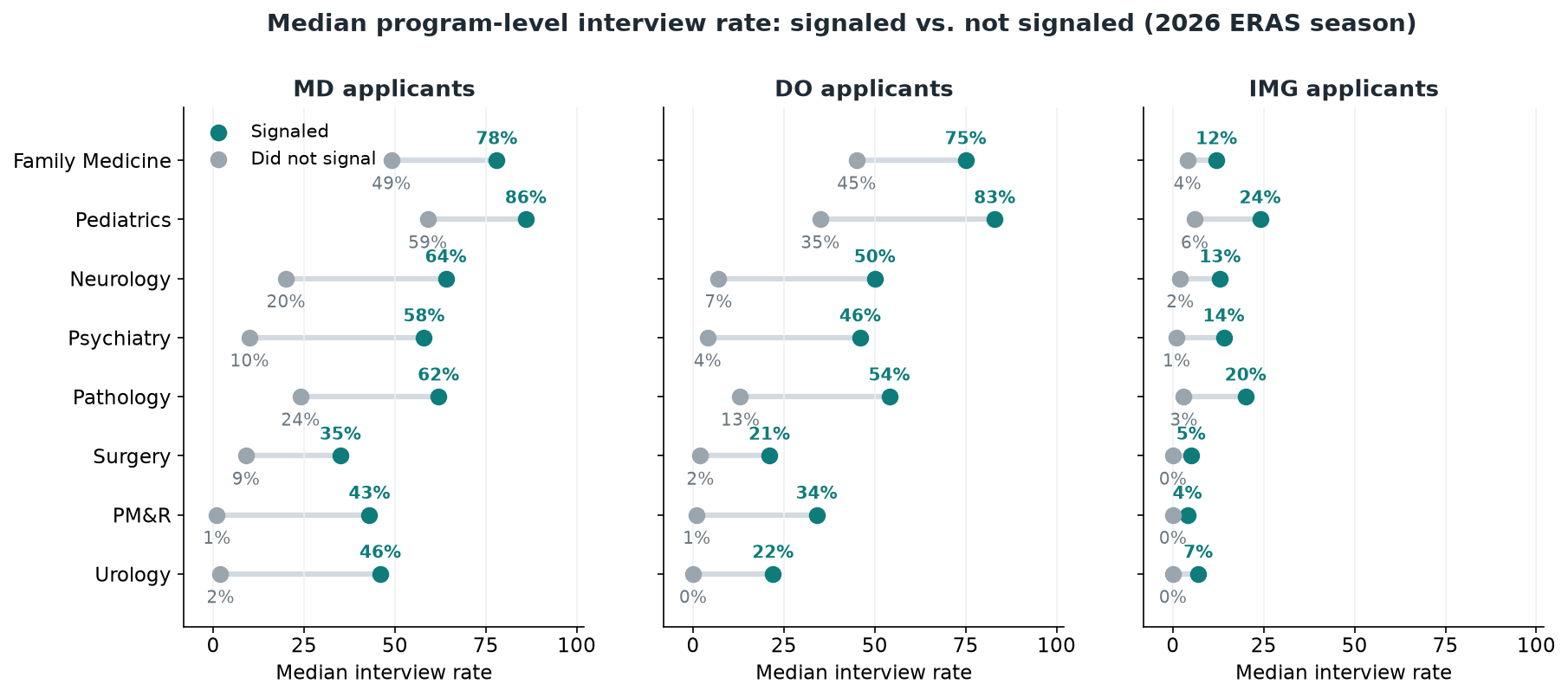
Look at the no-signal columns. In PM&R and urology the median program interviewed almost none of the MD applicants who had not signaled (1% and 2%), and surgery is close behind at 9%. In those specialties the case for using every signal is strongest. In family medicine and pediatrics, MD applicants without a signal still had medians of 49% and 59%, so a strong applicant can get interviews there without one.
Two-tier specialties: gold, silver and no signal
Six specialties split their signals into gold and silver. In the 2026 data, gold did better than silver for MD applicants in every two-tier specialty reported, and silver did better than, or matched, no signal.
| Specialty | Applicant type | Gold | Silver | No signal |
|---|---|---|---|---|
| Internal Medicine | MD | 62% | 50% | 11% |
| Internal Medicine | IMG | 24% | 9% | 1% |
| Anesthesiology | MD | 67% | 43% | 1% |
| Anesthesiology | IMG | 15% | 3% | 0% |
| Diagnostic Radiology | MD | 71% | 50% | 5% |
| Dermatology | MD | 61% | 14% | 0% |
Source: same AAMC report. Vascular surgery and child neurology were not reported for every applicant type. In dermatology the DO gold median was 33%, and the DO silver and IMG cells were 0% or suppressed.
The gap between gold and silver varies. For MD applicants it is 12 points in internal medicine and 47 in dermatology. Which tier you land on matters more in some specialties than in others.
What a 0% median means
Several cells say 0%, and they are easy to misread. A median of 0% means that at least half of the programs in the sample interviewed none of the applicants in that group (or rounded to 0%). Some programs did interview some of them. Read it as "the typical program did not interview this group", not "this group never gets interviews".
Six things to keep in mind
- This is not an experiment. Applicants who signal a program differ from those who do not in interest, location and probably in application strength. The AAMC says the analyses do not control for all the factors programs consider. Say "goes with", not "causes".
- Medians hide the spread. A program at the 90th percentile can behave very differently from one at the 10th.
- Coverage is partial. Only programs that used Thalamus Core and sent at least 10 invitations are in. Urology's 63 programs are 42% of its ERAS programs. Family medicine's 701 are 89%.
- The IMG group is one bucket. The report does not split IMGs by citizenship or visa status.
- A few small combined specialties go the other way. In pediatrics/medical genetics, IMG applicants who did not signal had a higher median (19%) than those who did (11%), and there are similar reversals for MD applicants in internal medicine/psychiatry and preventive medicine. The tables above cover the large specialties, where the pattern is consistent.
- Do not multiply medians by your signal count. A 24% IMG gold median in internal medicine does not mean three gold signals give you 0.72 interviews. These are program-level figures, and your result depends on where you sit among applicants.
What this means for your signals
Three things follow. First, if your specialty uses signals, use all of them. The no-signal medians are too low in most specialties to leave any unspent. Second, where the no-signal figure is close to zero, as in PM&R, urology and anesthesiology, a signal matters most. Third, in large specialties like family medicine, it makes sense to aim signals at programs that are realistic for your profile rather than at the programs everyone else is signaling.
That last point is where fit comes in. Our specialty pages list every ACGME program in a specialty with its IMG share, visa sponsorship and interview rate, so you can build your signal list from programs that have interviewed applicants like you. The ERAS application fee calculator shows what a longer list costs, and our guides to the application process and to IMG performance in the 2024 Match cover the rest of the picture. If you are an IMG, the best specialties to match as an IMG is worth a read before you choose where to spend signals.
Create a free account to compare programs against your profile before you assign a single signal.
Sources: AAMC, ERAS Program Signal and Interview Invitation, 2026 Residency (September cycle), data as of October 1, 2026; AAMC ERAS Statistics.