

Which Medical Schools Send the Most Residents to US Programs?
We traced the medical schools of 112,162 current US residents. One in four trained outside the US. Here are the countries and schools that send the most, and the specialties where they train.

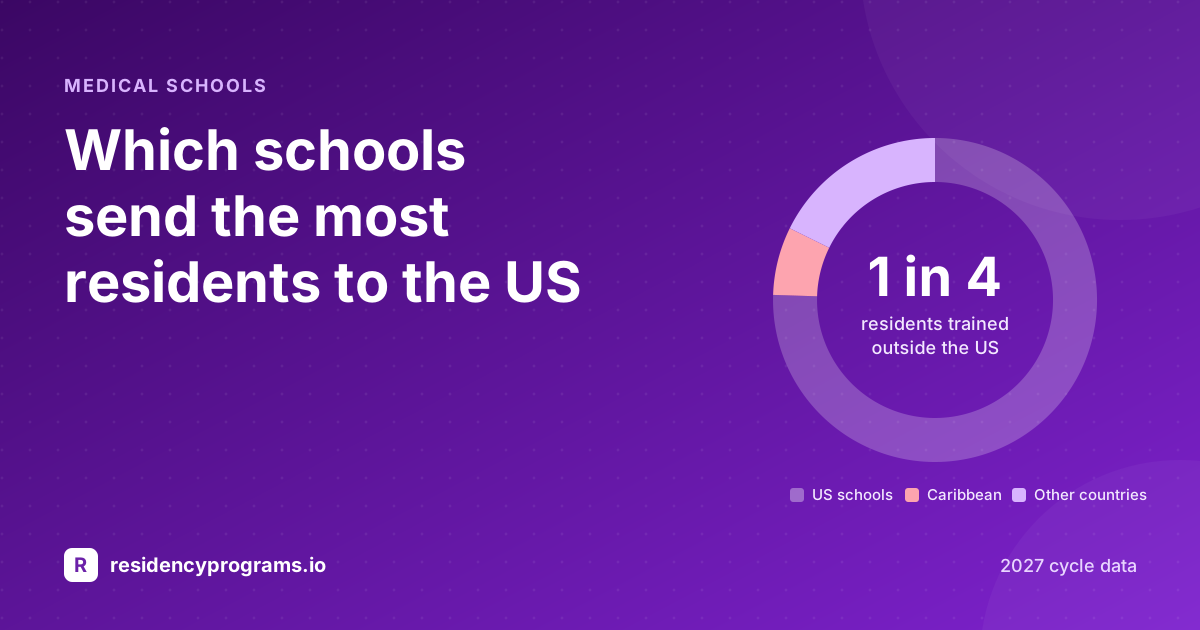
- We looked at where 112,162 current residents at 4,464 US programs went to medical school. 75.5% studied at US MD or DO schools, 6.8% at Caribbean schools and 17.7% at other schools outside the US.
- India sends more residents than any other country outside the US (3,629), spread across 343 schools. Pakistan is third with 2,773 from 93 schools.
- St. George's University in Grenada is the largest single source outside the US: 2,887 residents in 1,222 programs, about twice as many as the largest US school.
- The largest non-US schools outside the Caribbean are Dow Medical College and King Edward Medical University in Pakistan.
- The biggest US sources are osteopathic schools, led by LECOM (1,412 residents) and PCOM (1,102).
- Specialty matters: 46% of internal medicine residents went to school outside the US, against 2% in orthopaedic surgery.
Every residency program has a track record with certain medical schools. Some take a graduate from the same Caribbean school every year. Others have residents from a dozen countries. For an applicant, knowing which schools already send people into US residency, and where those people end up, is one of the best clues to where your own application will be read with interest.
We counted the medical schools of current residents across US programs, using the ResidencyPrograms.io database for the 2027 cycle. Here is what that shows.
How we counted
Programs report where their current residents went to medical school. We matched each school name to a single record using the World Directory of Medical Schools, so that different spellings of the same school count once. That covers 112,162 residents at 4,464 programs, from 2,054 medical schools in 155 countries.
These are residents in training now, across all years, not just new interns.
US schools, the Caribbean and everyone else
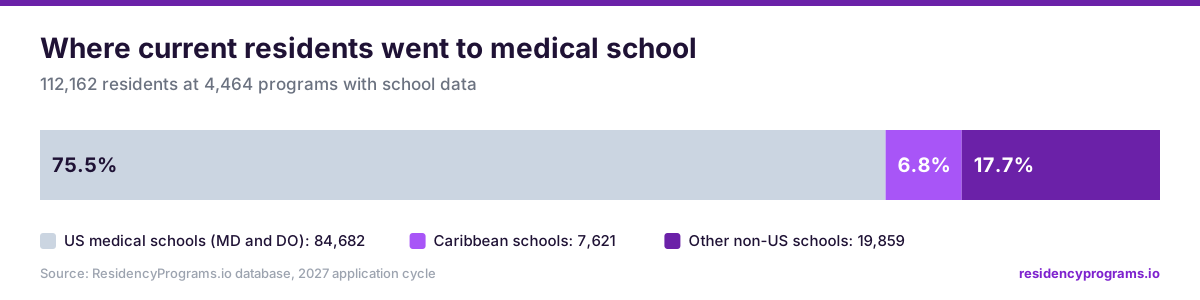
Three out of four residents went to an MD or DO school in the United States. The remaining quarter splits into two groups that behave very differently. About 7,600 residents (6.8%) went to Caribbean schools set up mainly to train students for US practice, many of them US citizens. Almost 20,000 (17.7%) went to schools in other countries, most of them in their home country.
The countries that send the most residents
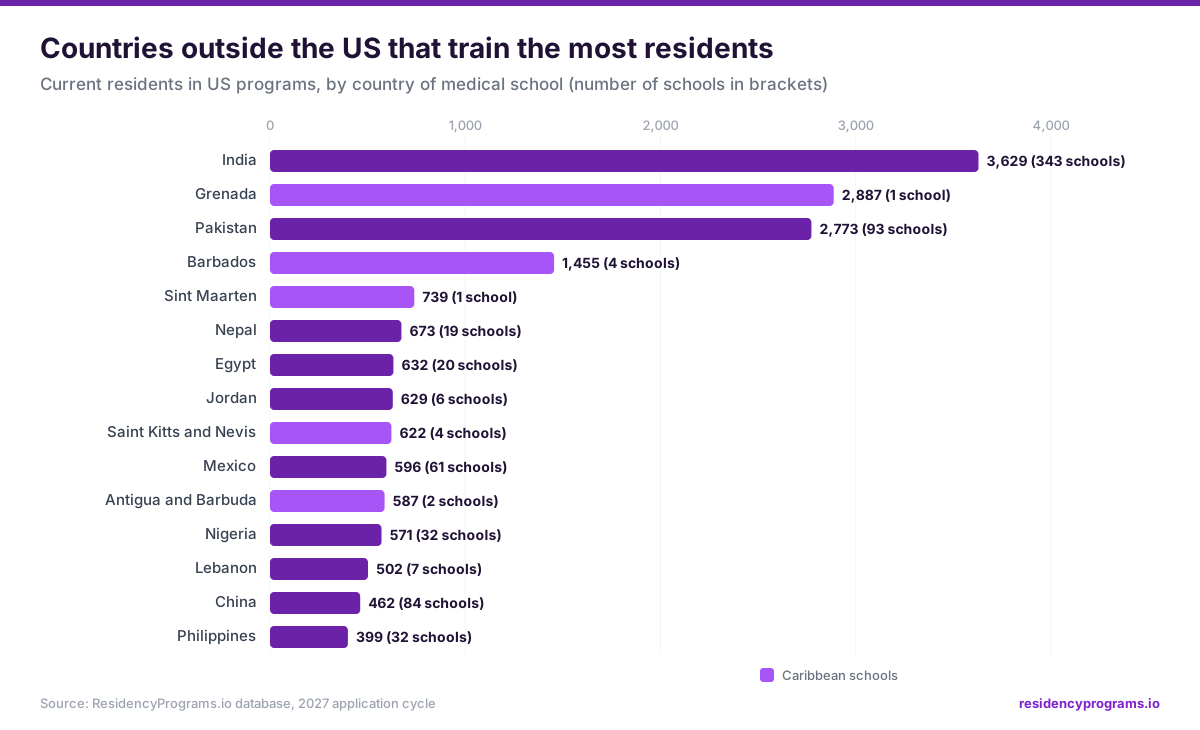
India sends the most residents of any country outside the US: 3,629. What stands out is how spread out they are. Those residents come from 343 different schools, and the largest Indian source, Kasturba Medical College in Manipal, has only 133 residents in US programs. Pakistan (2,773 residents from 93 schools) is more concentrated, with a few large schools in Karachi and Lahore sending most of its graduates.
Grenada sits between them with 2,887 residents, and every one of them comes from a single school. Barbados (1,455), Sint Maarten (739), Saint Kitts and Nevis (622) and Antigua and Barbuda (587) follow the same pattern: one to four schools, each sending large numbers.
The Middle East and North Africa are well represented too: Egypt (632), Jordan (629), Lebanon (502). Nepal (673) and Nigeria (571) round out a list that reflects where US residency is a common goal for graduates.
The schools that send the most residents
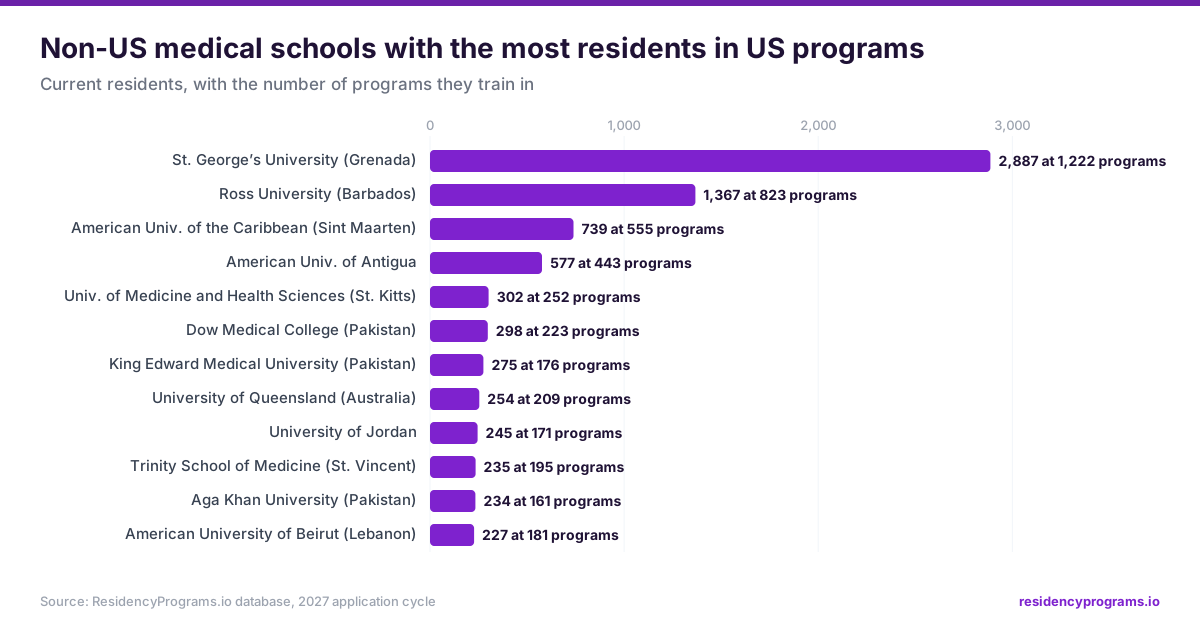
St. George's University in Grenada is in a class of its own: 2,887 residents spread across 1,222 programs. That is about twice as many residents as the largest US medical school in our data. Ross University (1,367), the American University of the Caribbean (739) and the American University of Antigua (577) are next.
The largest schools outside the Caribbean are in Pakistan and the Middle East. Here are the biggest sources in South Asia:
| Medical school | City | Residents | Programs |
|---|---|---|---|
| Dow Medical College | Karachi, Pakistan | 298 | 223 |
| King Edward Medical University | Lahore, Pakistan | 275 | 176 |
| Aga Khan University Medical College | Karachi, Pakistan | 234 | 161 |
| Jinnah Sindh Medical University | Karachi, Pakistan | 145 | 117 |
| Kasturba Medical College | Manipal, India | 133 | 114 |
| Allama Iqbal Medical College | Lahore, Pakistan | 114 | 93 |
Outside South Asia, the University of Jordan (245), the American University of Beirut (227), Jordan University of Science and Technology (197), Alexandria University in Egypt (138) and Cairo University (130) are the largest sources in the Middle East and North Africa. The University of Queensland in Australia (254) is a surprise entry, thanks largely to its program for North American students.
The biggest US sources are DO schools
Among US medical schools, the largest sources of residents are osteopathic. Lake Erie College of Osteopathic Medicine's Erie campus has 1,412 residents in US programs, and the Philadelphia College of Osteopathic Medicine has 1,102. The New York Institute of Technology College of Osteopathic Medicine (1,004), Kansas City University (995) and Nova Southeastern's osteopathic college (911) are close behind. Indiana University (1,063) is the largest MD school by this count.
DO schools tend to have large classes, and their graduates spread across many programs. If you are a DO applicant, the alumni of these schools are a large network already inside US residency.
Specialty makes a big difference
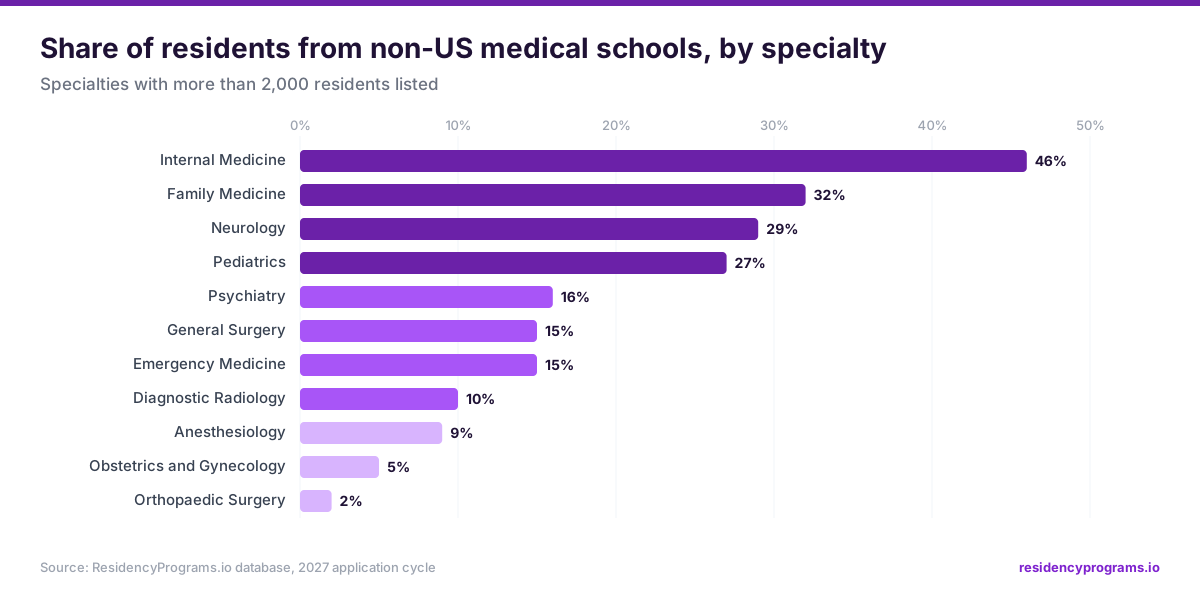
Close to half of all residents in internal medicine went to school outside the US: 46%, or about 13,000 residents. Family medicine (32%), neurology (29%) and pediatrics (27%) are the other specialties where international graduates make up a large part of the workforce. In surgical and procedural specialties the share drops fast, down to 5% in obstetrics and gynecology and 2% in orthopaedic surgery.
What this means for your application
- Look for programs that know your school. A program that already has residents from your school understands your transcript and grading, and current residents can tell you what the program is like. The ResidencyPrograms.io dashboard shows the medical schools of each program's residents.
- Use the alumni network. With 3,629 Indian graduates and 2,773 Pakistani graduates in US programs, there is very likely someone from your country, and often your school, in the specialty you want. Ask for advice, mock interviews and honest views of programs.
- Use the right benchmark. If your school sends few graduates to the US, compare yourself with applicants from similar schools, not with the large Caribbean pipelines. The specialty pages show how many IMGs each program trains.
- Match your list to your profile. The dashboard's Affinity Score shows how well each program matches your personal profile, based on the program's current residents. For signal strategy as an IMG, see our IMG guide to program signals.
About the data
Figures come from the ResidencyPrograms.io database for the 2027 application cycle, checked in October 2026. They count current residents at the 4,464 programs that report their residents' medical schools, matched to schools in the World Directory of Medical Schools (99.8% of school entries matched). "Caribbean schools" means schools in Caribbean countries that mainly train students for practice in the US, such as those in Grenada, Barbados, Sint Maarten, Saint Kitts and Nevis, Antigua and Barbuda, Saint Vincent, Saba, Curaçao, Aruba and Anguilla. Schools with several campuses may be counted per campus. Programs that do not report medical schools are not included.