

The Best States for IMGs: Where International Graduates Train
About one in four US residency positions goes to an IMG, but the share runs from 4% in Vermont to 48% in North Dakota. Here is where international graduates train, state by state.
- If each program's current resident mix holds, about 9,500 of 38,767 first-year residency positions (about one in four) go to IMGs.
- New York has the most IMG positions by far (about 1,530), followed by Florida (about 970), then Texas and Michigan (about 620 each), California, New Jersey and Pennsylvania.
- By share, North Dakota (48%), Arkansas (46%), New Jersey (43%) and Wyoming (41%) lead. Mississippi, Florida, New York and Connecticut are all above 35%.
- In internal medicine and family medicine, IMGs hold more than half of positions in nine states, led by New Jersey and Arkansas (61% each).
- Vermont, Utah, Colorado and Oregon are the hardest states for IMGs, all under 7%. California, despite its size, is at 15%.
Where you apply matters almost as much as what you apply in. Two internal medicine programs of the same size can have completely different histories with international graduates, and those differences cluster by state. Some states rely heavily on IMGs to staff their hospitals. Others train almost none.
This article ranks the states by how many residency positions go to IMGs, using resident data from the ResidencyPrograms.io database for the 2027 cycle.
How we measured it
For each program we know the number of first-year positions it offers and the share of its current residents who are IMGs (US citizens who studied abroad and non-US citizens). Multiplying the two gives an estimate of how many first-year spots in that program go to IMGs. Adding those up by state gives two numbers:
- Estimated IMG positions: how many first-year spots in the state go to IMGs.
- IMG share of positions: those spots as a share of all first-year positions in the state.
The first number tells you where the volume is. The second tells you how open a state's programs are on average. Both are estimates based on current residents, not promises about next year's class.
The map: IMG share by state
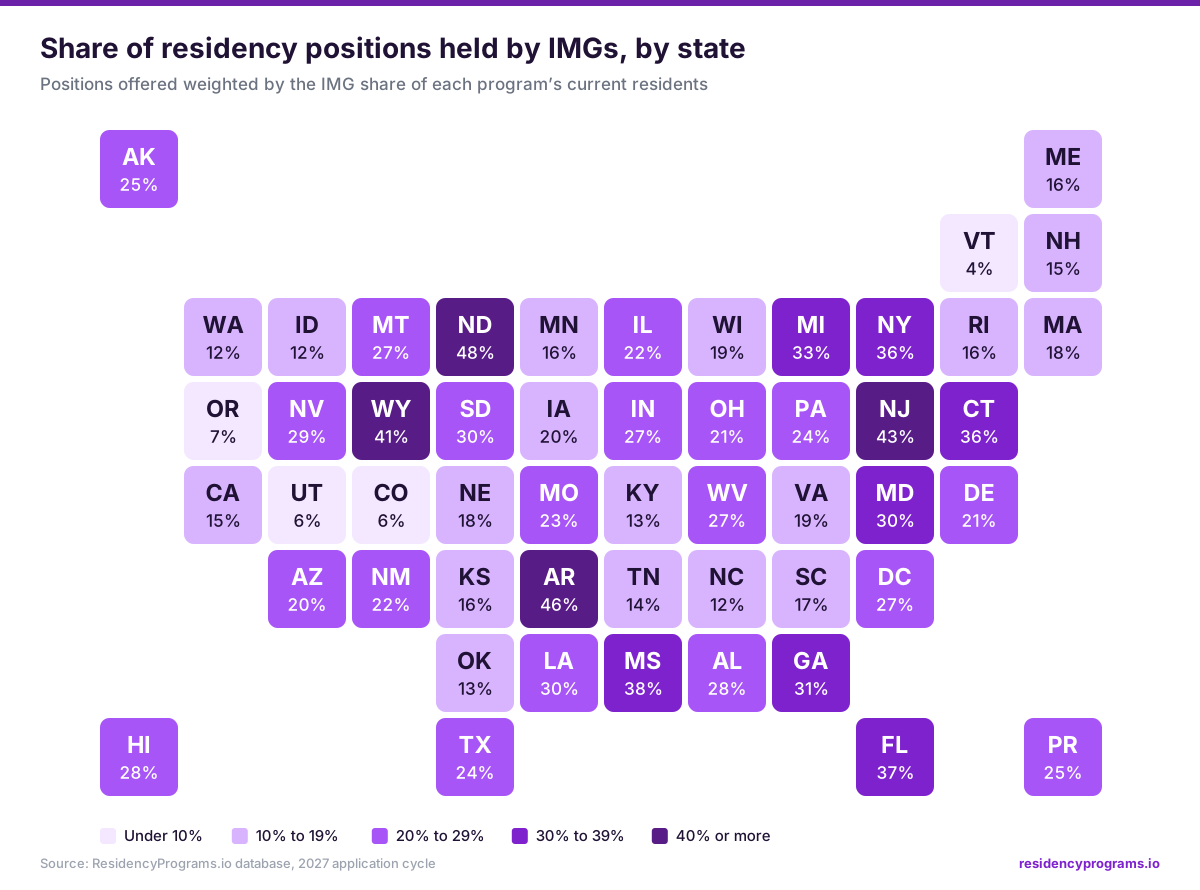
The darkest states form a few clear groups. New Jersey (43%), New York (36%) and Connecticut (36%) anchor the Northeast. Florida (37%), Mississippi (38%), Georgia (31%) and Louisiana (30%) lead the South. Michigan (33%) leads the Great Lakes, and Arkansas (46%) and North Dakota (48%) are two of the most IMG-heavy states in the country, though both have far fewer positions than the large states.
Wyoming also shows 41%, but it has only 15 first-year positions, so a handful of residents moves its number a lot. Small states like this are worth a look, but treat their percentages with care.
Where the most IMG positions are
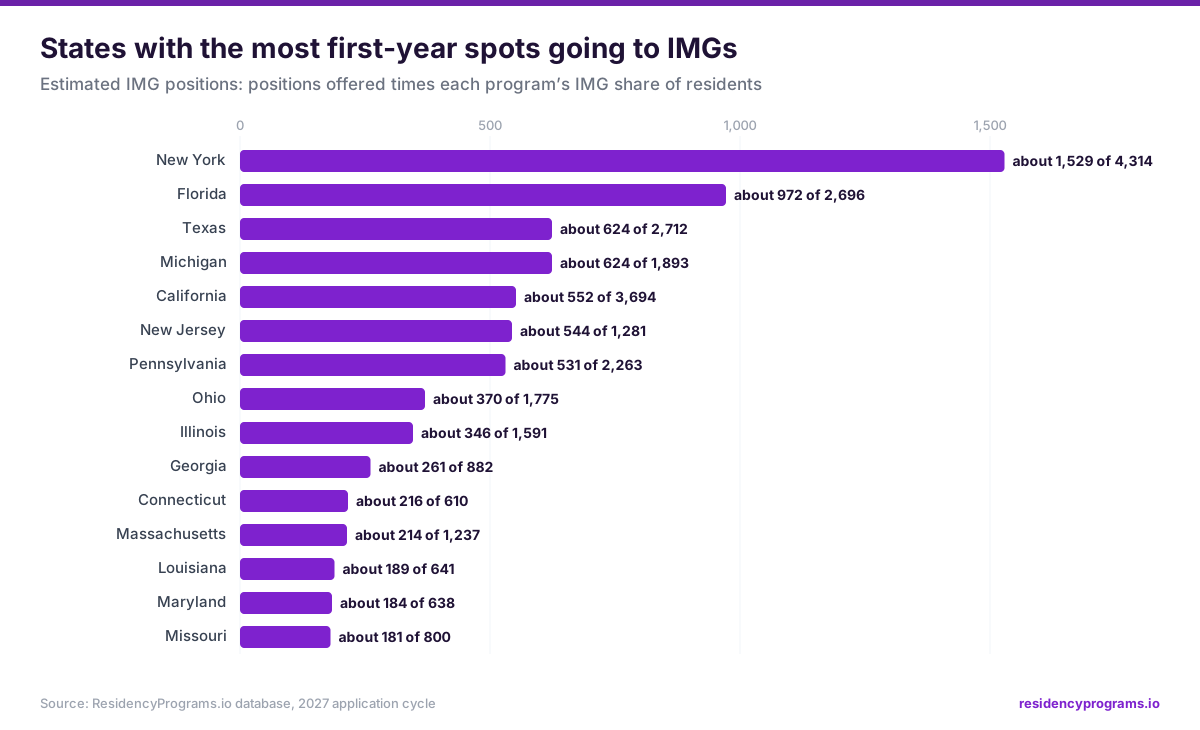
Share is one thing, volume is another. New York's estimated 1,530 IMG positions are about one in six of the national total. Florida is second with about 970. Texas and Michigan follow with about 620 each, then California, New Jersey and Pennsylvania with 530 to 550 each. Together these seven states hold close to six in ten IMG first-year positions.
| State | Programs | First-year positions | IMG share of positions | Est. IMG positions | Programs sponsoring a visa |
|---|---|---|---|---|---|
| New York | 591 | 4,314 | 36% | 1,529 | 480 |
| Florida | 396 | 2,696 | 37% | 972 | 268 |
| Texas | 397 | 2,712 | 24% | 624 | 255 |
| Michigan | 310 | 1,893 | 33% | 624 | 233 |
| California | 558 | 3,694 | 15% | 552 | 305 |
| New Jersey | 202 | 1,281 | 43% | 544 | 136 |
| Pennsylvania | 364 | 2,263 | 24% | 531 | 284 |
| Ohio | 288 | 1,775 | 21% | 370 | 195 |
| Illinois | 241 | 1,591 | 22% | 346 | 174 |
| Georgia | 129 | 882 | 31% | 261 | 91 |
| Connecticut | 84 | 610 | 36% | 216 | 72 |
| Massachusetts | 168 | 1,237 | 18% | 214 | 149 |
| Louisiana | 103 | 641 | 30% | 189 | 80 |
| Maryland | 123 | 638 | 30% | 184 | 84 |
| Missouri | 120 | 800 | 23% | 181 | 85 |
First-year positions offered for the 2027 cycle. "Sponsoring a visa" means the program sponsors the J-1, the H-1B or both.
Internal medicine and family medicine by state
Statewide figures mix in specialties where IMGs rarely train. Most IMGs apply in internal medicine and family medicine, so here are the states where those two specialties lean hardest on IMGs (states with at least eight programs in the two combined).
| State | IM and FM programs | First-year positions | IMG share of positions |
|---|---|---|---|
| New Jersey | 54 | 624 | 61% |
| Arkansas | 26 | 210 | 61% |
| North Dakota | 8 | 41 | 58% |
| Connecticut | 19 | 254 | 56% |
| New York | 107 | 1,689 | 55% |
| Mississippi | 17 | 169 | 54% |
| Michigan | 75 | 788 | 53% |
| Florida | 96 | 1,249 | 53% |
| Maryland | 20 | 282 | 51% |
| Georgia | 43 | 455 | 47% |
| Louisiana | 26 | 263 | 43% |
| Alabama | 23 | 293 | 42% |
In nine states, IMGs hold more than half of internal medicine and family medicine positions. New York stands out again because of its size: 1,689 first-year positions in the two specialties, with IMGs holding more than half. Florida (1,249 positions) and Michigan (788) are the next largest.
Big states with small IMG shares
Size alone does not make a state friendly. California has 3,694 first-year positions, the second most in the country, but IMGs hold only about 15% of them. North Carolina (12%), Washington (12%) and Tennessee (14%) are similar. At the bottom, Vermont (4%), Utah (6%), Colorado (6%) and Oregon (7%) train very few IMGs at all.
These states are not off limits, but an IMG application there needs a reason: a personal tie to the area, rotations at the hospital, or research with its faculty. Without one, the odds are much lower than the size of the state suggests.
Visa sponsorship by state
A high IMG share does not always mean visas. New Jersey has the highest IMG share of any large state, but only 9 of its 202 programs sponsor the H-1B. Michigan has 13 H-1B programs out of 310. Many IMGs in these states are US citizens who studied abroad or permanent residents.
The H-1B picture is different: Pennsylvania (106 programs), Massachusetts (70) and Ohio (64) offer far more H-1B programs than their IMG share would suggest, along with New York (119) and California (86). If you need an H-1B specifically, the best states are not the same as the most IMG-heavy ones.
Using geography in your application
- Start with the high-volume states. New York, Florida, Texas, Michigan, New Jersey and Pennsylvania hold most IMG positions. A list with no programs in any of them is fighting the numbers.
- Add the high-share smaller states. Arkansas, Mississippi, Connecticut, Louisiana and Georgia are open to IMGs and get less attention than New York.
- Think carefully about geographic preferences. ERAS lets you state preferred regions, and programs do read them. Our guide on whether to list geographic preferences in ERAS covers when that helps and when it narrows you too much.
- Price it out. Spreading applications across more states raises the cost. The ERAS fees calculator shows what a list of a given size costs, and our specialty pages let you sort each specialty's programs by state.
About the data
Figures come from the ResidencyPrograms.io database for the 2027 application cycle, checked in October 2026. Positions are first-year positions offered. IMG share is the share of each program's current residents who are US or non-US IMGs. Estimated IMG positions multiply the two for each program and add them up by state, so they assume next year's class looks like the current residents. Puerto Rico and Washington, DC are included. Programs without position or resident data are left out of the estimates.