

9 Myths About IMG Residency Applications, Checked Against the Data
Step 1 does not matter, you need a 240, five years out is too late, only community programs take IMGs: we checked nine common IMG beliefs against program data for the 2027 cycle.

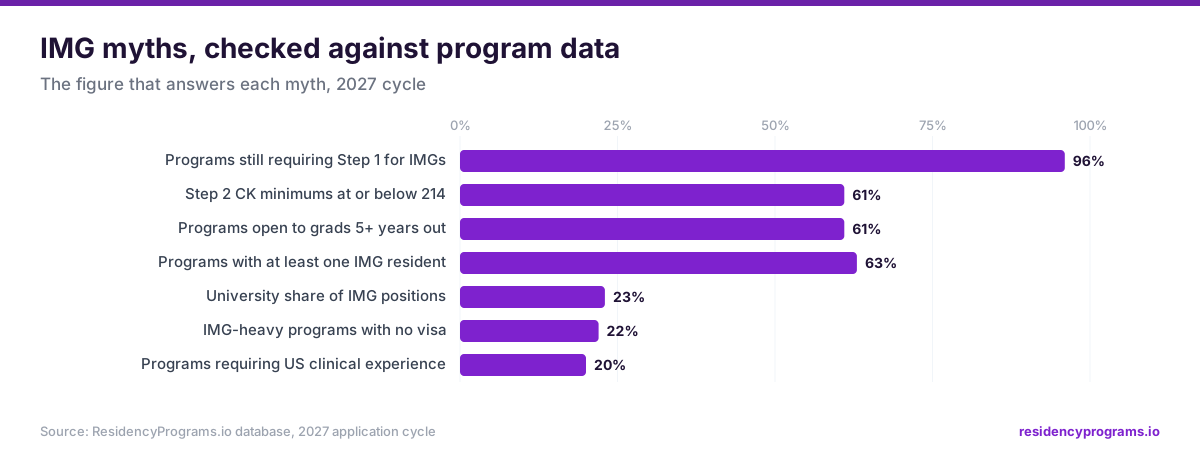
- "Step 1 does not matter any more." False: 96% of programs that report it still require IMGs to pass Step 1.
- "You need a 240+ on Step 2 CK." Not as a minimum: 61% of programs that list a Step 2 CK minimum set it at or below 214. Only 16% ask for 230 or more.
- "Five years after graduation, it is over." False: 61% of programs list no limit or accept a gap of more than five years.
- "Only community programs take IMGs" and "a high IMG share means visa sponsorship" are both wrong too.
- Two myths hold up partly: IMG-heavy programs really are crowded, and the H-1B really is limited, at 16% of programs.
IMG forums and group chats are full of rules that "everyone knows". Some are true, some were true ten years ago, and some were never true. They matter because they shape where people apply: a myth can make you skip programs that would have interviewed you, or spend fees on programs that never would.
We checked nine common beliefs against program data for the 2027 cycle.
The scorecard
Myth 1: "Step 1 is pass/fail, so it no longer matters"
Verdict: false. Step 1 no longer has a score, but it still has to be passed. Of 4,801 programs that report their exam requirements for IMGs, 4,631 (96%) require Step 1. A failed attempt also stays on your record and is one of the most common screening filters. Pass/fail changed how Step 1 is reported, not whether it counts.
Myth 2: "You need a 240+ on Step 2 CK to get interviews"
Verdict: false as a minimum, partly true in practice. Of 4,877 programs that list a Step 2 CK minimum, 2,978 (61%) set it at or below 214, which was the passing standard until it rose to 218 in July 2025 (see the USMLE announcement). Only 773 programs (16%) ask for 230 or more.
But a minimum is the floor, not the typical interviewee. At competitive programs, most interviewed applicants score well above the minimum. A higher score helps everywhere; it is just not the hard filter most people think it is.
Myth 3: "If you graduated more than five years ago, forget it"
Verdict: false. Of 5,487 programs with requirement data, 3,344 (61%) list no graduation limit or accept a gap of more than five years, and 2,424 of those also sponsor a visa. Family medicine is the exception: only 14% of its programs are open to a gap that long. Internal medicine and pathology have the most options.
Myth 4: "Most programs do not take IMGs"
Verdict: false, with a caveat. Of 5,525 programs that report their resident mix, 3,473 (63%) have at least one IMG resident. But 2,052 (37%) have none, and IMGs are concentrated in a few specialties. "Most programs" are open to IMGs in principle; a smaller set train many of them.
Myth 5: "Only community programs take IMGs"
Verdict: false. Community programs have much higher IMG shares, but university-based programs are larger and more numerous. By our estimate, university-based programs hold about 23% of all IMG residency positions, the same share as purely community programs. They also sponsor visas more often: 86% sponsor the J-1 and 23% the H-1B, against 54% and 6% at community-based programs.
Myth 6: "If a program has lots of IMGs, it sponsors visas"
Verdict: false. Among programs where at least a quarter of residents are IMGs, 22% sponsor no visa at all. Many of their IMG residents are US citizens or permanent residents who studied abroad. Check the visa policy separately, every time.
Myth 7: "You cannot match without US clinical experience"
Verdict: mostly false as a rule, true as advice. Only 1,124 of 5,487 programs (20%) list a minimum amount of US clinical experience. But hands-on US experience produces US letters, which most programs value, and it answers concerns about older graduation dates. It is rarely a hard requirement, and often a real advantage.
Myth 8: "IMG-friendly programs are the easiest to match at"
Verdict: false. Programs where at least half the residents are IMGs get about 194 applicants per position and interview about 12% of them on average. Programs with few IMGs get about 87 applicants per position and interview about 20%. IMG-friendly programs are where IMGs match most, but they are also where IMGs compete most. A good list mixes them with programs where IMGs are a smaller but real share.
Myth 9: "The H-1B is impossible for residency"
Verdict: false, but it is limited. 941 programs (16% of those that report a visa policy) sponsor the H-1B. Most also sponsor the J-1, and many require Step 3 before ranking. Current federal policy on new H-1B petitions adds uncertainty, so confirm each program's position for the coming year.
What to do with this
- Filter on the rules that are real: visa policy, graduation limits and stated requirements. They remove far more programs than score minimums do.
- Do not filter on myths: do not skip university programs, programs with a moderate IMG share or programs with no graduation limit just because the forums say so.
- Check each program. Our specialty pages show visa policy and IMG share for every program, and the ResidencyPrograms.io dashboard checks requirements such as graduation limits against your own profile.
- Use signals where they count. Our IMG guide to program signals covers where they help most.
About the data
All figures come from the ResidencyPrograms.io database for the 2027 application cycle, built from program-reported data and checked in October 2026. Each figure uses the programs that report the relevant item, so totals differ between myths. IMG share combines US and non-US IMGs among current residents; estimated IMG positions are positions offered times IMG share. Requirements change between cycles, so confirm with each program.