

How to Shortlist Residency Programs Without Wasting Application Fees
ERAS charges $11 per program for the first 30 in a specialty and $30 after that. Here is where application money is usually wasted and a five-step way to build a shortlist that costs less and works better.

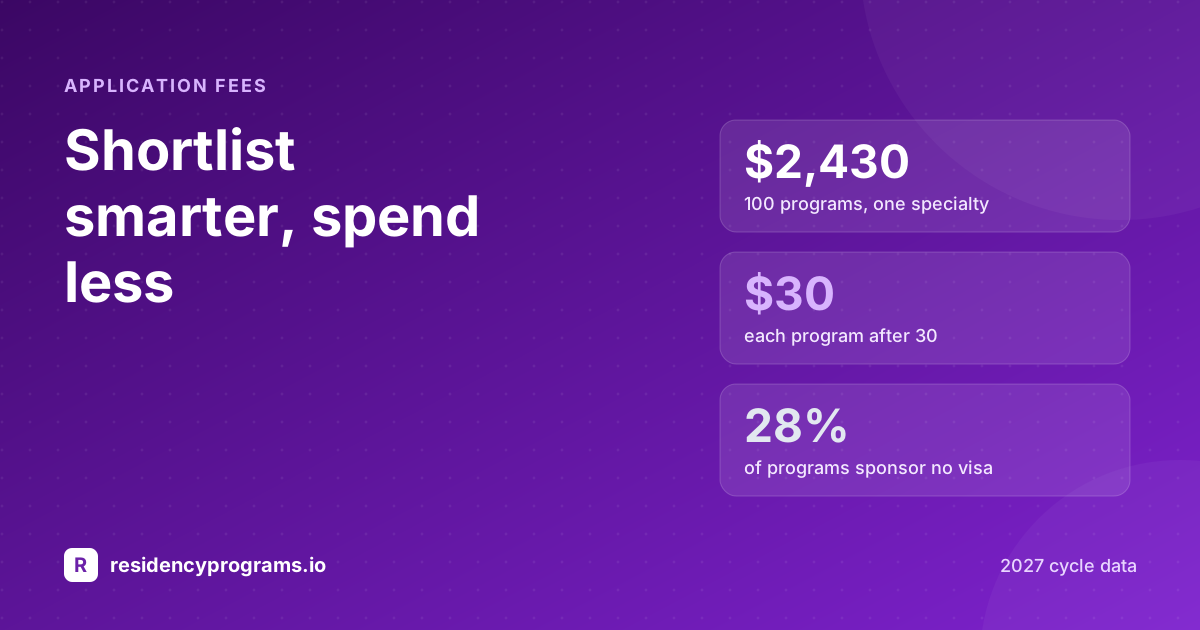
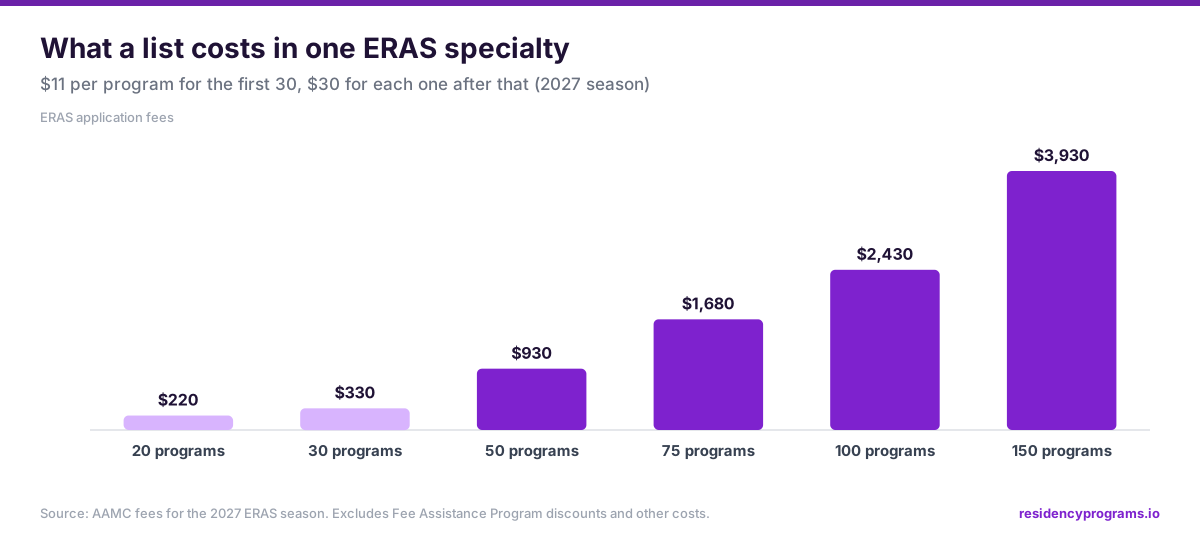
- ERAS fees for the 2027 season are $11 per program for the first 30 in a specialty and $30 for each program after that. A 100-program list in one specialty costs $2,430.
- Most of the cost is in programs 31 and up, so every program you add past 30 should earn its place.
- A quick screen removes many programs that cannot interview you: 28% of programs sponsor no visa, 84% do not offer the H-1B, 21% limit graduation to three years or less, and 20% list a minimum of US clinical experience.
- Screen in this order: visa, graduation year, hard requirements, then fit. Add programs only after that.
- The cheap tier resets for each specialty, which matters if you apply to two.
For many IMGs, application fees are the biggest single cost of the Match. A long list in a competitive specialty can cost several thousand dollars before travel, exams or visas. Yet a large share of that money is often spent on programs that were never going to send an interview.
Here is how the fees work, where the waste usually is, and a simple way to build a shortlist that costs less and works better.
How ERAS fees work in 2027
The AAMC charges per program, per specialty, in two tiers:
| Programs in one specialty | Fee per program |
|---|---|
| 1 to 30 | $11 |
| 31 and more | $30 |
The count resets for each specialty. If you apply to 43 internal medicine programs and 7 radiology programs, you pay 30 × $11 plus 13 × $30 for internal medicine, and 7 × $11 for radiology: $797 in all. The AAMC's fees page for the 2027 season has the official details.
Emergency medicine and obstetrics and gynecology use a different service, ResidencyCAS, with its own fee tiers. And IMGs pay other costs on top: ECFMG's ERAS support fee, score reports and NRMP registration. Our ERAS fees calculator works out the ERAS part for any mix of specialties.
Where the money is wasted
An application is wasted when the program screens you out before anyone reads it. The most common reasons, with how often they apply across programs in the ResidencyPrograms.io database for the 2027 cycle:
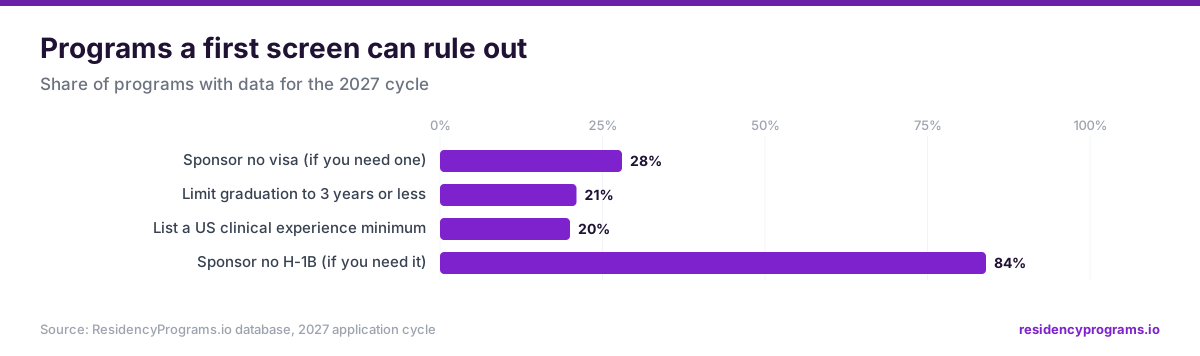
- Visa. 28% of programs sponsor no visa at all. If you need the H-1B, 84% of programs do not offer it.
- Graduation year. 21% of programs want you within three years of graduating. In family medicine, it is more than half of all programs.
- US clinical experience. 20% list a minimum number of months of US clinical experience.
- Scores. Most programs that list a Step 2 CK minimum set it at or near the passing mark, but about one in six programs that list one ask for 230 or more.
Take a 100-program list built without filtering. If 28 of those programs do not sponsor your visa, and they are the last 28 you added, you have spent $840 on programs that cannot rank you. Add graduation limits and requirements, and the waste on an unfiltered list can easily pass $1,000.
A five-step shortlist
1. Choose your specialties first
Decide your main specialty and whether you need a second one. Because the cheap tier resets for each specialty, 30 programs in a second specialty cost only $330. If you apply to preliminary positions, those count as their own specialty too.
2. Remove programs that cannot sponsor you
If you need a visa, start from the programs that sponsor it. Our specialty pages show J-1 and H-1B status for every program.
3. Remove programs you are past the graduation limit for
Programs post these limits in different places, if at all, and screening software applies them strictly. Check each one, or let the dashboard do it.
4. Remove clear requirement misses
Months of US clinical experience, ECFMG certification by a set date, a score minimum well above yours, or an attempt limit you exceed. If a requirement is clearly stated and you clearly miss it, the application is unlikely to be read.
5. Rank what is left by fit, then cut to budget
Among the programs you qualify for, prefer those whose current residents look like you: similar medical school background, similar visa needs, a real IMG presence. Then cut from the bottom until the list matches your budget and your interview target.
Let the dashboard do the screening
The ResidencyPrograms.io dashboard does steps 2 to 5 for you. Enter your visa needs, graduation date, scores and experience once, and it flags programs you are past the cut-offs for. Each remaining program gets an Affinity Score from 0 to 100 that shows how well it matches your personal profile, based on its current residents, with strong fits at 70 and above. Analyze Your List checks a list you have already built and shows the programs you are unlikely to qualify for and the best programs you are missing.
Other ways to save
- Apply once, early, in one batch. Adding programs later costs the same, but late applications are read less often.
- Use your signals well. A signal raises your chances at a program far more than one extra application elsewhere. Our IMG guide to program signals shows where they help most.
- Do not pay twice for the same program. Check for duplicate tracks (for example categorical and preliminary positions at the same hospital) and make sure you want both.
- Check whether you qualify for fee help. The AAMC's Fee Assistance Program covers some applicants; it is not included in our calculator.
About the data
Fees are the AAMC's ERAS fees for the 2027 season and exclude other costs. Program shares come from the ResidencyPrograms.io database for the 2027 application cycle, as reported by programs: visa figures cover programs that report a visa policy, and graduation, clinical experience and score figures cover programs with requirement data. Requirements change between cycles, so confirm with each program.