

What "Visa Sponsorship: Case by Case" Really Means for Residency
We read the visa notes of 2,924 residency programs. Here are the four things "case by case" usually means, the conditions attached to the H-1B, why visa listings disagree and three questions that get a straight answer.

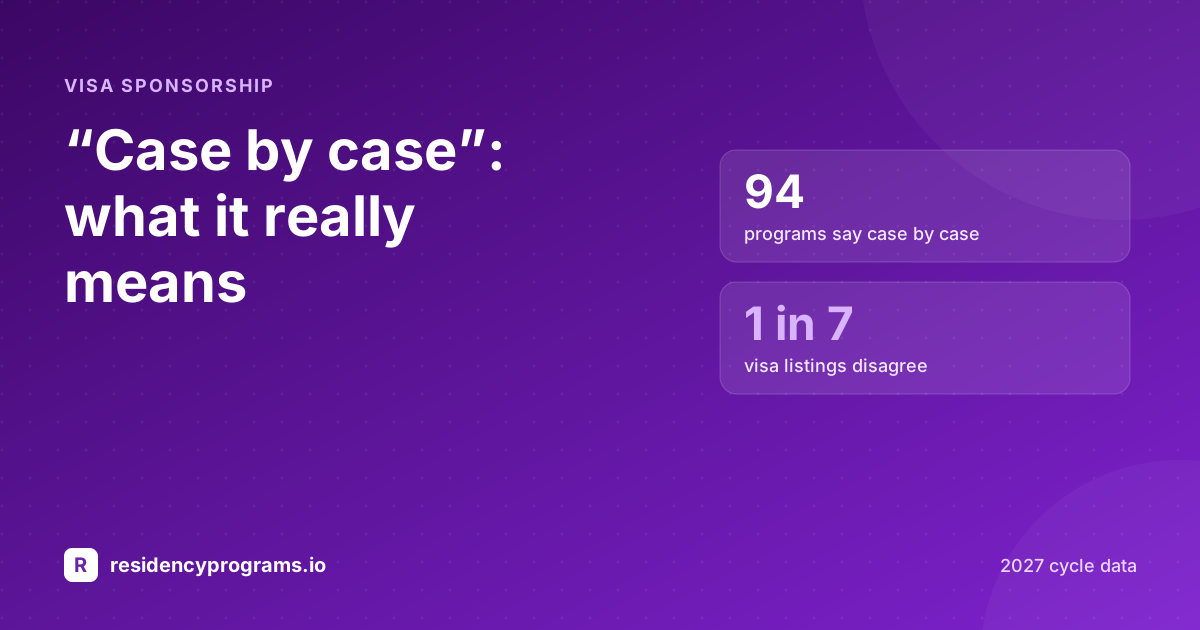
- "Case by case" usually means one of four things: the program sponsors the J-1 but considers the H-1B only for some applicants, it considers any visa only for strong candidates, it decides through a hospital office, or it accepts some visa types without sponsoring them.
- It is less common than it feels: 94 of the 2,924 programs with written visa notes for the 2027 cycle use "case by case", "at our discretion" or similar wording.
- The notes say more about what programs exclude: 279 rule out the H-1B explicitly, and 48 tie H-1B sponsorship to passing Step 3.
- Visa listings are not always consistent. For about 1 in 7 programs, two program-reported listings disagree on J-1 or H-1B sponsorship.
- For planning, treat "case by case" as "not guaranteed". Ask the coordinator three specific questions before you apply.
You find a program that looks perfect: the right specialty, a good location, plenty of IMG residents. Then you reach the visa line, and it says "visa sponsorship considered on a case-by-case basis". Is that a yes, a no or a polite maybe?
We read the visa notes that residency programs publish for the 2027 cycle to see what "case by case" covers in practice, how often programs use it, and how to get a straight answer.
What programs actually write
For the 2027 cycle, 2,924 programs in the ResidencyPrograms.io database include a written note about visas, in addition to their basic sponsorship status. Here is what those notes mention most often:
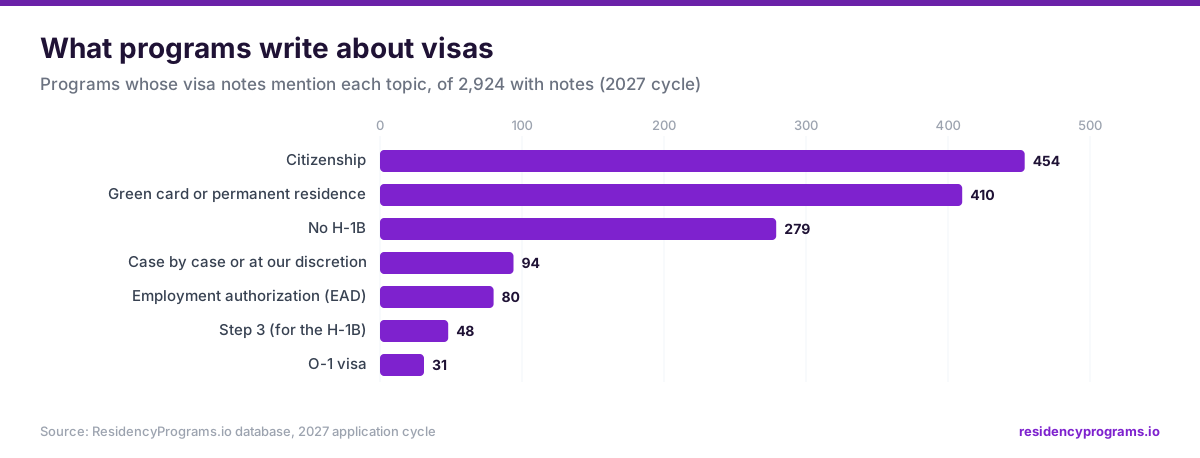
Notes about eligibility dominate: many programs spell out that applicants must be US citizens, permanent residents or J-1 holders. 279 notes explicitly rule out the H-1B, often in the same sentence that confirms J-1 sponsorship through ECFMG. And 94 notes, about 3%, use "case by case", "at the discretion of" or similar wording.
The four meanings of "case by case"
Reading those 94 notes, the phrase falls into four patterns:
| What the note says | What it usually means |
|---|---|
| "We sponsor the J-1. The H-1B is considered case by case." | Plan on the J-1. The H-1B may be offered to a top-ranked applicant, often only with Step 3 passed. |
| "Visa sponsorship is considered case by case." | No default. The program may sponsor a strong candidate it wants, but does not commit in advance. |
| "Visa requests are handled by our international or GME office." | The decision sits outside the program. Ask for that office's policy, not the program's. |
| "Other visas (EAD, H-1B) will be considered case by case." | The program accepts some work authorizations it does not sponsor itself, such as an EAD you already hold. |
The first pattern is the most common and the most useful to understand. In our data, case-by-case wording appears both at programs listed as sponsoring the J-1 only (44 programs) and at programs listed as sponsoring both visas (37). In both cases, the J-1 is the reliable route and the H-1B is the exception.
A handful of programs listed as not sponsoring visas (9) also use case-by-case wording. For those, sponsorship is possible but rare. Do not count on it.
The H-1B comes with conditions
Even programs that clearly offer the H-1B often attach conditions. 48 notes tie H-1B sponsorship to Step 3, usually requiring a passed result before the program finalizes its rank list, sometimes by a specific date in January or February. Others ask you to say at the interview that you need the H-1B, or state that the H-1B is offered only at the program's discretion.
The H-1B also carries extra uncertainty right now. In September 2025 a presidential proclamation added a $100,000 payment to many new H-1B petitions. A federal court blocked the policy in June 2026, an appeal is pending, and a September 2026 proclamation extended it on paper through September 2027. Some programs that offered the H-1B in the past may hold back while this is unsettled. The USCIS H-1B page has the current rules.
The J-1 is far more predictable. It is sponsored by ECFMG through its Exchange Visitor Sponsorship Program, so the program only needs to agree to take a J-1 resident.
Visa listings do not always agree
Program visa policies appear in more than one place: the program's own website, national program listings and requirement databases. They do not always match. In our database, 4,799 programs have visa information from two separate program-reported listings for the 2027 cycle. They disagree on J-1 sponsorship for about 15% of those programs and on H-1B sponsorship for about 14%.
Some of that is timing (a policy changed and one listing was updated first). Some is wording: a program that sponsors the H-1B "case by case" may be listed as a yes in one place and a no in another. Either way, the lesson is the same. For any program you care about, confirm the visa policy directly.
How to get a straight answer
Email the program coordinator before you apply, or before you spend a program signal on the program. Keep it short and ask questions that can be answered with facts:
- "Have you sponsored a J-1 (or H-1B) resident in the last two years?"
- "If H-1B sponsorship is possible, what are the conditions? For example, Step 3 passed by a certain date?"
- "When is the decision made: before interviews, before ranking, or after the Match?"
Questions like these get clearer answers than "Do you sponsor visas?", which often returns the same case-by-case sentence.
The resident mix is the other good clue. A program with several non-US IMGs among its current residents has sponsored visas recently, whatever its note says. Our specialty pages show each program's visa status and IMG share side by side.
How to plan around "case by case"
- If you can train on a J-1: treat a "J-1 yes, H-1B case by case" program as a normal J-1 program. It belongs on your list.
- If you need the H-1B: count "case by case" programs as reaches, not as H-1B programs. Pass Step 3 early, and build most of your list from programs that offer the H-1B outright.
- If the note says "visa sponsorship case by case" with no default: check the resident mix and ask the three questions. Without a clear yes, keep these to a small part of your list.
- If you hold an EAD or a green card: "case by case" notes about other visa types often work in your favor. Say clearly in your application that you do not need sponsorship.
The ResidencyPrograms.io dashboard filters programs by the visa you need, so programs that cannot sponsor you are flagged before you pay to apply.
About the data
Figures come from the visa notes and visa status that programs report for the 2027 application cycle, as held in the ResidencyPrograms.io database in October 2026. Topics were counted with keyword searches of the notes, so a note can count under several topics; counts are approximate. "Two listings disagree" compares two separate program-reported sources for the same program and cycle. Visa policies change; confirm with each program.