

How Many Residency Programs Should You Apply To? A Method for IMGs
Work backwards from interviews: matched IMGs ranked two to three times as many programs as unmatched IMGs, and interview rates range from 9% in internal medicine to 27% in pediatrics. Here is how to size your list.
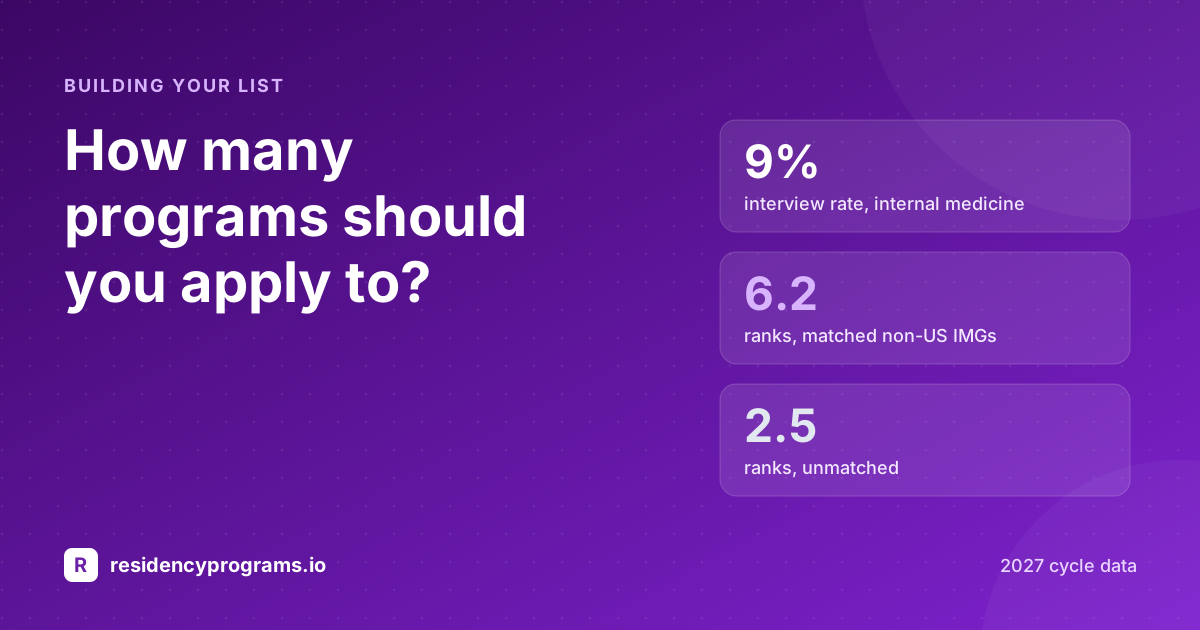
- Work backwards from interviews. In the NRMP's 2024 data, matched non-US IMGs had ranked 6.2 programs in their specialty on average and matched US IMGs 8.8. Unmatched IMGs had ranked about 2.5.
- Interview rates set the size of your list. Programs interview about 9% of applicants in internal medicine, 18% in family medicine and 27% in pediatrics.
- At those average rates, 10 interviews take about 110 internal medicine applications, 55 in family medicine or 37 in pediatrics. Many IMGs see lower rates than the average.
- Programs that screen you out (visa, graduation year, requirements) give you no interviews at any price. Filtering first raises your real interview rate more than adding programs does.
- The ResidencyPrograms.io dashboard groups programs by fit, so you can build a list from the programs most likely to interview you.
"How many programs should I apply to?" has no single answer, but it has a method. The number depends on your specialty, your profile and, most of all, on how carefully you choose. Two IMGs with similar scores can apply to the same number of programs and end up with three interviews or fifteen.
Here is a way to work it out with real data, and how to spend your application budget where it counts.
Step 1: Decide how many interviews you need
Interviews become ranks, and ranks become matches. The NRMP's Charting Outcomes report for IMGs (2024) shows the gap clearly:
| Applicant group | Matched | Did not match |
|---|---|---|
| US IMGs | 8.8 | 2.4 |
| Non-US IMGs | 6.2 | 2.5 |
Mean number of contiguous ranks in the preferred specialty. Source: NRMP Charting Outcomes, IMGs, 2024.
Matched IMGs ranked roughly three times as many programs as unmatched IMGs. Scores, visa and specialty all matter too, but a short rank list is one of the strongest warning signs. A reasonable target for most IMGs is 8 to 12 interviews in their main specialty, more if you need a visa or are applying to a competitive specialty.
Step 2: Know the interview rate in your specialty
Programs report how many applicants they interview. Weighted by the number of applications, here is the share of applicants interviewed in the largest specialties for the 2027 cycle:
| Specialty | Applicants per position | Interview rate | Applications for 10 interviews |
|---|---|---|---|
| Internal Medicine | 156 | 9.1% | about 110 |
| General Surgery | 197 | 9.3% | about 108 |
| Psychiatry | 100 | 11.8% | about 85 |
| Pathology (AP/CP) | 120 | 12.3% | about 81 |
| Neurology | 109 | 12.6% | about 79 |
| Diagnostic Radiology | 99 | 14.4% | about 69 |
| Anesthesiology | 70 | 17.4% | about 57 |
| Family Medicine | 94 | 18.2% | about 55 |
| Pediatrics | 66 | 27.1% | about 37 |
ResidencyPrograms.io database, 2027 cycle. Interview rate weighted by applications.
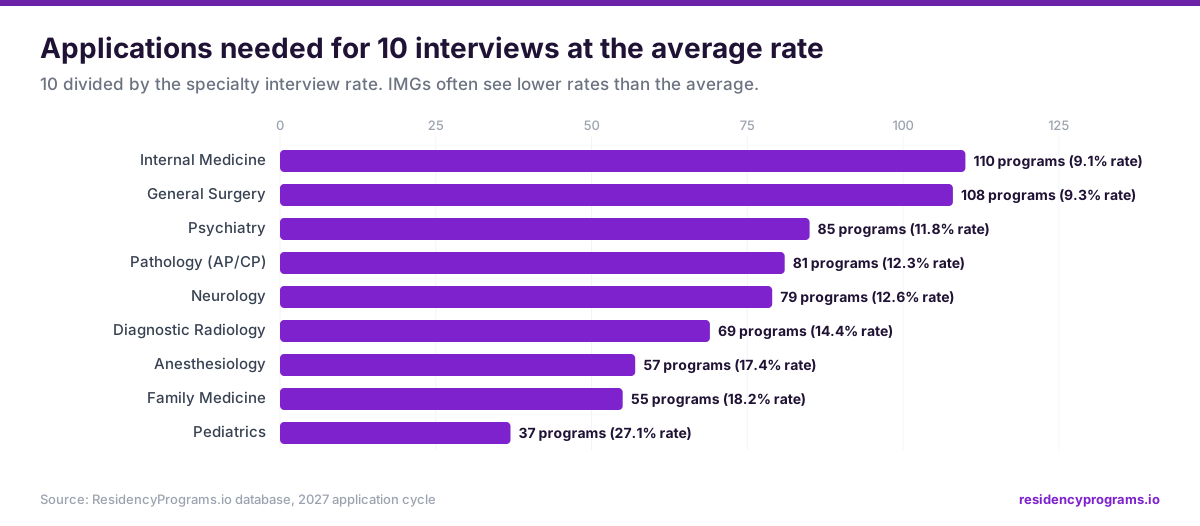
These are averages across all applicants, including US graduates who are interviewed more often. For many IMGs the real rate is lower, which is why IMG applicants in internal medicine often send well over 100 applications. Treat the last column as a floor, not a target.
Step 3: Remember where IMGs apply
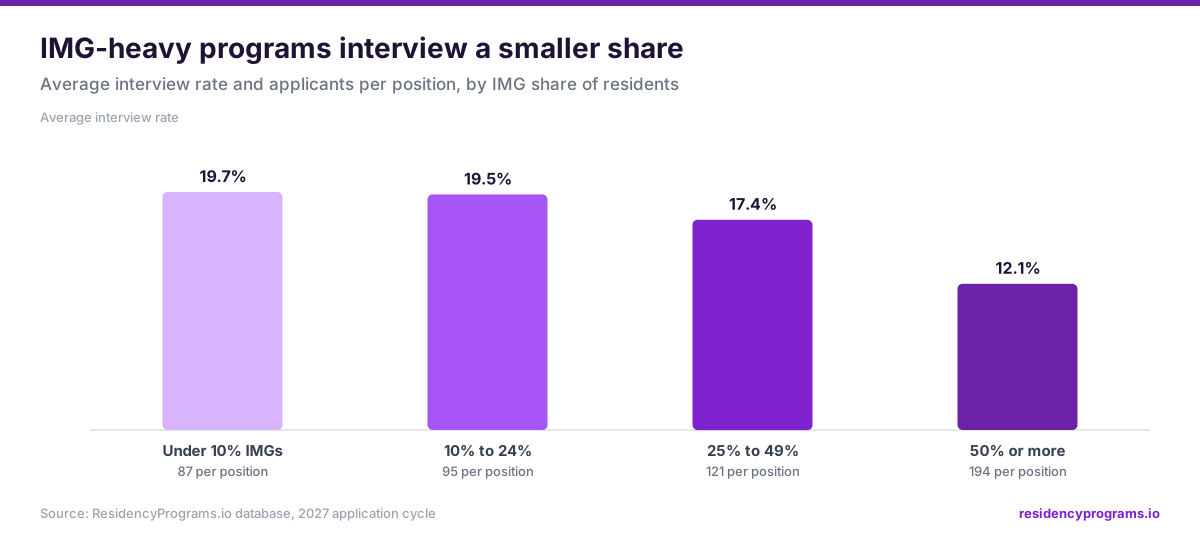
IMGs naturally apply to programs that already train IMGs. Those programs are the most crowded: programs where at least half the residents are IMGs report about 194 applicants per position and interview about 12% of them on average, against 20% at programs with few IMGs. A list made only of high-IMG programs needs to be longer than one that mixes in programs with a moderate IMG share.
Step 4: Filter before you count
Here is the part most applicants skip. The interview rate at a program that screens you out is zero. Every application to a program that does not sponsor your visa, has a graduation-year limit you are past, or requires US clinical experience you do not have, is a fee spent for nothing.
So the real question is not "how many programs?" but "how many programs that can actually interview me?" Removing ineligible programs does two things at once: it lowers your cost and it raises your real interview rate. Ten more well-chosen programs are worth more than thirty random ones.
A practical order:
- Remove programs that do not sponsor your visa (if you need one).
- Remove programs whose graduation limit you are past.
- Remove programs whose stated requirements you clearly miss, such as months of US clinical experience or ECFMG certification by a certain date.
- From what is left, keep the programs where your profile looks like their current residents.
- Only then decide how many to add to reach your interview target.
Step 5: Check the cost and balance the list
ERAS fees rise sharply after 30 programs in a specialty: $11 each for the first 30, $30 each after that. A 110-program internal medicine list costs about $2,730 in ERAS fees alone. Our ERAS fees calculator shows the cost of any list, by specialty.
Balance the list across levels of fit. In the ResidencyPrograms.io dashboard, every program gets an Affinity Score from 0 to 100 that shows how well it matches your personal profile, based on the program's current residents. Programs are grouped as strong fit (70 to 100), good fit (50 to 69) and reach (below 50), and programs that screen you out are flagged as not eligible. A sensible list leans on strong and good fits, with a smaller share of reaches.
Analyze Your List then checks the list you plan to send against your criteria. It shows the best programs you are missing and the programs you are unlikely to qualify for, so you can swap weak applications for strong ones before you pay.
Signals change the math
Preference signals raise interview rates at the programs you signal, sometimes by a lot. Spend them on programs where you are a realistic candidate, not on long shots. How many you get depends on the specialty; see our list of ERAS signal limits by specialty.
A worked example
A non-US IMG applying to internal medicine needs a J-1, graduated four years ago and has a solid Step 2 CK score. They aim for 10 interviews.
- At the average internal medicine rate, 10 interviews would take about 110 applications. They assume their own rate is somewhat lower and plan for 120 to 130.
- They filter out programs that sponsor no visa and programs with a graduation limit of three years or less. That shortens the list of candidate programs considerably.
- From the rest, they pick programs that are a strong or good fit, plus a handful of reaches, and use their signals on strong-fit programs they would love to attend.
- Because every program on the list can interview them, their real interview rate is higher than the unfiltered average, and 120 well-chosen applications do the work that 180 random ones would not.
About the data
Interview rates and applicants per position come from the ResidencyPrograms.io database for the 2027 application cycle, as reported by programs, for specialties with at least 60 programs. Contiguous rank figures come from the NRMP's Charting Outcomes in the Match: International Medical Graduates (2024). ERAS fees are the AAMC's fees for the 2027 season. Applications needed are 10 divided by the average interview rate, rounded, and are a starting point rather than a prediction.