

Residency Programs That Accept Graduates With a Gap of 5+ Years
61% of US residency programs list no graduation limit or accept a gap of more than five years. Here is how many also sponsor visas and train IMGs, by specialty and state, and how to make a long gap work.

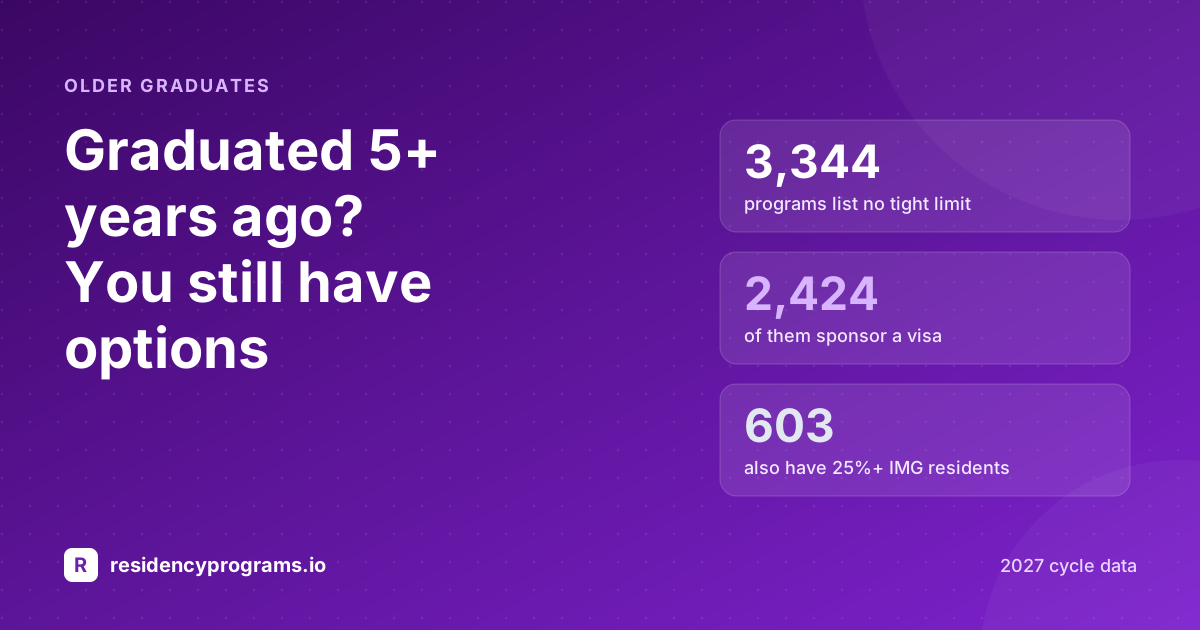
- Of 5,487 residency programs with requirement data, 3,344 (61%) list no graduation limit or accept a gap of more than five years. Another 917 accept exactly five years.
- 2,424 of those programs also sponsor a visa, and 603 also have IMGs as at least a quarter of their residents.
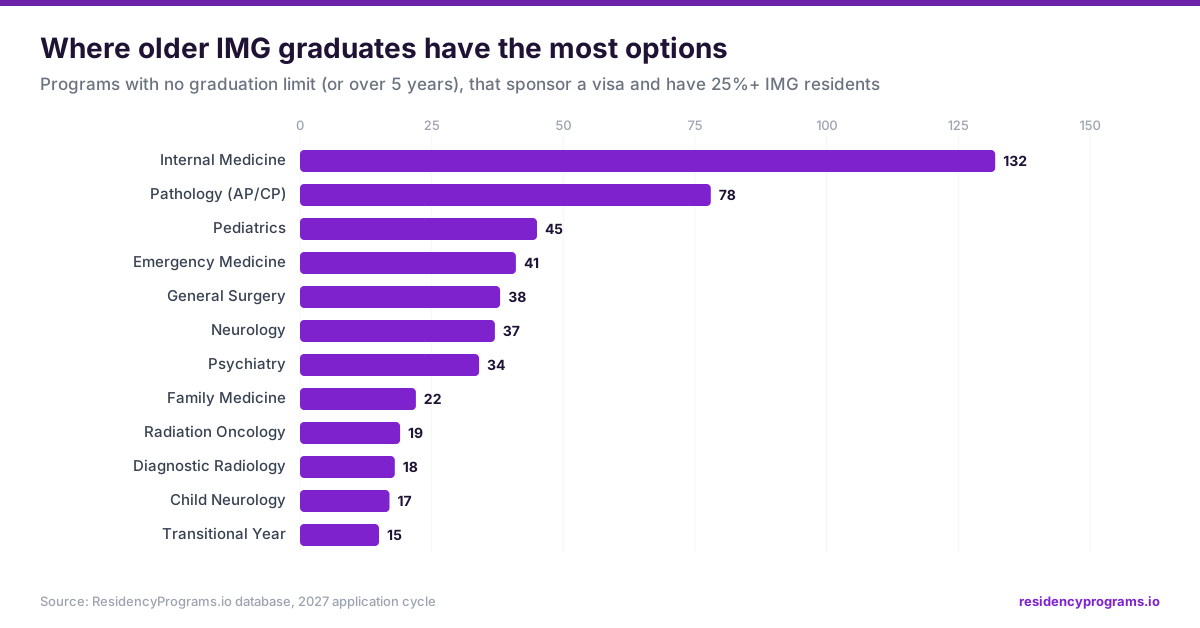
- Internal medicine has the most options (132 programs that pass all three tests), followed by pathology (78), pediatrics (45) and emergency medicine (41). Family medicine has only 22.
- Graduation limits are tighter where IMGs are common: 46% of programs with a majority of IMG residents are open to older graduates, against 69% of programs with few IMGs.
- University-based programs are more open (71%) than community programs (49%).
If you graduated from medical school more than five years ago, most residency advice is not written for you. It assumes you finished school last spring, took your exams on schedule and are applying in your first or second year out. Many IMGs do not fit that picture. They worked as doctors at home, did research, raised children, waited on visas or exams, or spent years on US clinical experience.
The common belief is that a gap of five years or more ends your chances. The data says otherwise. We counted the residency programs that will still consider you, and where they are.
How many programs accept a gap of five years or more
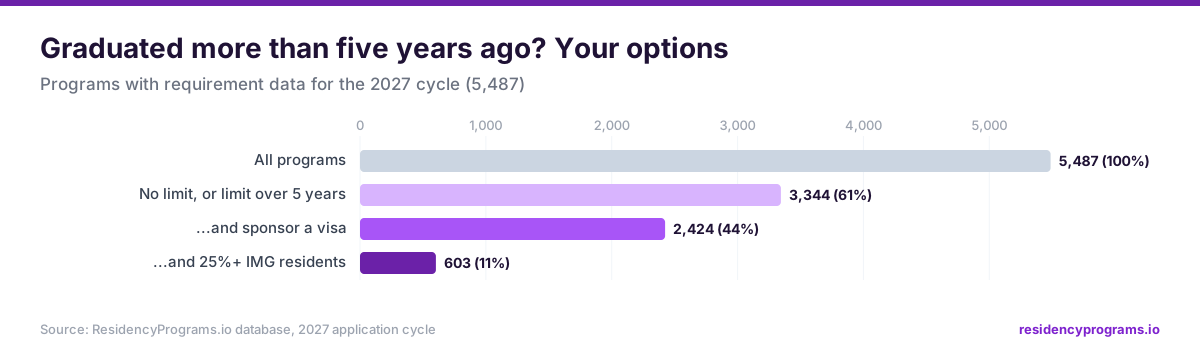
For the 2027 cycle, 5,487 programs in our database report their requirements. Of those:
- 3,172 list no maximum time since graduation.
- 172 list a limit longer than five years.
- 917 list a limit of exactly five years. If your gap is five years or just under, these are open to you as well, which brings the total to 4,261 (78%).
So for a graduate more than five years out, 3,344 programs (61%) remain. That is not a small list. The real question is how many of those programs are realistic for an IMG, and that is where the next two filters come in.
Add visa sponsorship and IMG share
Of the 3,344 open programs, 2,424 sponsor a visa (the J-1, the H-1B or both). 606 sponsor the H-1B. And 603 sponsor a visa and have IMGs as at least 25% of their current residents. Those 603 are the strongest starting point for a non-US IMG with a long gap: they are open on paper, they can sponsor you, and their residents show that they rank IMGs.
If you are a US citizen or permanent resident who trained abroad, you can drop the visa filter. Then the open programs with a 25% or higher IMG share come to 766.
Which specialties are most open
| Specialty | Programs | Open to 5+ years | ...and sponsor a visa | ...and 25%+ IMGs |
|---|---|---|---|---|
| Internal Medicine | 682 | 296 (43%) | 204 | 132 |
| Pathology (Anatomic and Clinical) | 139 | 106 (76%) | 97 | 78 |
| Pediatrics | 215 | 106 (49%) | 94 | 45 |
| Emergency Medicine | 283 | 229 (81%) | 165 | 41 |
| General Surgery | 362 | 192 (53%) | 138 | 38 |
| Neurology | 201 | 114 (57%) | 97 | 37 |
| Psychiatry | 345 | 203 (59%) | 136 | 34 |
| Family Medicine | 791 | 107 (14%) | 47 | 22 |
| Diagnostic Radiology | 199 | 166 (83%) | 132 | 18 |
| Obstetrics and Gynecology | 300 | 194 (65%) | 140 | 14 |
| Anesthesiology | 187 | 78 (42%) | 63 | 3 |
Programs with requirement data for the 2027 cycle. Open means no graduation limit or a limit longer than five years.
A few points stand out:
- Internal medicine has the most options in raw numbers, even though fewer than half its programs are open. It is large enough that 132 programs pass all three tests. Start with our internal medicine program list.
- Pathology is the most open in relative terms. Three quarters of its programs accept a gap over five years, and most of those sponsor a visa and train many IMGs. See the pathology program list.
- Family medicine is the hardest. It is often suggested as an IMG-friendly specialty, but only 14% of its programs accept a gap over five years. Most want graduation within two or three years.
- Emergency medicine, radiology and the surgical specialties look open, but they have few IMG residents. An open graduation policy does not make a competitive program easy.
The paradox: IMG-heavy programs are stricter
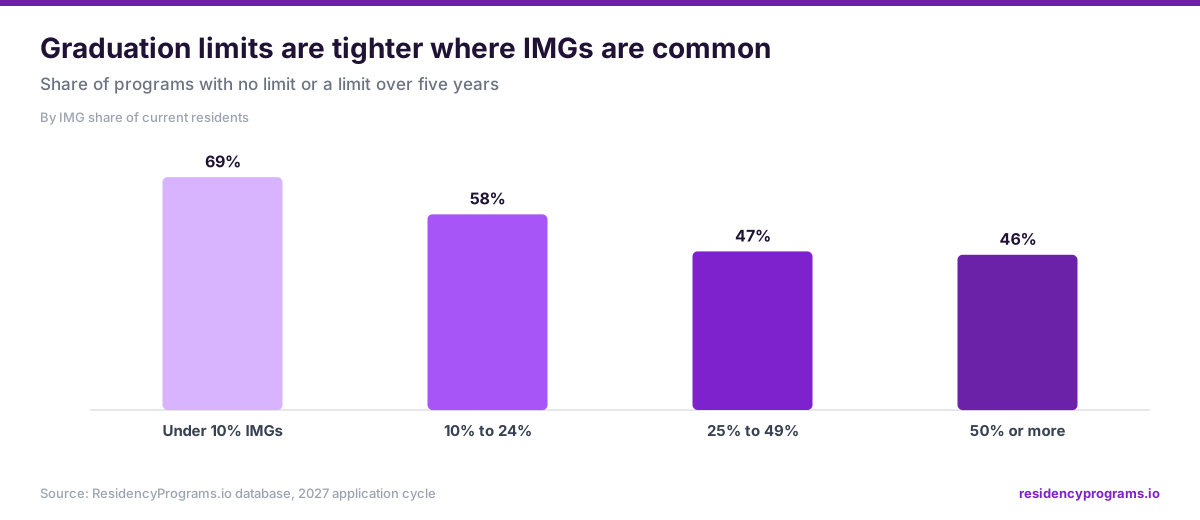
You might expect IMG-friendly programs to be the most relaxed about graduation year. The opposite is true. Among programs where at least half the residents are IMGs, only 46% are open to graduates more than five years out. Among programs with fewer than 10% IMGs, 69% are.
The reason is volume. A program that gets thousands of IMG applications needs a quick way to cut the pile, and graduation year is easy to filter on. A program that gets few IMG applications rarely bothers to set the rule.
The same pattern shows up by type of program: 71% of university-based programs are open to a gap over five years, against 49% of community programs. For older graduates, university programs with a moderate IMG share are worth a closer look than their reputation suggests.
Where the open programs are
Counting programs that are open to a gap over five years, sponsor a visa and have at least 25% IMG residents, a handful of states hold most of them:
| State | Programs |
|---|---|
| New York | 116 |
| Florida | 67 |
| Texas | 41 |
| Michigan | 35 |
| Pennsylvania | 35 |
| New Jersey | 29 |
| California | 27 |
New York alone holds almost one in five. If you are open to any location, the Northeast corridor and Florida give you the most room.
How to make a long gap work
- Show recent clinical work. The worry behind graduation limits is that clinical skills fade. Recent hands-on US clinical experience, or clinical work at home in the last year or two, answers it directly.
- Explain the gap once, plainly. One or two sentences in your personal statement or experiences section: what you did and what you kept up. Research, clinical work, family duties, visa delays and exam timing are all normal reasons.
- Take or retake a recent exam. A recent Step 2 CK or a passed Step 3 shows that your knowledge is current. For the H-1B, Step 3 is usually needed anyway.
- Do not count on exceptions. Some programs with a limit make exceptions, but screening software often removes applications before a person sees them. Put most of your fees on programs that are open on paper.
- Check each program's limit. Limits are buried in requirement pages and change between cycles. The ResidencyPrograms.io dashboard flags programs where you are past the graduation cut-off once you enter your graduation date, along with visa and other requirements you do not meet.
A long gap narrows the list. It does not empty it. More than 600 programs are open on paper, sponsor visas and already train many IMGs.
About the data
All figures come from the ResidencyPrograms.io database for the 2027 application cycle, built from program-reported requirements and checked in October 2026. "Open" means the program reports no maximum time since graduation, or a maximum longer than 60 months. Programs that did not report a limit are counted as having none, so some may still apply one; confirm with the program. Visa sponsorship means the J-1, the H-1B or both. IMG share combines US and non-US IMGs among current residents. Specialty figures include specialties with at least 80 programs.