Signal allocations for 2027, specialty by specialty
This table comes from the AAMC's 2027 residency program signal report, with data as of October 1, 2026. The season was still in progress, so program counts can go up. The "average sent" column is the mean among applicants who signaled at least one program in that specialty. It describes signalers, not every applicant.
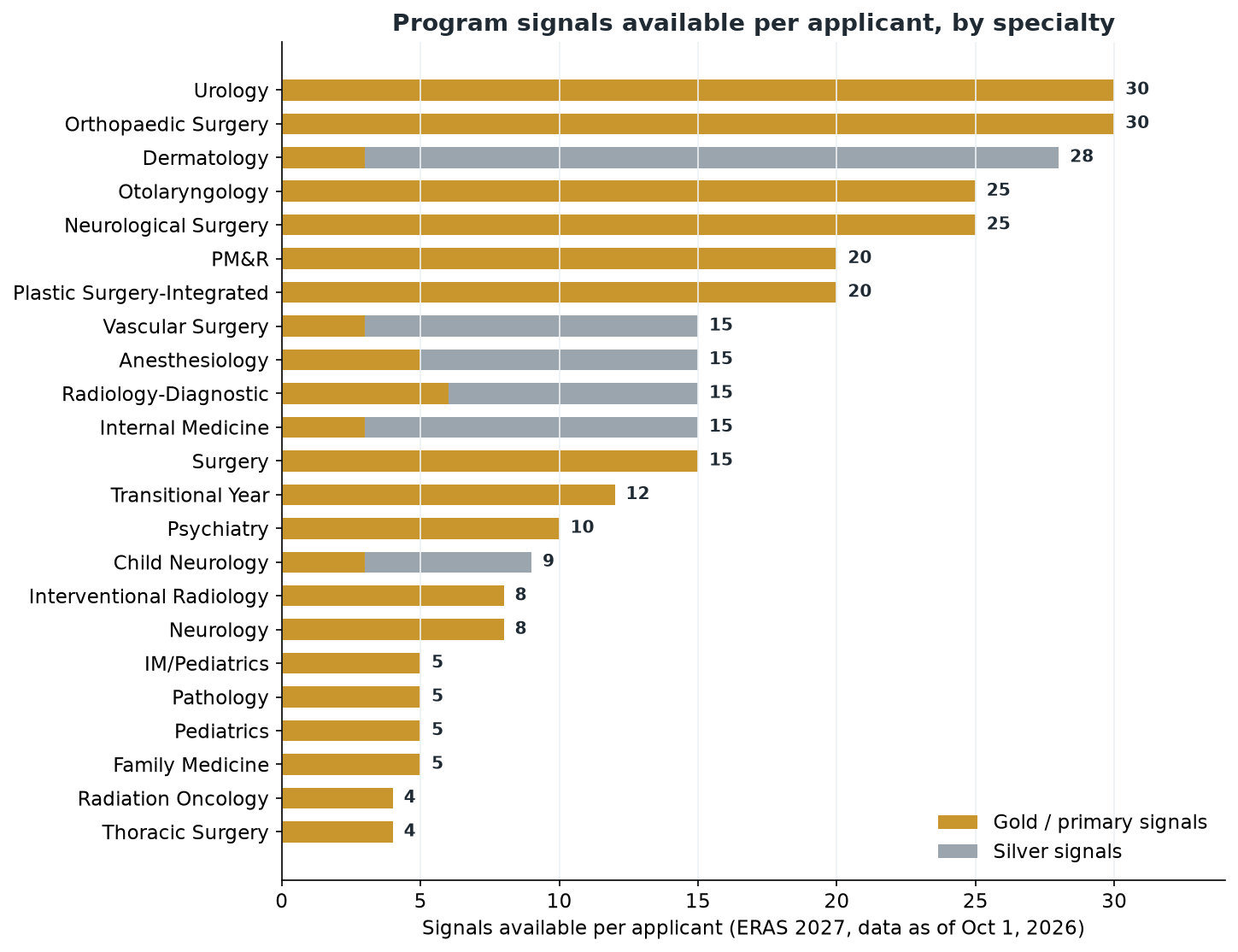
| Specialty | Signals per applicant | Programs in signaling | Average sent |
|---|---|---|---|
| Orthopaedic Surgery | 30 | 207 | 28.1 |
| Urology | 30 | 150 | 28.9 |
| Dermatology | 3 gold + 25 silver | 141 | 2.96 gold / 23.7 silver |
| Otolaryngology | 25 | 127 | 24.0 |
| Neurological Surgery | 25 | 122 | 24.0 |
| Physical Medicine and Rehabilitation | 20 | 114 | 18.7 |
| Plastic Surgery-Integrated | 20 | 93 | 19.5 |
| Internal Medicine | 3 gold + 12 silver | 689 | 2.94 gold / 11.3 silver |
| Diagnostic Radiology | 6 gold + 9 silver | 188 | 5.85 gold / 8.79 silver |
| Anesthesiology | 5 gold + 10 silver | 188 | 4.95 gold / 9.79 silver |
| Vascular Surgery-Integrated | 3 gold + 12 silver | 77 | 2.88 gold / 11.27 silver |
| Surgery | 15 | 354 | 13.6 |
| Transitional Year | 12 | 188 | 9.5 |
| Psychiatry | 10 | 348 | 9.6 |
| Child Neurology | 3 gold + 6 silver | 83 | 2.87 gold / 5.66 silver |
| Neurology | 8 | 199 | 7.7 |
| Interventional Radiology-Integrated | 8 | 102 | 7.6 |
| Family Medicine | 5 | 789 | 4.82 |
| Pediatrics | 5 | 210 | 4.81 |
| Pathology | 5 | 133 | 4.83 |
| Internal Medicine/Pediatrics | 5 | 77 | 4.33 |
| Radiation Oncology | 4 | 80 | 3.88 |
| Thoracic Surgery-Integrated | 4 | 34 | 3.89 |
| Public Health and General Preventive Medicine | 3 | 29 | 2.59 |
| Pediatrics/Medical Genetics | 3 | 26 | 2.77 |
| Pediatrics/Psychiatry/Child and Adolescent Psychiatry | 3 | 11 | 2.73 |
| Internal Medicine/Medical Genetics | 3 | 5 | 2.59 |
| Internal Medicine/Psychiatry | 2 | 13 | 1.84 |
| Neurodevelopmental Disabilities | 2 | 9 | 1.73 |
The two-tier specialties
In six specialties the allocation is split into a few gold signals and a larger set of silver ones. Gold is meant to say more about your interest, and the 2026 interview data backs that up: in every two-tier specialty reported, applicants who sent a gold signal had a higher median interview rate than applicants who sent silver. Dermatology shows it most clearly, with a median of 61% for MD applicants with gold against 14% with silver.
Gold is the tight resource in these specialties. Three gold signals in Internal Medicine or six in Diagnostic Radiology cover a small part of any program list, so it is worth knowing where each one goes. The full comparison is in our gold vs. silver signals breakdown.
How many signals people actually send
Applicants who signal do not save signals. Among signalers, the average number sent is within one or two of the maximum in every specialty in the table. In internal medicine, signalers sent 2.94 of 3 gold and 11.27 of 12 silver on average. In orthopaedic surgery they sent 28.1 of 30.
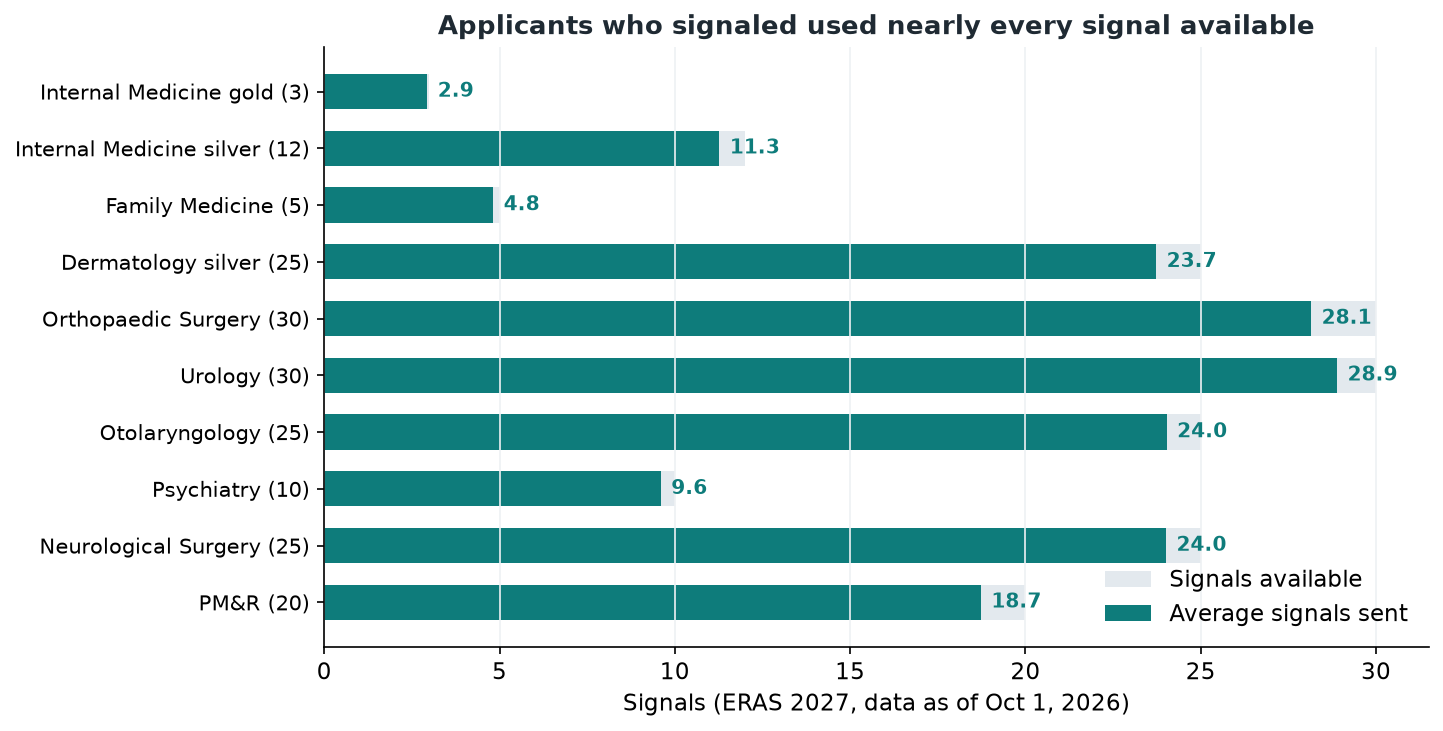
Two things to keep in mind. These averages only cover applicants who sent at least one signal, so they say nothing about how many applicants skipped signaling. And they hide differences between applicant groups. IMG signalers sent fewer signals on average than MD signalers in several specialties: 15.4 against 19.2 in Physical Medicine and Rehabilitation, 8.0 against 9.8 in Transitional Year and 23.1 against 29.1 in Orthopaedic Surgery. The data does not say why. We look at that group in more detail in the IMG guide to program signals.
What this table does not cover
Emergency medicine and obstetrics and gynecology are not in this report. We can't tell from the report whether they run signaling somewhere else or do not use it, so check the AAMC's current guidance for those two. Ophthalmology applicants go through a separate match and are not covered here either.
Also remember that a bigger allocation does not make a specialty easier. A 30-signal specialty can still be harder to match into than a 5-signal one, because the number of applicants for each program is very different.
Fitting your allocation to your list
What your signals are worth depends on how many programs you are choosing from. Five family medicine signals spread across 789 programs are scarce. Thirty urology signals across 150 programs reach a fifth of the field.
Before you assign a single signal, work out which programs are realistic for you. Our specialty pages list programs with their IMG share and visa sponsorship, and the ERAS application fee calculator shows what a longer list costs. For the bigger picture on how signals relate to interviews, read Do residency program signals get you interviews?