

Red Flags and Green Flags on a Residency Program Page
What each number on a residency program page tells an IMG: visa sponsorship, IMG residents, requirements, interview rate and more, with the green flags to look for and the red flags that should make you skip a program.
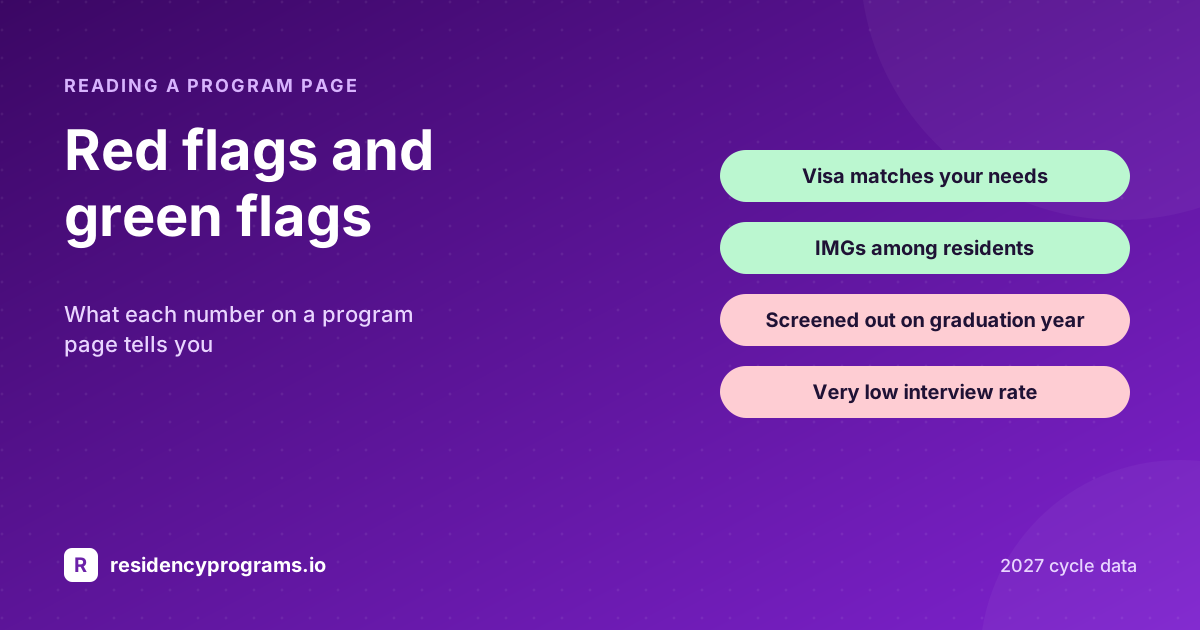
- Read a program page in this order: visa, IMG residents, requirements, interview rate, then everything else.
- Green flags: a visa that matches your needs, current IMG residents (especially non-US IMGs if you need a visa), requirements you meet, and an interview rate near or above the specialty median.
- Red flags: no visa when you need one, no IMG residents, a graduation limit or clinical experience minimum you miss, and a very low interview rate with many applicants per position.
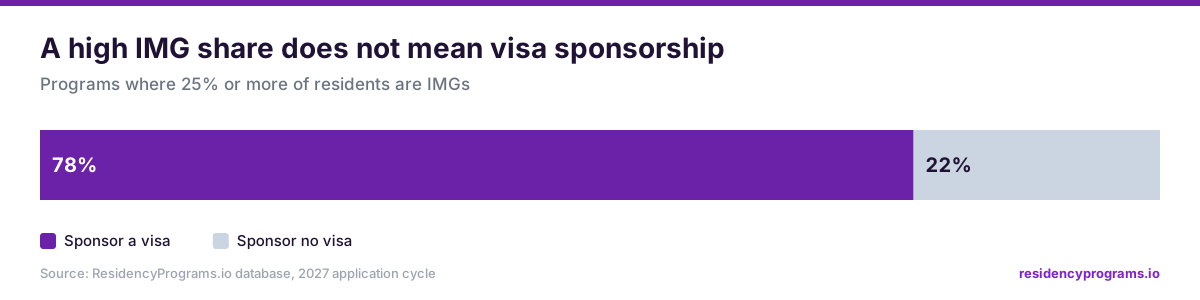
- A high IMG share does not mean visa sponsorship: 22% of programs where at least a quarter of residents are IMGs sponsor no visa.
- No single number decides. Two or three red flags together are a good reason to skip a program and save the fee.
Every program page on ResidencyPrograms.io packs a lot of data into one screen: positions, applicants, interview rate, IMG share, visa policy, requirements, resident mix and contacts. Applicants often read it top to bottom and come away unsure whether the program is worth an application.
This guide shows what each part of the page tells you, and what counts as a green flag or a red flag for an IMG. You can follow along on any program, for example from the internal medicine program list.
The quick check: five numbers at the top
The top of each program page shows five key facts. Together they answer the first question: is this program even possible for me?
| Number | Green flag | Red flag |
|---|---|---|
| Visa sponsorship | Matches what you need (J-1, H-1B or both) | No sponsorship when you need a visa |
| IMG residents | IMGs are a real share of current residents | 0% IMGs, or IMGs are all US citizens when you need a visa |
| Interview rate | Near or above the specialty median | Far below the median (for example under 5%) |
| Applicants | In line with positions for the specialty | Thousands of applicants for a handful of positions |
| Positions | Several positions per year | One or two positions, which makes any match a long shot |
Visa sponsorship
Start here if you need a visa. Nothing else on the page matters if the program cannot sponsor you. The page shows whether the program sponsors the J-1, the H-1B or neither.
Two cautions. First, visa policies change between cycles, and some programs consider visas "case by case". If the page says no sponsorship but you see many non-US IMGs among the residents, email the coordinator to confirm. Second, the H-1B often comes with conditions, such as a passed Step 3 before ranking.
IMG residents and the resident mix
The IMG share tells you whether a program actually ranks IMGs, which is more useful than any "IMG-friendly" label. The Current residents section breaks it down further: US MD graduates, US DO graduates, US IMGs and non-US IMGs.
- Green flag: non-US IMGs among current residents if you need a visa. It shows the program has sponsored people in your situation.
- Yellow flag: a high IMG share made up mostly of US IMGs (US citizens who trained abroad). The program welcomes IMGs but may not sponsor visas.
- Red flag: no IMG residents at all. About 37% of programs in our database have none. Some still interview IMGs, but your odds are lower.
Requirements and screening
This section holds the details IMGs most often need before deciding: the Step 2 CK minimum, the Step 2 CK range of applicants the program interviewed, the graduation-year limit, US clinical experience requirements, the application deadline, signal results and the medical schools of current residents. You can see which of these a program reports, and open the values for the programs you care about.
- Graduation limit. A hard red flag if you are past it. Screening software applies these strictly.
- US clinical experience. If the program requires more months than you have, skip it or plan to add experience first.
- Step 2 CK minimum and interviewed range. Most minimums sit near the passing mark, so the interviewed range is more telling. If your score sits in the middle of it, that is a green flag. If it sits below the lowest interviewed score, think twice.
- Residents' medical schools. If current residents come from your school or country, that is one of the strongest green flags there is.
- Signal results. If the program interviews far more signaled applicants than others, a signal there is worth a lot. Our study of program signals and interview rates shows how large the difference can be.
Applications and interviews
The interview rate is the share of applicants a program interviews. On its own it is hard to read, so compare it with the specialty median shown on each specialty page.
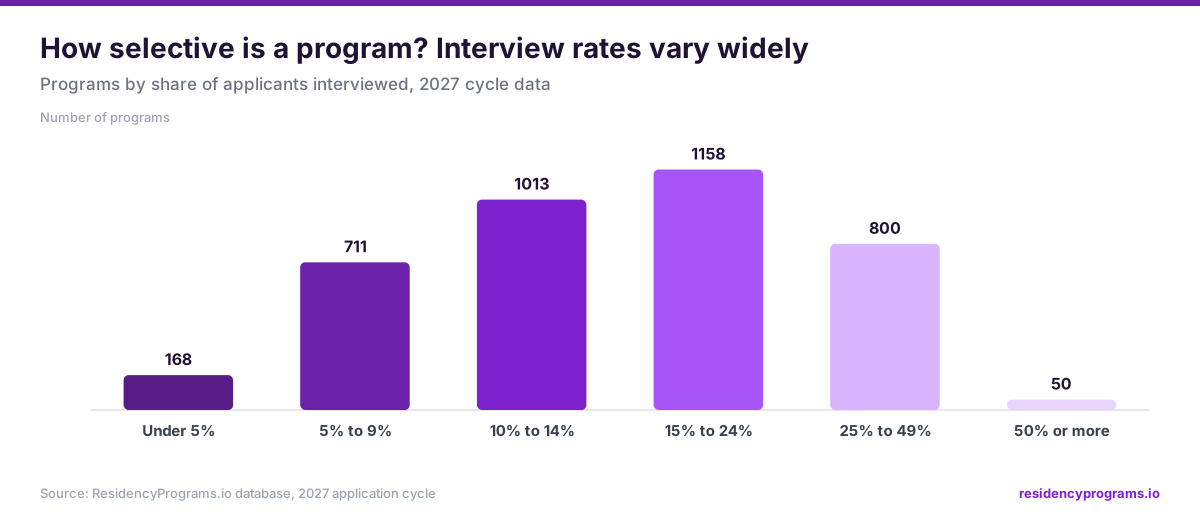
A program that interviews under 5% of applicants is either very competitive or very popular with IMGs (often both). That is not a reason to skip it on its own, but it should not fill your list. A program with a rate well above its specialty median, that sponsors your visa and trains IMGs, is the kind of program a list should be built on.
This section also shows how many letters of recommendation the program asks for. Most ask for three; a program that asks for four or a specialty-specific letter takes more preparation.
Contact details
A program page lists the program director, coordinator, phone, email and website. Missing contact details are not a red flag in themselves, but a program with an out-of-date website and no coordinator email is harder to ask questions of, and you may need to confirm its visa and requirement details before you apply.
Putting the flags together
No single number should decide. A practical rule:
- Apply when the visa matches, the program has IMG residents and you meet its stated requirements. These programs are the core of your list.
- Think twice when one thing is off, such as a very low interview rate or no non-US IMGs when you need a visa.
- Skip when two or more red flags appear, or when you miss a hard requirement such as the graduation limit. Save the fee for a program that can say yes.
Doing this for 100 programs by hand takes days. The ResidencyPrograms.io dashboard checks your profile against each program's requirements, flags the ones that screen you out, and gives every remaining program an Affinity Score from 0 to 100 that shows how well it matches your personal profile, based on its current residents. Programs scoring 70 to 100 are strong fits.
About the data
Figures come from the ResidencyPrograms.io database for the 2027 application cycle, as reported by programs. IMG share combines US and non-US IMGs among current residents. The interview rate distribution covers 3,900 programs that report an interview rate. Program details change between cycles; confirm anything that decides your application with the program itself.