

How to Build Your Residency Rank Order List (2027 Match)
Ranking opens on February 1 and closes on March 3. Here is how the Match uses your list, how many programs to rank, how to order them and the mistakes that cost applicants a match.

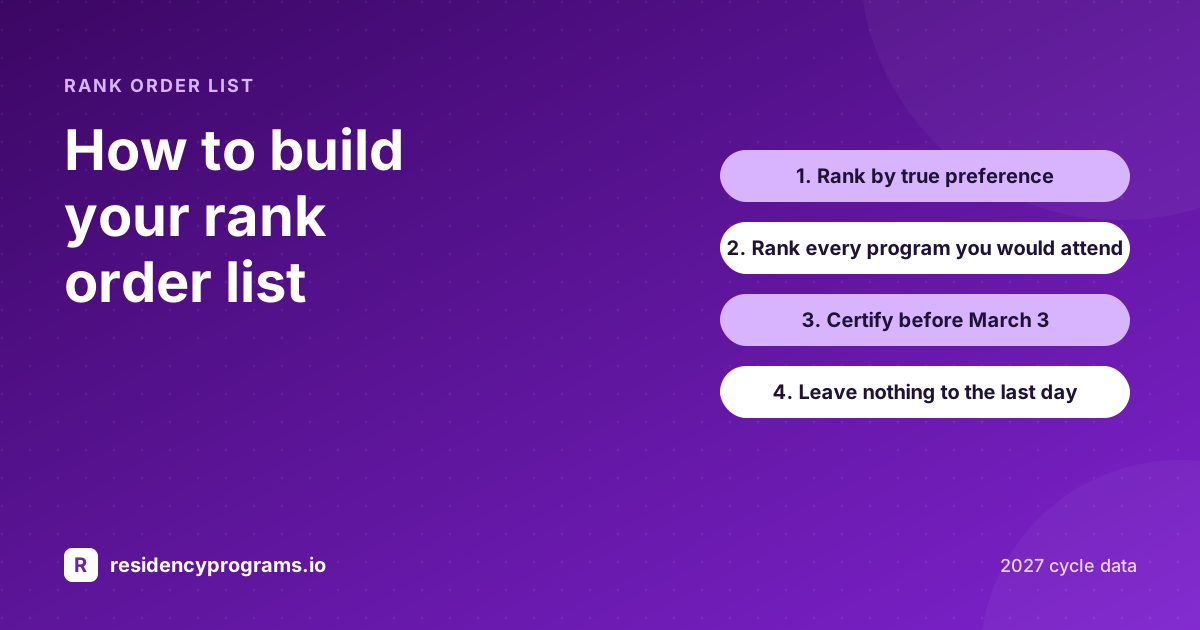
- Ranking for the 2027 Match opens on February 1 at 12 p.m. Eastern. Your list must be certified by March 3 at 9 p.m. Eastern. An uncertified list is not used.
- Rank programs in the order you want them. The Match algorithm works in your favor: ranking your dream program first never costs you a place lower down.
- Rank every program you would be willing to attend. In the NRMP's 2024 data, matched non-US IMGs had ranked an average of 6.2 programs in their specialty; those who did not match had ranked 2.5.
- Do not rank a program you would not attend. A match is binding.
- Do not try to guess how programs will rank you, and do not let post-interview messages change your order.
After months of applications and interviews, the rank order list is the one document that decides where you train. It is also the step most applicants overthink. The rules are simpler than they look, and the most common mistakes come from trying to outsmart a system that is designed so you do not have to.
Here is how to build your list for the 2027 Main Residency Match.
Key dates
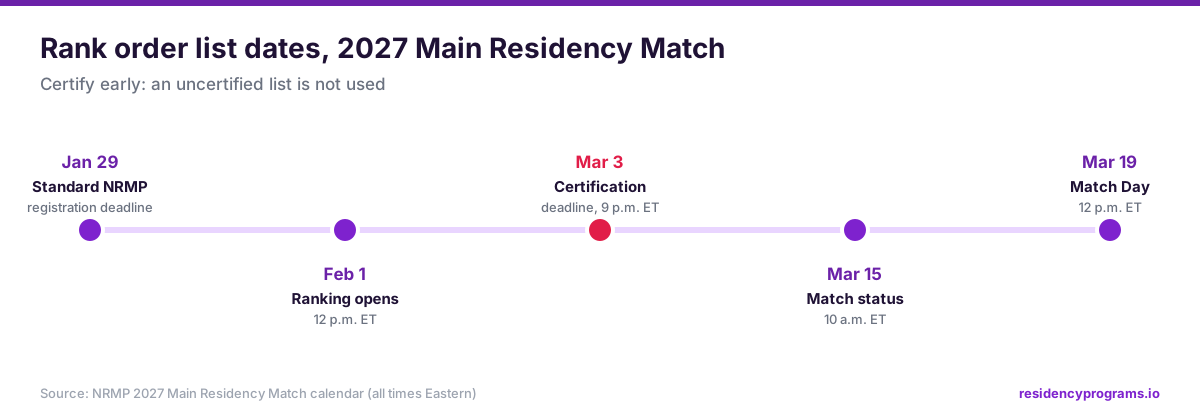
You enter your list in the NRMP's R3 system. Ranking opens on February 1, 2027, at 12 p.m. Eastern. You can enter, change and re-certify your list as often as you like until the deadline on March 3 at 9 p.m. Eastern. After that, the list is locked. The NRMP applicant calendar has every date.
Two practical points. First, if you change a certified list, you must certify it again or the old version stands. Second, do not wait for the last evening: systems slow down near deadlines, and a problem you discover at 8:45 p.m. cannot be fixed.
How the Match uses your list
The Match algorithm starts from the applicants' side. It tries to place you at your first choice. If that program has ranked you and has room for you (or prefers you to someone it had tentatively placed), you are tentatively matched there. If not, it tries your second choice, and so on down your list.
The result is a simple rule: you match at the program highest on your list that also ranked you highly enough to take you. Two things follow:
- Ranking a long-shot first does not hurt you. If your first choice does not take you, the algorithm moves on to your second choice as if the first were never there. You do not lose your place anywhere else.
- Guessing does not help you. Moving a program up because you think it liked you, or down because you think it did not, can only put you somewhere you like less. The order of your list should be your true preference and nothing else.
Step 1: List every program where you interviewed
Start with all of them. Then remove only the programs where you would rather go unmatched than train. That is a high bar. For most IMGs, the cost of going unmatched (a lost year, visa uncertainty, another round of fees and a growing graduation gap) is much higher than the cost of training at a program that was not your favorite.
Length matters. In the NRMP's Charting Outcomes report for IMGs (2024), matched applicants had ranked far more programs in their preferred specialty than unmatched applicants:
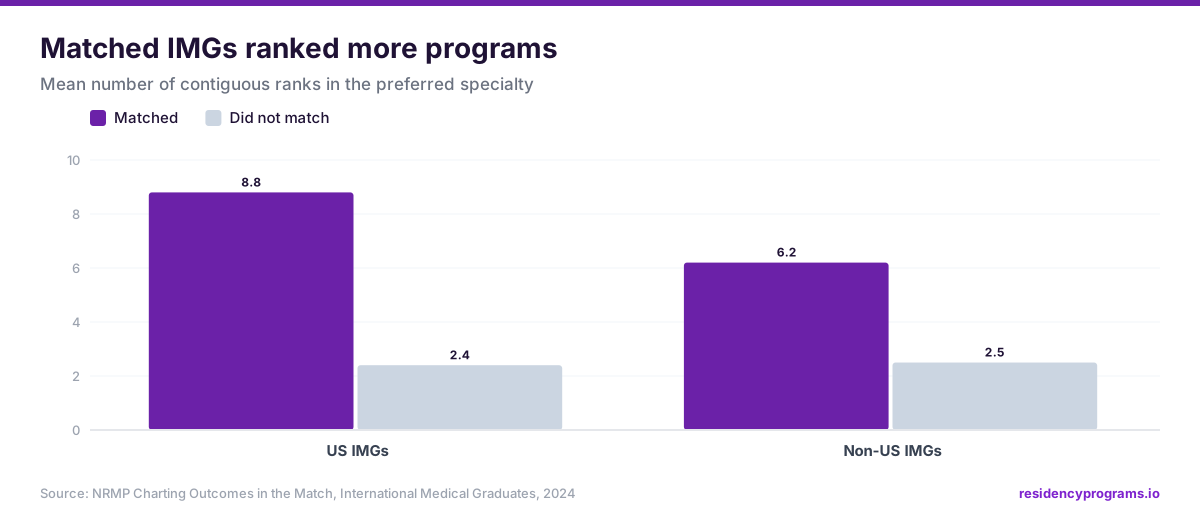
Part of that gap simply reflects interviews: applicants with more interviews have more programs to rank. But the lesson holds either way. If you have interviews, rank them. Leaving a program off your list for a small reason is one of the most common regrets in the Match.
Step 2: Put them in your true order
Write down what matters to you before you start moving programs around. Common factors:
- Visa. If you need the H-1B, or need a J-1 program that is experienced with ECFMG sponsorship, this comes first.
- Training quality and fit. How residents described the teaching, the workload and the support. Whether residents seemed happy and spoke openly.
- Career goals. Fellowship match history, research time, contacts in your target subspecialty.
- Location and life. Family, partner, community, cost of living, climate.
- The IMG experience. Whether the program has current IMG residents and how they are supported. Program pages show the resident mix, for example across the internal medicine programs.
A simple method: score each program from 1 to 5 on your top four or five factors, weight the factors, and sort. Then look at the sorted list and ask, for each pair, "if both offered me a place today, which would I choose?" Trust your answer over the spreadsheet when they disagree.
Keep your notes from each interview day. By February, programs blur together. If you kept a program list in the ResidencyPrograms.io dashboard, your notes and each program's data are already in one place.
Step 3: Preliminary, transitional and couples lists
- Advanced positions. If you are applying to specialties that start in the second year (such as some anesthesiology, neurology, radiology or dermatology positions), you need a first-year preliminary or transitional position as well. You enter those on supplemental lists linked to each advanced program. Rank enough of them, or a match to an advanced program can leave you without a first year.
- Preliminary positions as a back-up. Ranking one-year preliminary positions at the end of your list can keep you in training if you do not match categorically. It is not the same as a full residency, so think about what you would do after the year.
- Couples. If you are matching as a couple, you rank pairs of programs, and the list gets long fast. Include combinations where one of you is unmatched only if you would really accept that outcome.
Step 4: Ignore the noise
After interviews, some programs send warm emails, and some applicants hear things like "you will rank highly with us". Under NRMP rules, programs may express interest, but they may not ask you how you will rank them or ask for a commitment, and neither side can make a binding promise. A friendly email is not an offer.
The only safe use of a post-interview message is as a small piece of information about the program's culture. It should never move a program above one you prefer.
Common mistakes
- Leaving off programs because they felt less impressive on the day. If you would attend, rank it.
- Ranking a program you would not attend just to make the list longer. The Match is binding. If you match there, you are expected to go.
- Ordering by your chances instead of your preference.
- Not certifying, or editing a certified list and forgetting to certify it again.
- Forgetting supplemental lists for advanced positions.
- Missing the ECFMG deadline. IMGs must meet ECFMG's verification requirements by the rank list deadline, March 3, to stay in the Match.
After you certify
On Monday, March 15, at 10 a.m. Eastern, you will learn whether you matched, but not where. If you did not, the Supplemental Offer and Acceptance Program (SOAP) starts that day, so have a plan ready before Match Week begins. On Friday, March 19, at 12 p.m. Eastern, you will learn where you matched.
If you are already thinking about the next cycle, or want to see how your interview programs compare with others in your specialty, the specialty pages show the visa policy and IMG share of every program.
About the data
Dates come from the NRMP's 2027 Main Residency Match calendar. Contiguous rank figures come from the NRMP's Charting Outcomes in the Match: International Medical Graduates report (2024), which counts the number of programs ranked in a row in the applicant's preferred specialty. Always check the NRMP's own rules and calendar, which can change between cycles.