

Step 2 CK Score Cut-offs for Residency, Now That Step 1 Is Pass/Fail
4,877 residency programs list a minimum Step 2 CK score, but most of those minimums are below today's pass mark. Here is what programs ask for, and what the applicants who get interviews actually score.

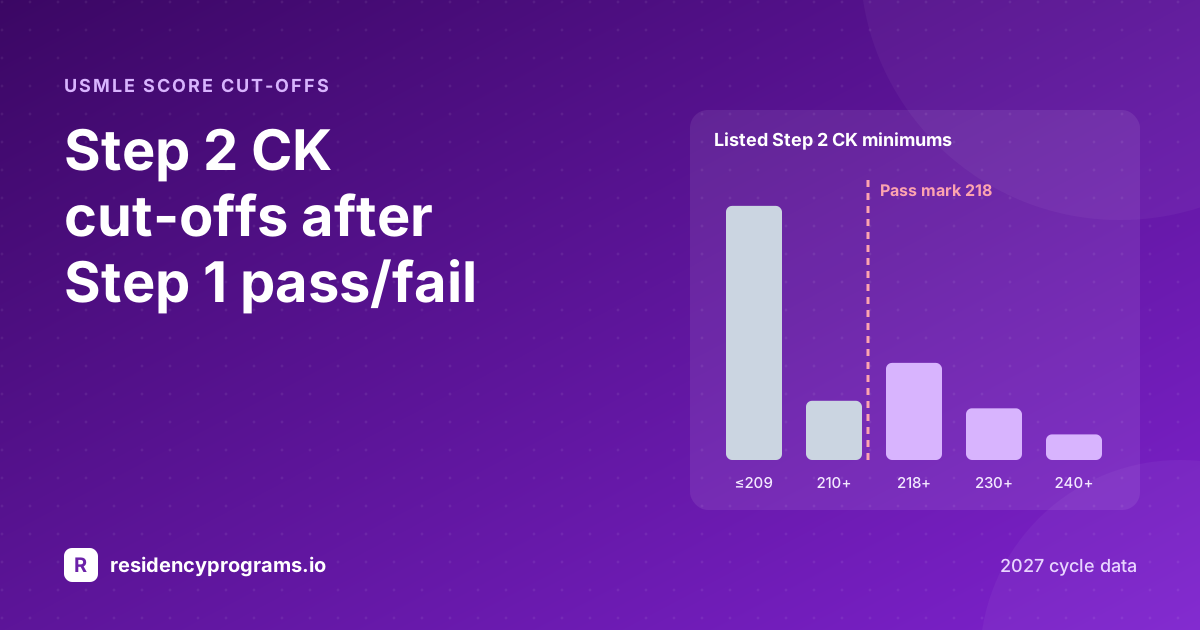
- With Step 1 pass/fail since January 2022, Step 2 CK is the score programs screen on. 4,877 programs, about 9 in 10 of those with data, list a minimum Step 2 CK score.
- More than half of those minimums (2,541 programs) are 209 or lower, the pass mark before July 2022. In practice these programs are asking for a pass. The pass mark has been 218 since July 1, 2025.
- Only 773 programs (16%) list a minimum of 230 or higher, and 256 (5%) list 240 or higher.
- The scores that get interviews are far higher than the minimums: the typical interviewed applicant's median is 238 in family medicine, 247 in internal medicine and 256 to 260 in the surgical specialties.
- Non-US IMGs who get interviews in internal medicine have a higher median Step 2 CK (251) than US MD applicants (246).
When Step 1 moved to pass/fail, many applicants hoped scores would matter less. Mostly, the pressure just moved to Step 2 CK. Programs still need a quick way to sort thousands of applications, and Step 2 CK is the one standardized number left on most of them.
So what do programs actually ask for? We looked at the Step 2 CK minimums that residency programs list for the 2027 cycle, and compared them with the scores of applicants who were invited to interview. The two numbers tell very different stories.
Why Step 2 CK now carries the weight
Step 1 has been reported as pass or fail since January 26, 2022. Step 2 CK still gives a three-digit score, and its pass mark has gone up twice since then. The USMLE raised it from 214 to 218 for exams taken on or after July 1, 2025. That followed an increase from 209 to 214 in July 2022.
Those two dates matter when you read program requirements, because many programs have not updated their listed minimum since the old pass mark.
What programs list as their minimum
Of the 5,487 programs in our database with requirement data, 4,877 list a minimum Step 2 CK score. Here is how those minimums are spread:
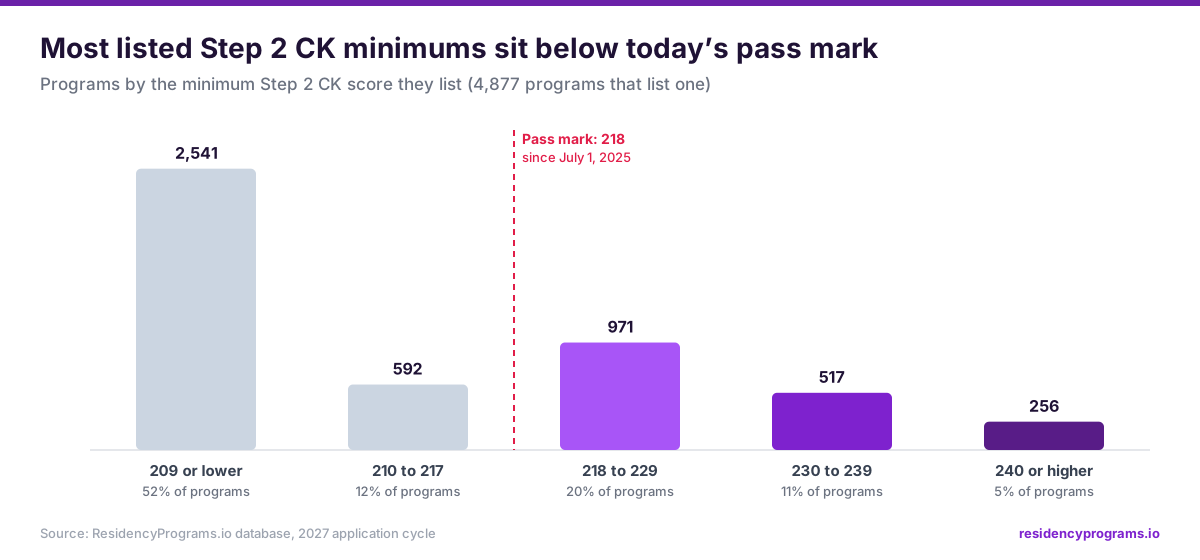
2,528 programs list exactly 209, the pass mark that applied until mid-2022. Another 592 list a number between 210 and 217. Together that is 64% of programs with a listed minimum below today's pass mark. Since you cannot pass Step 2 CK today with less than 218, those programs are in effect asking only for a pass.
Programs that set a real bar above passing are a minority: 971 list 218 to 229, 517 list 230 to 239 and 256 list 240 or more.
By specialty, the average listed minimum (among programs that list one) runs from 211 in child neurology to 223 in dermatology and general surgery. Every general surgery program in our data lists a minimum, and 148 of the 362 say the cut-off is strict.
The minimum is not the target
A listed minimum tells you the score below which your application may be screened out. It does not tell you what it takes to get an interview. For that, the better guide is the score of the applicants who were actually invited.
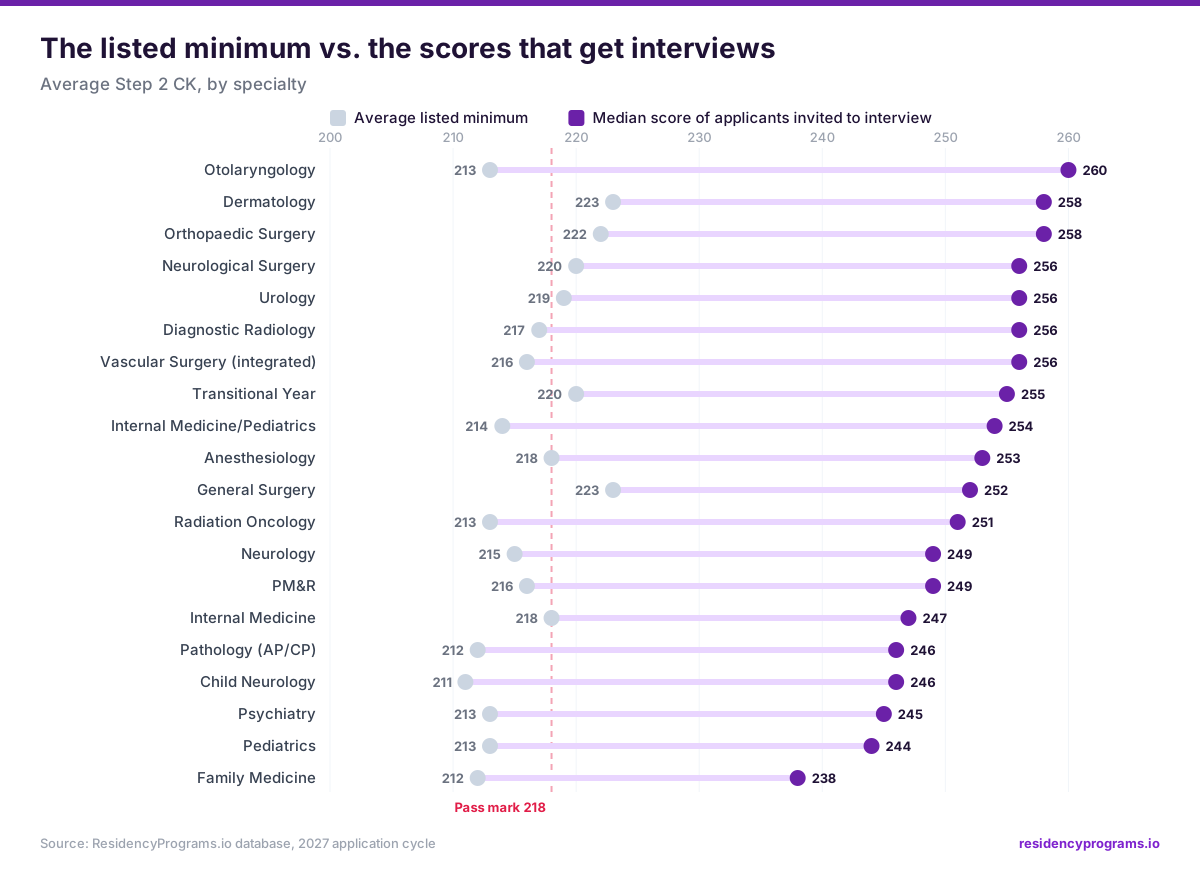
The gap is large everywhere. In internal medicine the average listed minimum is 218, but the median interviewed applicant scored 247. In family medicine it is 212 against 238. In otolaryngology, programs list an average minimum of 213, while the median interviewed applicant scored 260.
A rough way to read the chart: the grey dot is the floor, the purple dot is where the middle of the interview pool sits. If your score is near the floor, you can still apply, but expect a lower interview rate and plan a longer list.
Scores by applicant type
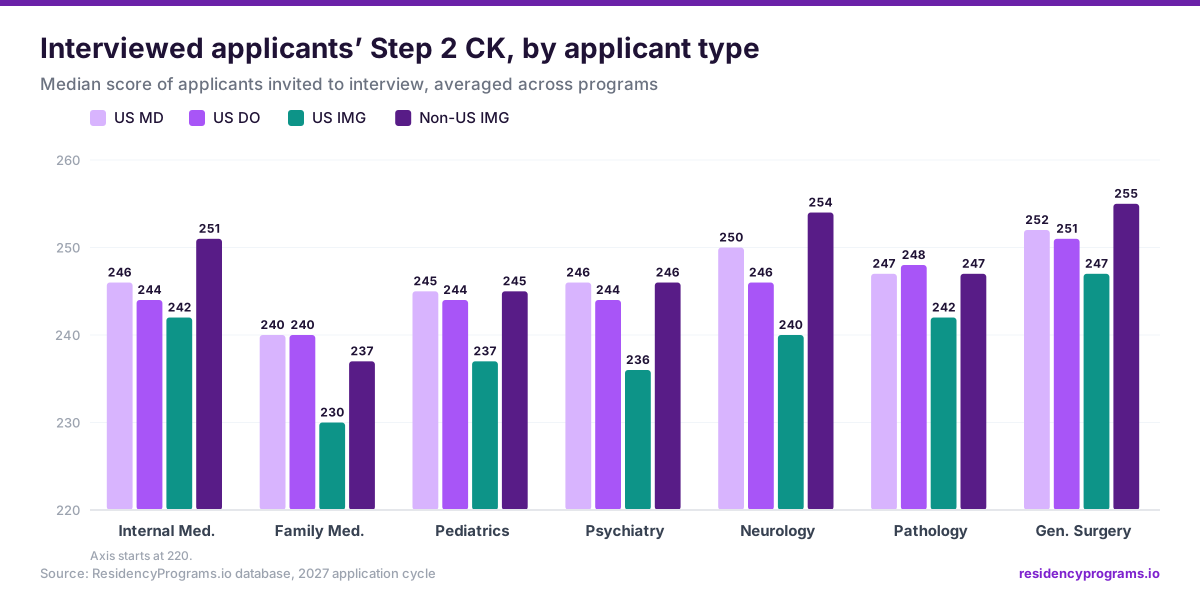
This chart shows the median score of applicants invited to interview, split by applicant type and averaged across programs. Two patterns stand out.
First, non-US IMGs who get interviews tend to have high scores. In internal medicine their median is 251, five points above US MD applicants. In neurology it is 254 against 250, and in general surgery 255 against 252. Programs that interview non-US IMGs, often with visa costs attached, appear to set a higher bar for them.
Second, US IMGs who get interviews have the lowest medians in every specialty shown, from 230 in family medicine to 247 in general surgery. One explanation is that programs weigh other strengths for US IMGs, such as US clinical experience and no need for a visa.
If you are a non-US IMG, use the dark purple bars as your benchmark, not the overall average.
Strict cut-offs and old Step 1 scores
1,426 programs (26% of those with requirement data) describe their score cut-off as strict, meaning they say they do not look at applications below it. Family medicine (360 programs) and internal medicine (262) have the most, followed by psychiatry (95), obstetrics and gynecology (87) and pediatrics (82).
Many programs also still list a Step 1 minimum: 5,434 do, and 3,300 of them list a number above the old pass mark of 196. This only matters if you took Step 1 before it went pass/fail and have a three-digit score. If you passed under the pass/fail system, a Step 1 minimum generally means a pass.
What this means for your application
- Read 209 as "pass". A listed minimum at or near the old pass mark is a pass requirement. It does not tell you the program is easy.
- Benchmark against interviewed scores. Compare your score with the median of interviewed applicants in your specialty. That says more about your chances than the listed minimum.
- Respect strict cut-offs. If a program calls its cut-off strict and you are below it, an application there is usually wasted.
- Use signals where your score is competitive. Signals raise interview rates, but they work best at programs where your score is already in range. See our analysis of whether program signals get you interviews and the signal limits for each specialty.
- Let the tools do the screening. The ResidencyPrograms.io dashboard shows each program's Step 2 CK minimum and flags the programs where your score falls below a cut-off.
About the data
Figures come from the ResidencyPrograms.io database for the 2027 application cycle, checked in October 2026. Listed minimums are program-reported requirements. Interviewed scores are program-reported ranges for applicants invited to interview: we take each program's median and average it across programs in the specialty, for specialties and applicant groups with at least 25 programs reporting. Averages of medians are a guide, not an exact threshold. Pass marks are from USMLE announcements.