

How to Spend Your Gold Signals
A four-step way to decide where gold signals go in the two-tier specialties, with the 2026 interview numbers behind it.

If you apply to internal medicine, anesthesiology, diagnostic radiology, dermatology, child neurology or vascular surgery, you get a handful of gold signals and a bigger pile of silver ones. Gold is the scarce one. Here is a practical way to think about where it goes, based on the AAMC's 2026 interview data.
First, what gold is worth
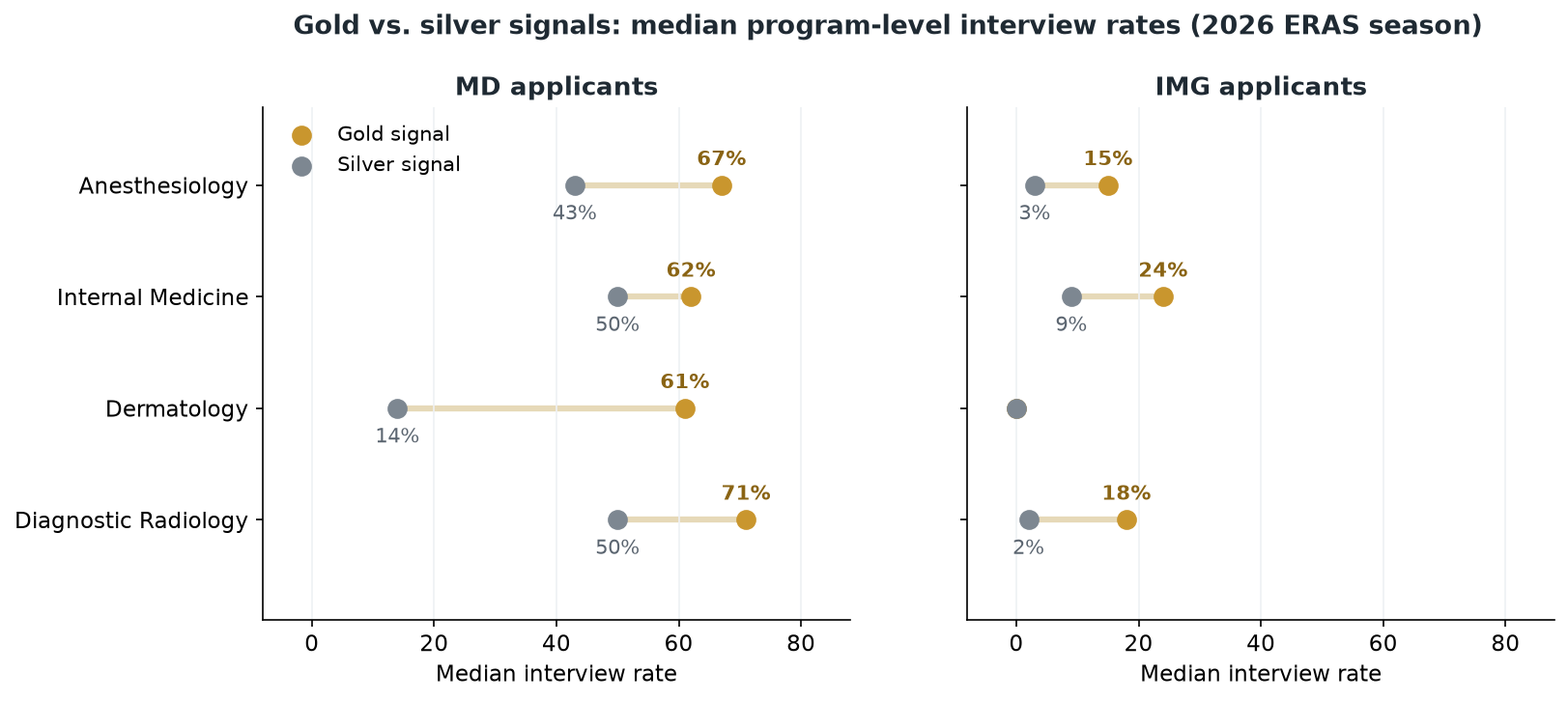
In internal medicine, MD applicants had a median program interview rate of 62% with gold, 50% with silver and 11% with no signal. For IMGs it was 24%, 9% and 1%. Dermatology is the sharpest case: 61% with gold against 14% with silver. These are medians across programs, not your personal odds.
Step 1: pick programs you would actually want
A gold signal tells a program you are serious. That only works if you are. List the programs you would be happy to attend, not the ones you think look good on paper.
Step 2: check that they can say yes
A signal does not fix a mismatch. Before you spend gold, look at the program's IMG share, visa sponsorship and graduation-year limits. If you are an IMG, a program that has never trained one is a poor home for a scarce signal. Our specialty pages list these for every program.
Step 3: think about location
The AAMC also looked at geography. In anesthesiology, signaled applicants whose signal landed in a region they had listed had a median of 59% with gold. A gold signal outside their listed regions had 26%. Internal medicine showed 45% against 21%. A gold signal inside your regions went with about double the median.
Step 4: do not treat silver as filler
In internal medicine and diagnostic radiology the MD silver median is 50%. Silver is a real signal. Use it on the wider band of programs you would be glad to interview with, and keep gold for the ones you want most.
A caution
The AAMC did not adjust for how strong applicants were, so these numbers show an association, not a guarantee. Gold sent to a program that screens you out on scores or visa status is unlikely to help.
The full comparison
We broke down every two-tier specialty by applicant type, with the geography numbers, in our guide: Gold vs. silver signals: what the data shows. If you are not sure how many gold signals you have, the signal limits by specialty table lists them all.
Read the gold vs. silver guide
Sources: AAMC, ERAS Program Signal and Interview Invitation, 2026 Residency; AAMC, Exploring the Relationship Between Signaling, Geographic Preferences, and Interview Invitations, 2026 Analysis.