Applicants: four final seasons and one snapshot
The AAMC publishes applicant statistics during the ERAS season. Past seasons are final as of May 31. The current season is a mid-cycle snapshot. Keeping those two apart is most of what it takes to read this data honestly.
| Season | Total | MD | DO | IMG |
|---|---|---|---|---|
| ERAS 2023 (final) | 49,926 | 22,701 | 8,686 | 18,539 |
| ERAS 2024 (final) | 51,816 | 22,657 | 9,285 | 19,874 |
| ERAS 2025 (final) | 52,051 | 21,875 | 9,420 | 20,756 |
| ERAS 2026 (final) | 50,540 | 21,323 | 8,422 | 20,795 |
| ERAS 2027 (October 1, 2026) | 47,169 | 21,060 | 8,387 | 17,722 |
Across the completed seasons the total went from 49,926 in 2023 to 52,051 in 2025 and then to 50,540 in 2026. MD applicants dropped every year, from 22,701 to 21,323. IMG applicants rose every year, from 18,539 to 20,795.
The 2027 snapshot is lower, but how much lower depends on the group. MD and DO counts on October 1 are already within about 1% of last year's final numbers (21,060 against 21,323 for MD, 8,387 against 8,422 for DO). The IMG count is 17,722 against 20,795. That gap could be timing, with more IMGs submitting later in the season, or it could be a real decline. A single snapshot can't say which, and we would need last year's October 1 figure to compare like with like. The final 2027 count will not be known until the season closes.
Applications per applicant
The other thing worth watching is how many programs each applicant applies to. These are averages for the completed seasons:
- Internal medicine: 73.2 in 2023, a peak of 76.7 in 2024, then about 71 in 2025 and about 62 in 2026.
- Family medicine: 53.1 in 2023, falling to about 41 by 2025, then roughly flat.
- Psychiatry: rising through 2025, then lower in 2026 (about 61).
- Surgery: a peak in 2024 and lower each year since, to about 58 in 2026.
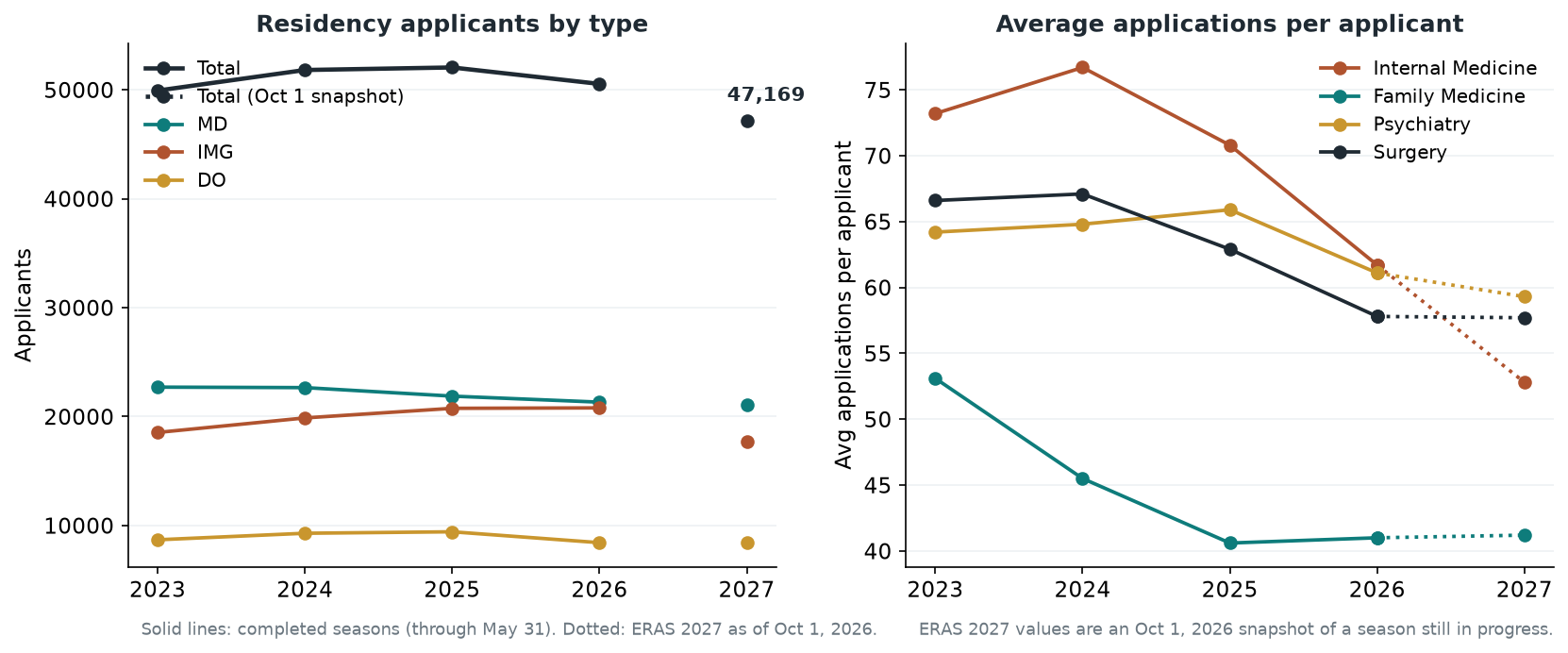
The 2027 snapshot values, such as 52.8 in internal medicine and 59.3 in psychiatry, are lower or flat, but they come from a season that is not finished. Applications keep arriving after October 1, so a snapshot count is likely to sit below the final one and we do not read it as a trend yet. The snapshot also shows a large split inside internal medicine: 74.4 applications per IMG against 26.6 per MD.
At the program end, the average internal medicine program had received 1,910 applications by October 1. It received 2,984 across the whole 2023 season. Those two figures measure different spans of time, so they do not show whether program inboxes are shrinking.
What is behind the drop in applications per applicant across the final seasons? Program signaling is one candidate, and the cost of applying is another. This data does not test either.
IMG applicants
IMGs are more than a third of the pool in the snapshot (17,722 of 47,169) and made up about 41% of the 2026 total (20,795 of 50,540). They are concentrated in a few specialties. In the snapshot, 12,843 IMG applicants applied to internal medicine, 6,885 to family medicine, 2,785 to pediatrics, 1,828 to transitional year, 1,744 to surgery, 1,115 to neurology and 1,009 to psychiatry. An applicant can appear in more than one of these, so the numbers should not be added up. We cover how signals work for this group in the IMG guide to program signals.
What not to conclude
- Do not read 47,169 as a fall in competition. It is a mid-season count, and the AAMC updates it monthly.
- Do not read lower application averages as a reason to apply casually. Fewer applications per applicant does not make any single program easier to get into.
- Do not treat applicant volume as a measure of how competitive a specialty is. Applicant totals say nothing about how many positions the specialty has, and the files used here do not include positions.
Where this leaves you
If the pool is stable and lists are getting shorter, the quality of your list matters more than its length. A short list works when every program on it plausibly interviews someone with your profile: your scores against their screening, your graduation year against their limits, your visa status against their sponsorship policy and, for IMGs, whether they actually train international graduates. Use the ERAS application fee calculator to see what each extra application costs, the specialty pages to compare programs, and the signal limits by specialty to plan your signals. For how the signals themselves relate to interviews, see Do residency program signals get you interviews?
Sources
- AAMC ERAS Statistics: applicant statistics and 2027 program signal report (prior seasons final as of May 31; ERAS 2027 as of October 1, 2026)
- AAMC, ERAS Program Signal and Interview Invitation, 2026 Residency