

Residency Thank-You Notes and Interview Emails: What the Rules Say
What NRMP rules allow before and after residency interviews, whether thank-you notes matter, when to send an update email or a letter of intent, and templates you can adapt.
- Before the interview: reply to invites fast, schedule politely, cancel early if you must, and send questions to the program coordinator.
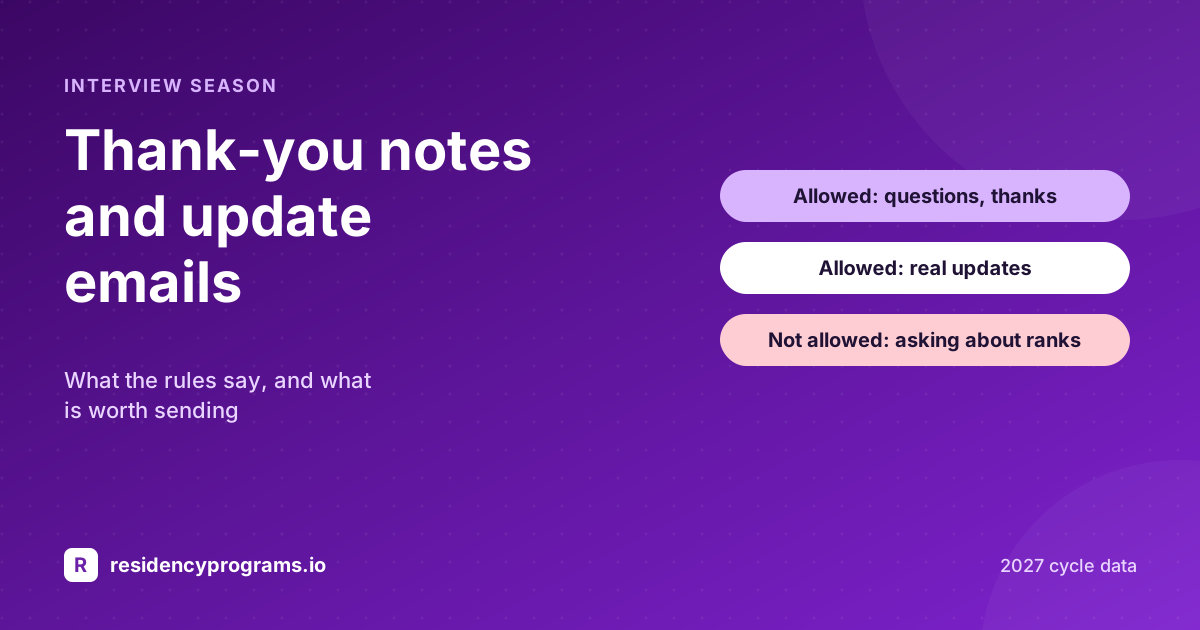
- After the interview, NRMP rules let you thank a program, ask questions and share real updates. Neither side may ask how the other will rank, and promises are not binding.
- Thank-you notes are courteous but rarely change rankings. Many programs say they do not expect them. A short, specific email is enough.
- Send a "letter of intent" (that a program is your first choice) to one program at most, and only if it is true.
- About 75% of programs in our data report virtual interviews, so most of this happens by email and video.
Interview season brings a lot of small messages: replies to invites, scheduling changes, questions, thank-you notes, update emails, and sometimes a warm note from a program that seems to mean more than it says. Each one is a chance to make a good impression, and a few are chances to make a mistake.
Here is what the rules allow, what programs actually look for, and short templates you can adapt.
Before the interview
Replying to an invite
Popular dates go fast, so reply the same day if you can. Pick a date in the scheduling platform, then send nothing else unless the invite asks for a reply. If no dates work, write once to the coordinator, say which dates you could do, and ask about a waitlist.
Changing or cancelling
Plans change. If you need to reschedule or cancel, do it as early as possible, ideally at least a week before the date, so the program can offer your slot to someone else. A one-line apology is enough. Not showing up for an interview is remembered, and residency is a small world.
Questions before the day
Send practical questions (time zone, platform, schedule, who you will meet) to the program coordinator. Coordinators run the interview day and are usually the fastest to answer. Be polite to them: their impression of you often reaches the program director.
Pre-interview socials
Many programs hold a virtual social with residents the evening before. It is usually optional, but it is the best chance to hear how residents really feel about the program. Go if you can, keep your camera on, and ask about things residents know: schedules, teaching, support for IMGs and life outside work.
What NRMP rules say about communication
The NRMP's Code of Conduct for applicants and the Match Participation Agreement set the ground rules. In short:
| Fine | Not allowed, or a bad idea |
|---|---|
| Thanking a program after the interview | A program asking how you will rank it, or where else you interviewed |
| Asking questions you need to make your rank list | Asking a program how it will rank you |
| Expressing interest in a program | A program asking you for a commitment to rank it highly |
| Sharing real updates (scores, publications, experience) | Either side treating a statement of interest as a binding promise |
| Telling one program it is your first choice, if true | Telling several programs they are your first choice |
Programs may say they are interested in you, and some will say you will rank highly. That is allowed, but it is not a promise, and the Match does not enforce it. Build your rank list on your own preferences, not on these messages.
Thank-you notes
Do programs read thank-you notes? Usually yes. Do they change rankings? Rarely. Many programs state on their websites or on the interview day that thank-you notes are not expected and are not part of their decision. Some interviewers like them anyway.
The safe approach is a short, specific email within a day or two, to the program director and to interviewers whose email you have. Two to four sentences, one specific detail from your conversation, no attachments. If a program says it does not want thank-you notes, respect that.
Example (change the names and details to your own):
Dear Dr. Patel, thank you for speaking with me on Tuesday about the internal medicine residency. I especially appreciated what you said about the night-float system and the protected teaching time on Wednesdays, and it gave me a clear picture of how residents learn on the wards. I enjoyed meeting the team and look forward to the rest of the process. Kind regards, Ayesha Khan, AAMC ID 12345678
Update emails
An update email is worth sending when something real has changed since you applied: a new exam result, a new publication or presentation, a new US clinical experience, or a new letter. Send it to the coordinator and program director once, and keep it short.
Example:
Dear Dr. Patel, I wanted to share an update to my application to your internal medicine residency. Since applying, I have passed USMLE Step 3, with my result released on November 12. I remain very interested in your program and am grateful for your consideration. Kind regards, Ayesha Khan, AAMC ID 12345678
Swap the middle sentence for your own news, for example a paper accepted for publication or a rotation you have completed since you applied.
Update emails are most useful for H-1B applicants who have just passed Step 3, since many programs need that result before they can rank someone for an H-1B position.
Letters of intent
A letter of intent tells a program it is your first choice. It can help at the margin, because some programs like to know who truly wants to come. But two rules matter:
- Send it to one program at most. Telling two programs they are your first choice is dishonest, and program directors talk to each other.
- Only if it is true. If you send a letter of intent, rank that program first. A letter of intent does not change how the Match works: you still match at the highest program on your list that ranked you.
Sending "high interest" emails to the rest of your list is fine, as long as you do not imply a ranking you will not keep.
If a program contacts you after the interview
A warm email or call is a nice sign. Thank them, answer any real questions, and do not feel pressure to make promises. If a program asks how you will rank it or where else you have interviewed, you do not have to answer. You can say politely that you are still making your rank list. If you feel pressured, you can report it to the NRMP.
A note on interview data
Communication matters most at the margins. Getting the interview in the first place depends far more on fit: visa, graduation year, scores and specialty. In the ResidencyPrograms.io database, programs interview about 13% of applicants on average, and preference signals can raise those odds; see our analysis of program signals and interview rates. Most programs ask for three letters of recommendation (3,663 of the 4,328 programs that report a number), so plan your letters early in the next cycle.
To keep track of interviews, notes and follow-ups in one place, use My Program List in the ResidencyPrograms.io dashboard. And if you are still deciding where to apply, our IMG guide to program signals covers where signals help most.
About the data
Rules summarized here come from the NRMP's Match Codes of Conduct and Match Participation Agreement; read the current versions on nrmp.org, as wording can change between cycles. Figures on interview rates, virtual interviews and letters come from the ResidencyPrograms.io database for the 2027 application cycle, as reported by programs.