

Program Signals for IMGs: Seven Questions Answered
Seven common IMG questions about program signals, answered from the AAMC 2026 interview data and the 2027 signal reports.

International medical graduates ask the same questions about program signals again and again. Here are seven of them, answered from the AAMC's 2026 data.
1. Do signals help IMGs?
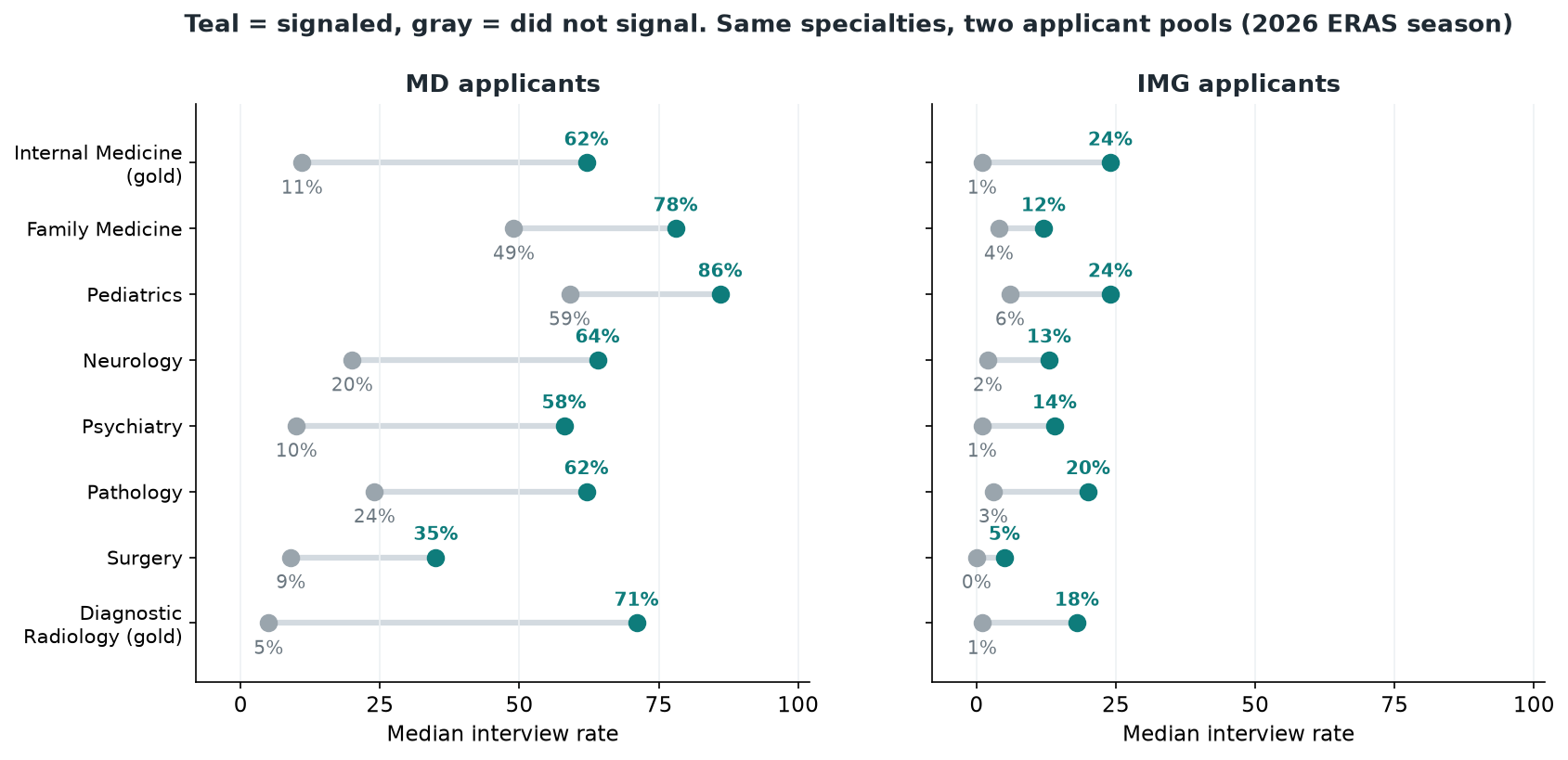
The numbers say they go with higher interview rates. In internal medicine the median program interviewed 24% of IMGs who sent a gold signal and 1% of those who did not signal. In family medicine it was 12% with a signal and 4% without.
2. Are the rates high?
No. Even with a gold signal, IMG medians were 24% or less in every specialty the AAMC reported. MD medians with a signal ran from 35% to 86% in the same table. That points to a longer, more careful list, not to skipping signals.
3. Why can one median mislead me?
In these tables, IMGs are one group. US citizens who studied abroad, non-US citizens who need a visa and Caribbean graduates are all counted together. Programs treat them differently, so the median blends very different situations. It also hides where IMGs really get interviews: programs that train many international graduates can sit far above the specialty median.
4. Do IMGs send fewer signals?
Among applicants who signaled, IMGs sent slightly fewer on average in several specialties. In orthopaedic surgery it was 23.1 against 29.1 for MDs, in urology 24.3 against 29.6 and in PM&R 15.4 against 19.2. The data does not say why. The average in every group is close to the maximum, so leaving signals unused is unusual.
5. Where are IMGs applying?
In the October 2026 snapshot, 12,843 IMG applicants applied to internal medicine and 6,885 to family medicine. Applicants can appear in more than one specialty, so do not add the numbers up. Internal medicine programs received an average of 54 IMG gold signals each.
6. Should I hold some signals back?
No. The no-signal medians for IMGs are too low to justify it.
7. What should I do first?
Research programs, not specialties. Look at each program's IMG share among current residents, its visa policy and its graduation-year limits. Our specialty pages show IMG share and visa sponsorship for every program.
Want the full numbers?
Our guide has the whole table, the IMG vs. MD signal use and what the data cannot tell you: IMG guide to residency program signals. For the bigger picture, see Do residency program signals get you interviews?, the gold vs. silver guide and our post on the best specialties to match as an IMG.
Sources: AAMC, ERAS Program Signal and Interview Invitation, 2026 Residency; AAMC ERAS Statistics, 2027.