

Year of Graduation Cut-offs: How Many Residency Programs Limit Time Since Med School?
42% of US residency programs list a maximum time since medical school graduation. We looked at which specialties set these limits, how strict they are and where older graduates still have options.

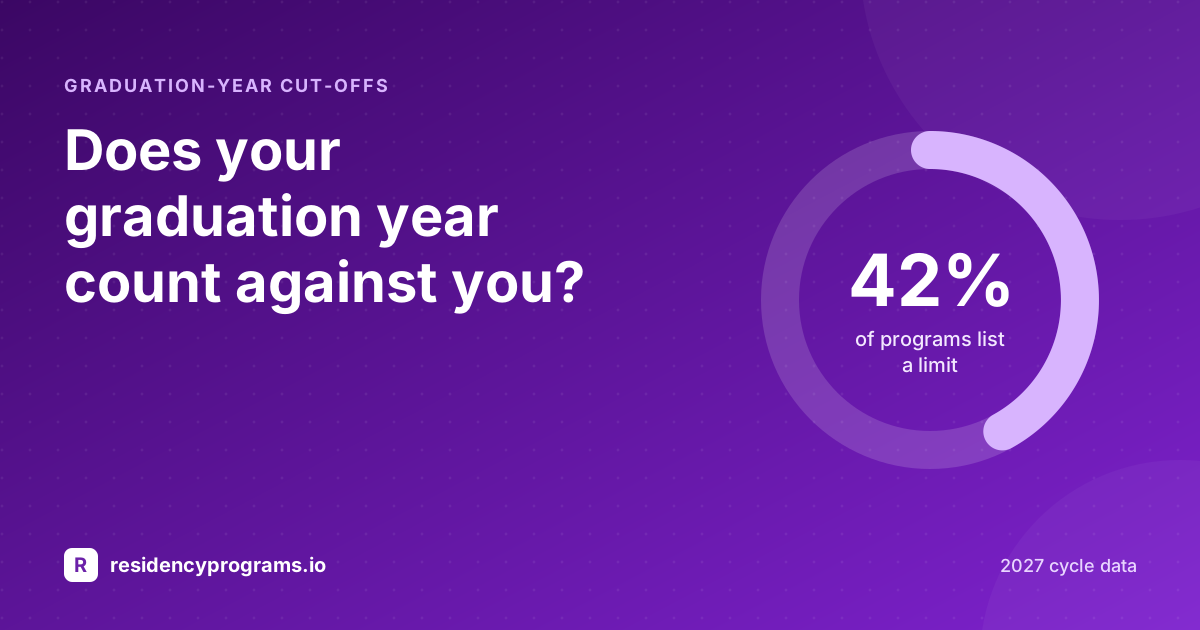
- 2,315 of 5,487 programs (42%) list a maximum time since medical school graduation. The rest list no limit.
- Family medicine is the strictest specialty by far: 90% of programs list a limit, and most of those want you within three years of graduating.
- The most common limits are 5 years (917 programs), 2 years (509) and 3 years (498).
- Pathology is the most open of the larger specialties for older graduates. Half its programs list no limit, and almost all that do accept a gap of four years or more.
- Competitive specialties rarely set a graduation limit (3% to 7% in dermatology, ophthalmology, otolaryngology, urology and neurosurgery). Their other filters already do that job.
Ask a room of IMGs which rule worries them most and many will name this one: "graduated within the last X years". It is a quiet filter. It rarely appears in rankings or Match reports, and you only find it by reading each program's requirements one by one. For an applicant who spent a few years working, doing research or waiting for a visa, it can rule out a large share of the country.
We pulled the graduation-year limits that residency programs list for the 2027 cycle to see how common they are, which specialties use them and how strict they get.
What a graduation-year limit is
A graduation-year limit, often called a "year of graduation" or YOG cut-off, is the longest gap a program accepts between your medical school graduation and the start of residency or the date you apply. A program with a three-year limit might accept a 2024 graduate for the 2027 cycle and screen out a 2021 graduate.
Programs give a few reasons: clinical skills fade without practice, recent graduates adapt faster to residency, and hospital or state policies may require recent training. Whatever the reason, the effect is the same. If you are past the limit, the program's screening software may drop your application before a person ever reads it.
How many programs set one
Of the 5,487 programs in our database with requirement data, 2,315 (42%) list a maximum time since graduation. The other 3,172 list no limit. That is good news in one sense: a majority of programs do not set a hard number. But the limits are not spread evenly. They cluster in exactly the specialties where most IMGs apply.
Limits by specialty
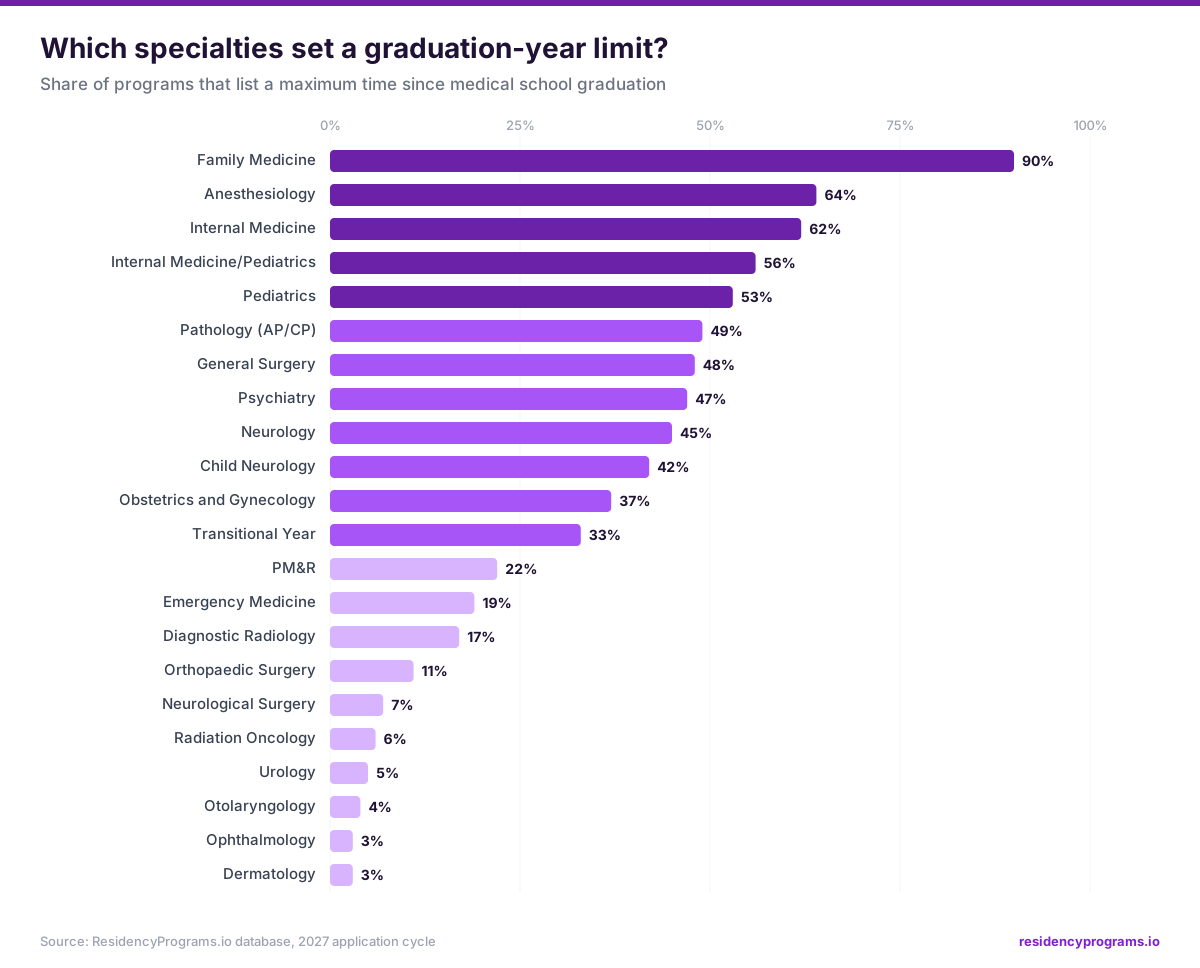
Family medicine stands far above the rest: 708 of its 791 programs list a limit. Anesthesiology (64%), internal medicine (62%), internal medicine/pediatrics (56%) and pediatrics (53%) follow. In each of those, at least half the programs set a number.
At the bottom are the most competitive specialties. Only 3% of dermatology and ophthalmology programs list a limit, and neurological surgery, radiation oncology, urology and otolaryngology are all under 10%. This is not because they are more welcoming to older graduates. Their applicants are mostly recent US graduates already, and score and research expectations do the filtering.
Emergency medicine (19%) and diagnostic radiology (17%) are two larger specialties where most programs do not list a limit.
How strict: 1 year, 3 years or 5 years?
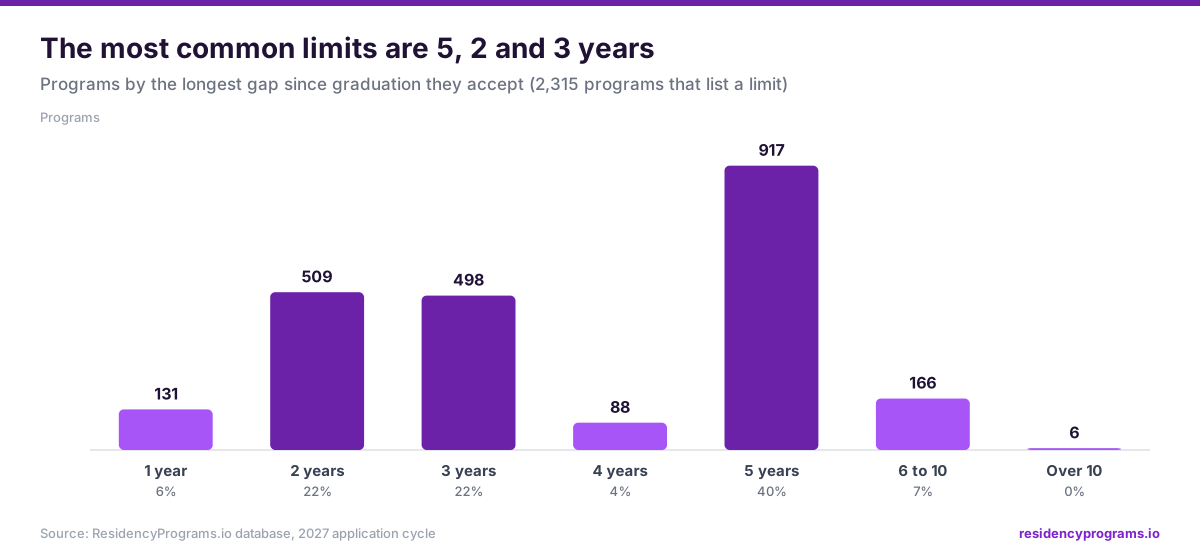
Five years is the most common limit by a wide margin (917 programs, 40% of those with a limit). Two-year and three-year limits come next, at about 22% each. Only 131 programs, about 6%, insist on graduation within a year, and 172 accept a gap of more than five years.
The mix changes a lot by specialty:
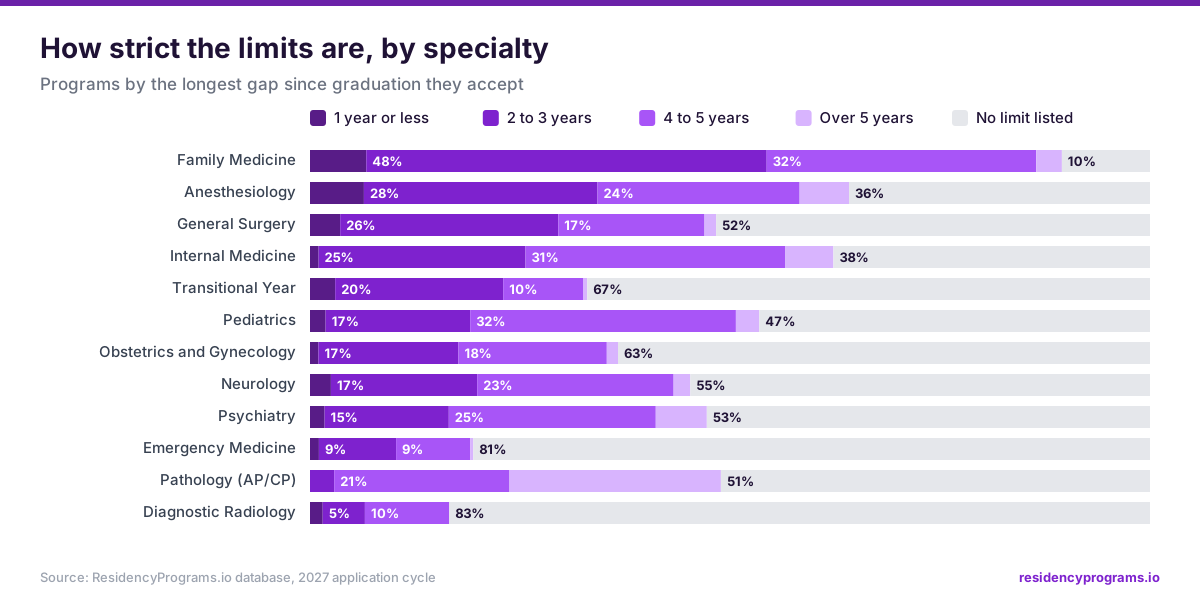
- Family medicine: the strictest. 377 programs want graduation within two to three years and another 53 within a year. Only 83 programs list no limit.
- Internal medicine: more forgiving than its 62% headline suggests. The most common band is four to five years (211 programs), and 257 programs list no limit.
- General surgery and transitional year: fewer programs set a limit, but those that do tend to want two to three years.
- Psychiatry and pediatrics: about half list a limit, mostly four to five years.
- Pathology: 35 of the 68 programs with a limit accept more than five years, the highest share of any specialty.
If you graduated more than five years ago
Being more than five years out narrows your list, but it does not empty it. The table counts programs that either list no limit or accept a gap of five years or more, and how many of those also sponsor a visa.
| Specialty | Programs | No limit or 5+ years | ...and sponsor a visa |
|---|---|---|---|
| Internal Medicine | 682 | 488 (72%) | 369 |
| Psychiatry | 345 | 280 (81%) | 198 |
| General Surgery | 362 | 248 (69%) | 184 |
| Emergency Medicine | 283 | 250 (88%) | 180 |
| Obstetrics and Gynecology | 300 | 242 (81%) | 174 |
| Family Medicine | 791 | 341 (43%) | 173 |
| Pediatrics | 215 | 169 (79%) | 154 |
| Diagnostic Radiology | 199 | 184 (92%) | 146 |
| Neurology | 201 | 158 (79%) | 138 |
| Pathology (Anatomic and Clinical) | 139 | 133 (96%) | 124 |
| Anesthesiology | 187 | 118 (63%) | 99 |
Programs with requirement data for the 2027 cycle. "Sponsor a visa" means the J-1, the H-1B or both.
Internal medicine is the clear leader in raw numbers: 369 programs list no tight limit and sponsor a visa. Pathology is the most open in relative terms, with 96% of programs either listing no limit or accepting five years or more. Family medicine, despite its size, drops to fewer than half of its programs.
Keep in mind that the specialties with high "open" rates, such as diagnostic radiology and emergency medicine, are often competitive for other reasons. An open graduation policy does not make a program easy to match.
A few things help when you are further from graduation:
- Recent clinical work. Hands-on US clinical experience in the last year or two answers the main worry behind these limits. Some programs make exceptions for applicants who have kept practising.
- A clear account of the gap. Research, clinical work abroad, family duties or visa delays are all normal. Say what you did in one or two plain sentences in your personal statement.
- Recent exam scores. A Step 2 CK or Step 3 taken recently shows your knowledge is current.
- A focused list. Concentrate on programs with no limit or a five-year limit, and on the specialties in the table above.
How to check a program's limit
Graduation-year limits are easy to miss because programs post them in different places, if at all. The ResidencyPrograms.io dashboard shows the limit for every program that lists one. Once you enter your graduation date, it flags programs where you are past the cut-off, along with visa and score requirements you do not meet.
Check this before you spend a program signal as well. A signal sent to a program that screens you out on graduation year is lost. Our IMG guide to program signals explains how to place signals where they can count.
About the data
Figures come from the ResidencyPrograms.io database for the 2027 application cycle, built from program-reported requirements and checked in October 2026. Limits are recorded in months and rounded up to whole years, so a 30-month limit counts as three years. Programs that report no limit, or did not report one, count as "no limit listed". Specialty figures include specialties with at least 40 programs. Requirements change and some programs make exceptions, so confirm with the program before ruling it in or out.