

Which Residency Programs Sponsor H-1B vs. J-1 Visas? Data by Specialty
We checked the visa policy of 5,900 US residency programs. 72% sponsor the J-1, 16% sponsor the H-1B and 28% sponsor neither. Here is how that breaks down by specialty, state and type of program.

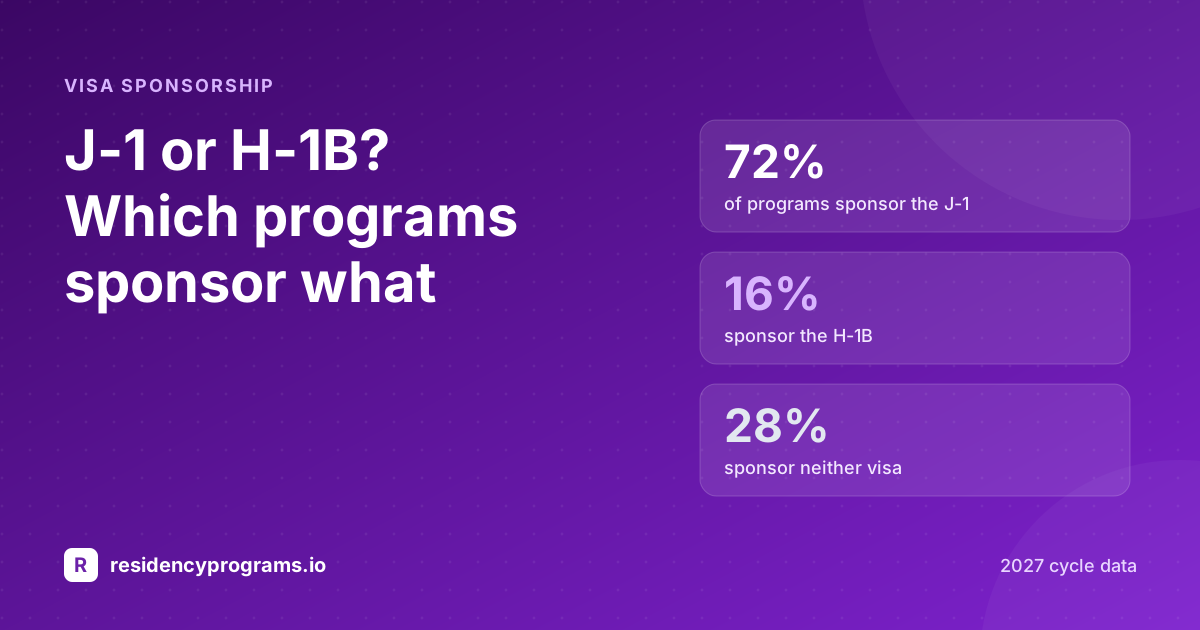
- Of 5,900 residency programs that state a visa policy for the 2027 cycle, 4,225 (72%) sponsor the J-1 and 941 (16%) sponsor the H-1B. 1,642 programs (28%) sponsor neither.
- The H-1B is almost always offered on top of the J-1, not instead of it. Only 33 programs offer the H-1B alone.
- H-1B sponsorship is most common in smaller specialties such as neurological surgery (32%) and radiation oncology (31%), and rare in family medicine (7%) and transitional year (6%).
- University-based programs are almost four times as likely as community programs to sponsor the H-1B (23% vs. 6%).
- New York, Pennsylvania, California and Massachusetts hold about 4 in 10 of all H-1B programs.
If you need a visa to train in the United States, one question decides whether a program belongs on your list at all: will it sponsor you? It is worth answering before you look at reputation, location or scores, because a program that cannot sponsor you costs an application fee and gives nothing back.
We looked at the visa policy of every accredited residency program in the ResidencyPrograms.io database for the 2027 application cycle. Here is what they report, and what it means for where you apply.
Most programs sponsor the J-1
Our database covers 6,009 programs. 5,900 of them state whether they sponsor visas. The split looks like this:
| Visa policy | Programs | Share |
|---|---|---|
| Sponsor the J-1 (with or without the H-1B) | 4,225 | 72% |
| Sponsor the H-1B (with or without the J-1) | 941 | 16% |
| Both J-1 and H-1B | 908 | 15% |
| J-1 only | 3,317 | 56% |
| H-1B only | 33 | under 1% |
| No visa sponsorship | 1,642 | 28% |
Share of the 5,900 programs that report a visa policy for the 2027 cycle.
Two things stand out. The J-1 is the default: nearly three out of four programs will take a J-1 resident. And the H-1B almost never stands alone. Of the 941 programs that offer it, 908 also offer the J-1. If a program sponsors the H-1B, you can usually assume it handles J-1 residents as well.
J-1 vs. H-1B: what the difference means for you
The two visas lead to very different places after training, which is why many applicants care which one a program offers.
| J-1 (exchange visitor) | H-1B (temporary worker) | |
|---|---|---|
| Who sponsors it | ECFMG sponsors all J-1 physicians in clinical training. The program agrees to take you. | The hospital files a petition as your employer. |
| Exams | ECFMG certification. | ECFMG certification, and in practice a passed Step 3 before the petition is filed. |
| After training | Two years in your home country, unless you get a waiver (for example a Conrad 30 job in an underserved area). | No home-country requirement. You can move toward a green card. |
| Cost and effort for the program | Low. ECFMG runs the sponsorship. | Higher. Legal work, filing fees and timing risk. |
That last row explains most of the gap in the numbers. A J-1 resident costs a program very little extra, because ECFMG's Exchange Visitor Sponsorship Program handles the sponsorship. An H-1B means the hospital takes on the paperwork and fees itself, and it has to be ready to wait on government processing before your start date.
The H-1B also carries extra uncertainty right now. In September 2025 a presidential proclamation added a $100,000 payment to many new H-1B petitions. A federal court blocked the policy in June 2026, an appeal is still pending, and a September 2026 proclamation extended it on paper through September 2027. If a program lists H-1B sponsorship, ask whether that still applies to residents starting in July 2027, and check the USCIS H-1B page for the current rules.
Visa sponsorship by specialty
Specialty makes a large difference, and not in the direction most people expect.
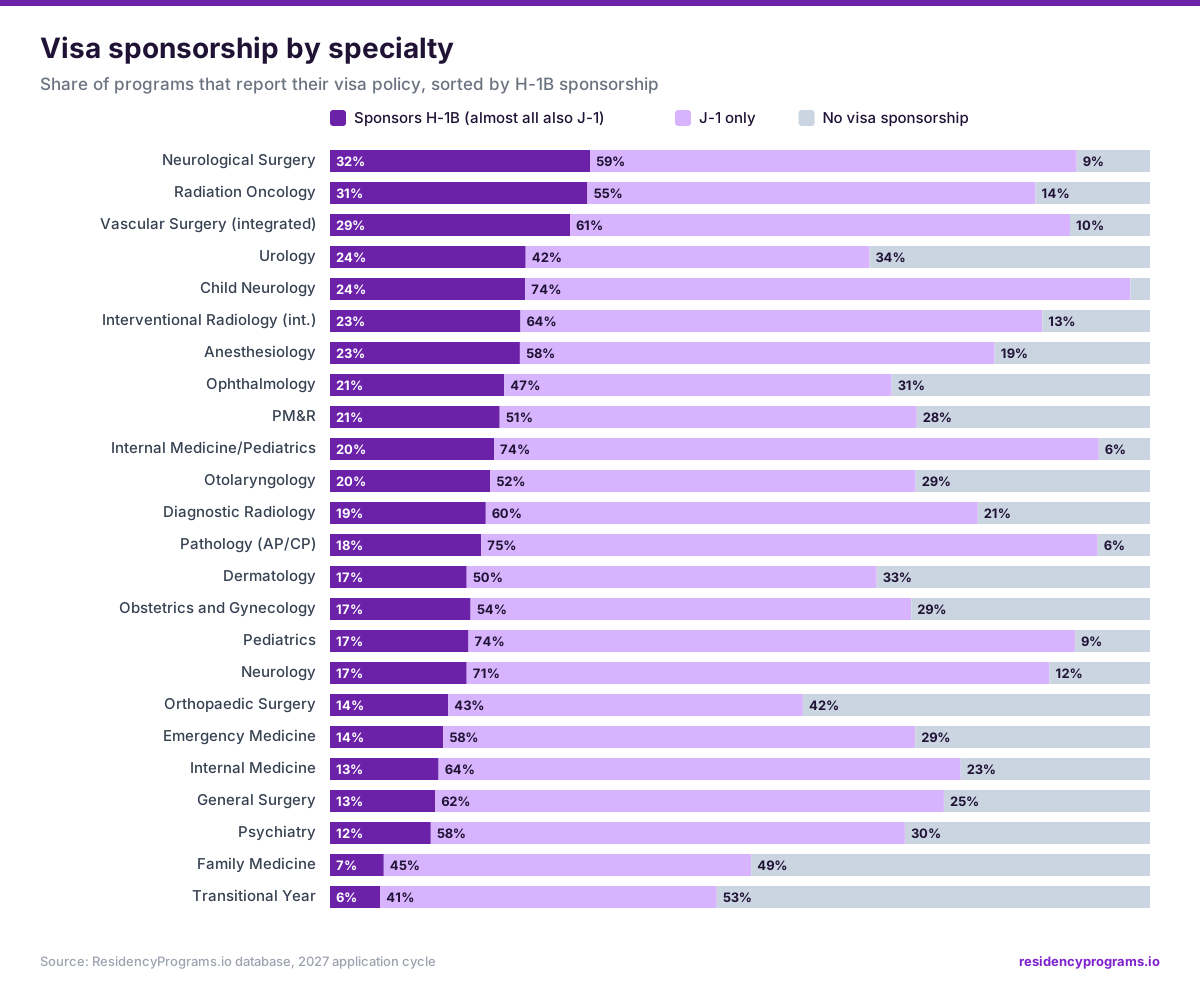
The specialties with the highest H-1B rates are small and academic: neurological surgery (32%), radiation oncology (31%) and integrated vascular surgery (29%). These programs sit mostly in large university hospitals with legal teams that already file H-1B petitions for faculty and researchers.
At the other end, transitional year has the highest share of programs that sponsor no visa at all (53%), followed by family medicine (49%) and orthopaedic surgery (42%). Child neurology (98%), pathology (94%), internal medicine/pediatrics (93%) and pediatrics (91%) are the most likely to accept the J-1.
Percentages only tell half the story, though. Internal medicine sponsors the H-1B at just 13% of its programs, but because it is by far the largest specialty, that is 93 programs, more than any other specialty. Obstetrics and gynecology and family medicine each have 53 H-1B programs, and general surgery has 47. If you need an H-1B, the large specialties still hold most of your options in raw numbers.
University programs vs. community programs
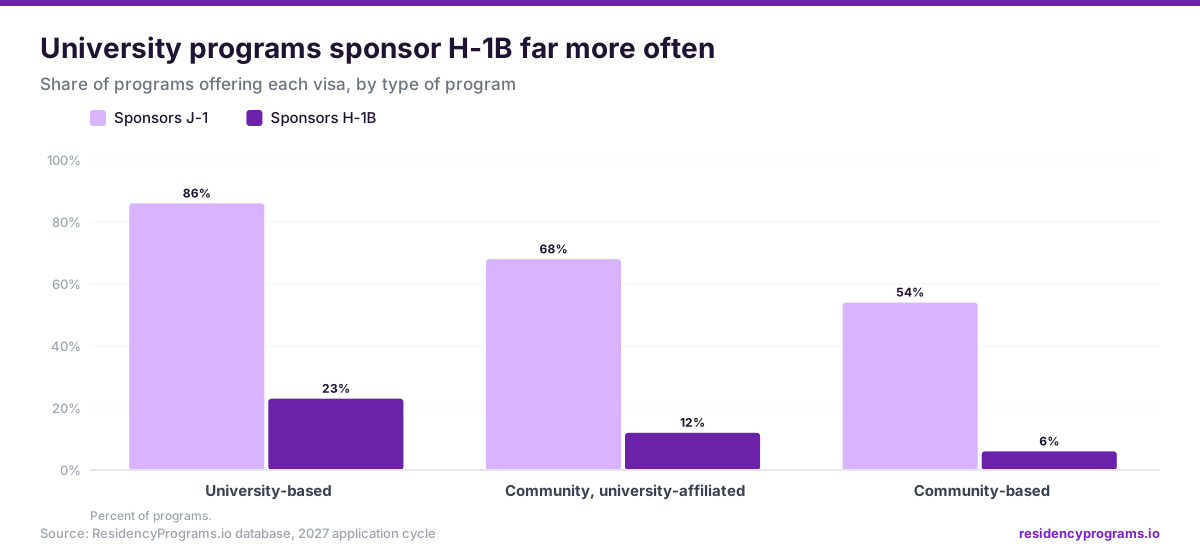
23% of university-based programs sponsor the H-1B, against 12% of university-affiliated community programs and 6% of community-based programs. The J-1 follows the same pattern: 86%, 68% and 54%.
This surprises a lot of applicants, because community programs train more IMGs. The average community-based program's residents are 32% IMGs, against 12% at university-based programs. The explanation is that many IMGs in community programs do not need a visa: they are US citizens who studied abroad, or permanent residents. Programs with no visa sponsorship still average 17% IMG residents, but only 5% are non-US IMGs. In programs that sponsor the J-1 only, non-US IMGs make up 15%.
So a high IMG share is not proof that a program sponsors visas. Check the visa policy on its own.
Where the H-1B programs are
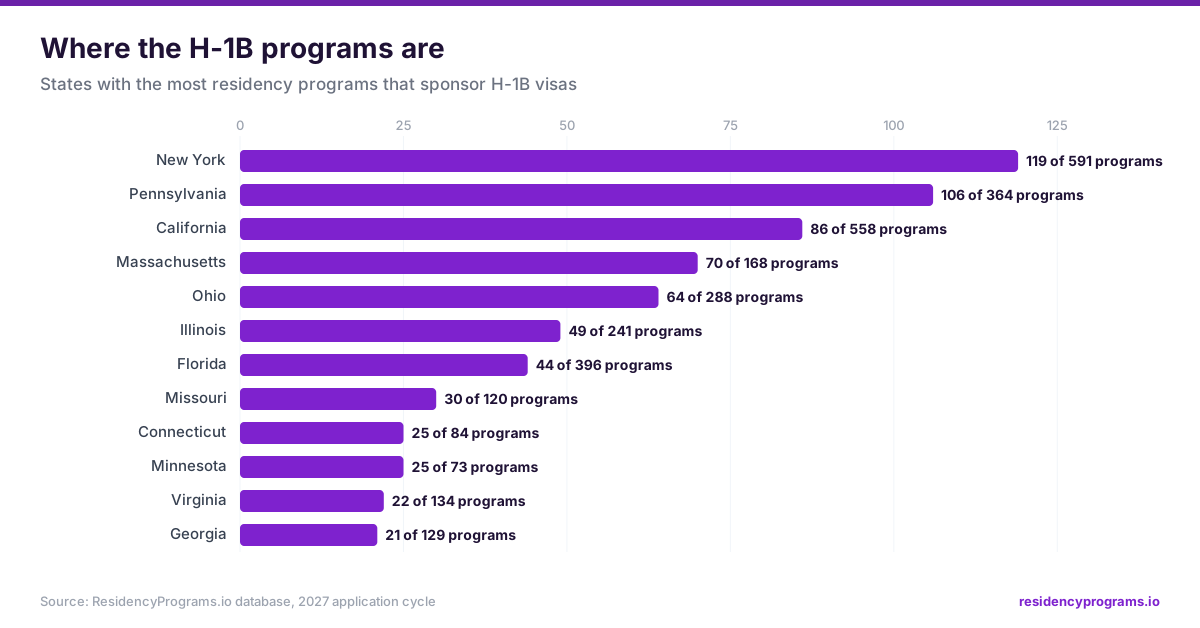
New York (119 programs), Pennsylvania (106), California (86) and Massachusetts (70) together hold 381 of the 941 H-1B programs. Massachusetts stands out for its rate: 42% of its programs sponsor the H-1B. Oregon is higher still at 47%, though with only 21 programs.
Some large states are much harder. Texas has 397 programs and only 21 of them sponsor the H-1B (5%). Florida has 396 programs and 44 H-1B sponsors (11%). Both still take many J-1 residents (255 and 266 programs).
What the 2026 Match says about needing a visa
Visa needs show up clearly in Match results. In the NRMP's 2026 Main Residency Match report, non-US citizen IMGs who needed visa sponsorship matched to a first-year position at a rate of 54.4%, a five-year low. Non-US IMGs who did not need sponsorship matched at 67.9%.
A gap of more than 13 points is a strong reason to build your list around sponsorship from the start, rather than finding out in February that more than a quarter of your programs could never rank you.
How to use this when you build your list
- Filter first. Start every specialty search by removing programs that do not sponsor your visa. Our specialty pages show J-1 and H-1B status for every program, so you can see the options in a specialty at a glance.
- Decide how much the H-1B matters to you. If you need it, you are choosing from about 16% of programs, so apply broadly within that group and plan to pass Step 3 before the season starts. If the J-1 is acceptable, your list can be about four times larger.
- Confirm every year. Visa policies change between cycles, and H-1B policies are especially likely to change while the federal fee question is open. A short email to the program coordinator settles it.
- Do not spend signals on programs that cannot take you. A program signal is wasted on a program that will not sponsor your visa. Our IMG guide to program signals covers how to place them.
- Count the cost. Every program you cut for visa reasons is a fee you do not pay. The ERAS fees calculator shows what a list of a given size costs.
About the data
All figures come from the ResidencyPrograms.io database for the 2027 application cycle, built from program-reported data and checked in October 2026. A program counts as sponsoring a visa when it reports that it does for this cycle. 109 programs did not report a visa policy and are left out of the percentages. Specialty figures include specialties with at least 80 programs. Visa policies change, so always confirm with the program before you apply.