

The Most IMG-Friendly Residency Programs by Specialty (2027 Data)
Which specialties and programs train the most international medical graduates? We ranked 5,525 programs by the share of current residents who are IMGs.
- Across 5,525 programs with resident data, IMGs make up 21% of the average program's residents. That average hides a split: 2,052 programs (37%) have no IMG residents at all, while 973 (18%) are at least half IMG.
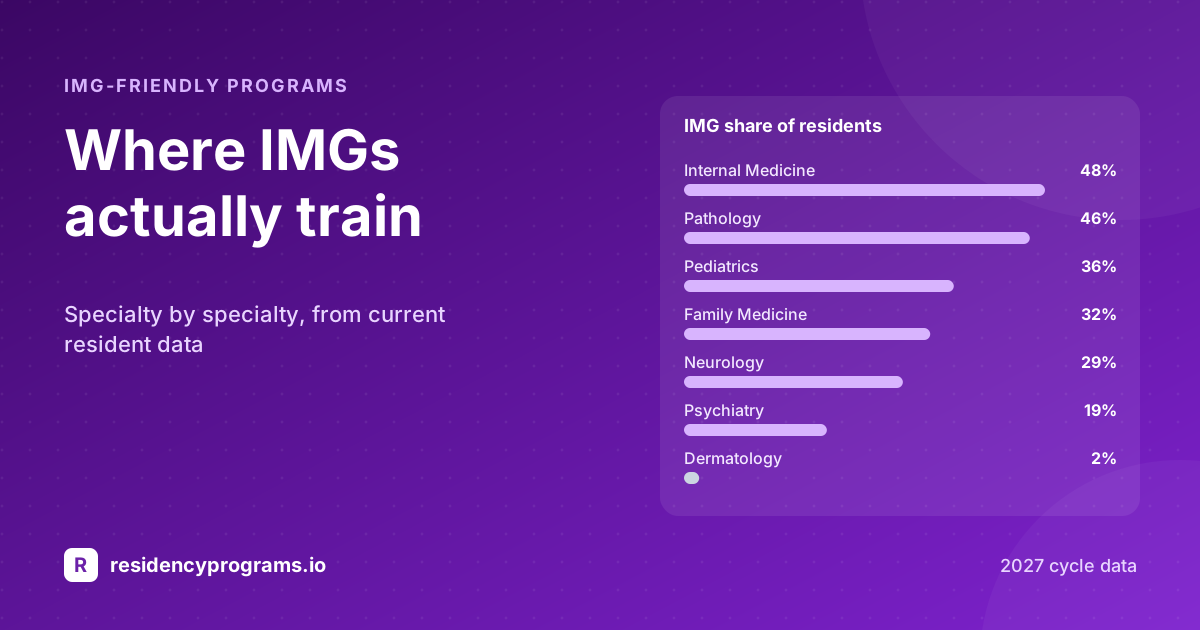
- Internal medicine (48%), pathology (46%), pediatrics (36%) and family medicine (32%) have the highest IMG shares. Dermatology, orthopaedic surgery and otolaryngology are all at 2% or less.
- Internal medicine alone has 332 programs where IMGs are half or more of the residents.
- A high IMG share is a good sign, not a promise. Check visa sponsorship, graduation-year limits and score cut-offs too.
- Below are the programs with the highest IMG share in nine specialties.
"IMG-friendly" gets used loosely. Some lists call a program friendly because it once interviewed an international graduate. Others use a single badge with no explanation. We wanted a number you can check, so this article uses one measure: what share of a program's current residents are international medical graduates.
If a program has trained many IMGs in recent years, it knows how to read your application, it has residents who took the same path, and its faculty are used to the paperwork. That is about as close to "friendly" as data can get.
What "IMG-friendly" means here
For each program we take the share of current residents who went to medical school outside the US and Canada. That includes US citizens who studied abroad (US IMGs) and non-US citizens (non-US IMGs). We use the 2027 cycle data in the ResidencyPrograms.io database, which has resident figures for 5,525 accredited programs.
Two cautions. First, the share describes the residents a program already has, not a quota for next year. Second, small programs swing a lot: one IMG in a class of four is 25%. In the program tables below we only include programs with at least four first-year positions.
IMG share by specialty
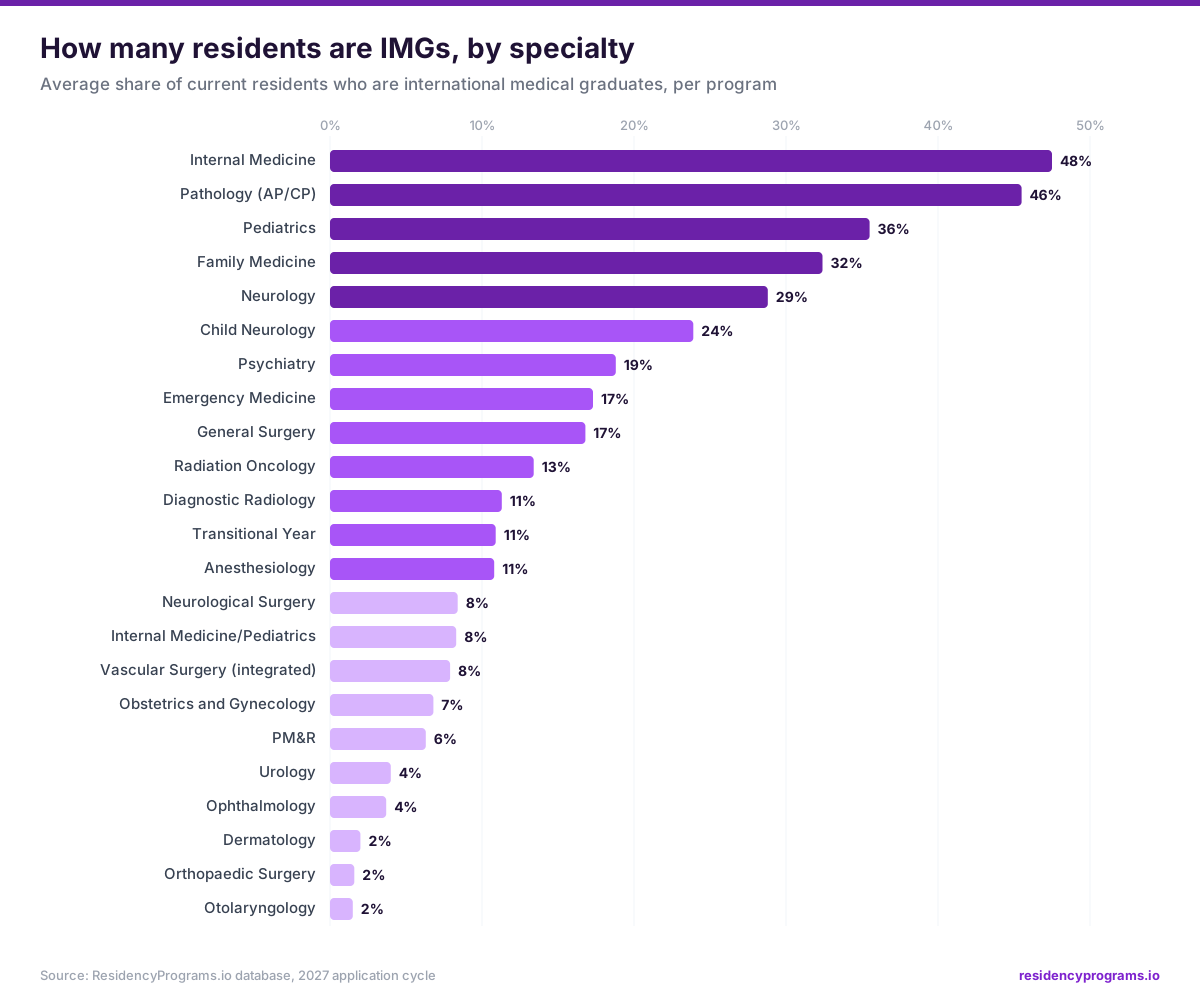
The ranking will not shock anyone who has looked at Match data, but the size of the gaps is worth seeing. In internal medicine, the average program's residents are 48% IMGs. In orthopaedic surgery it is under 2%.
Pathology deserves more attention than it gets. It sits right behind internal medicine at 46%, and 58 of its 140 programs are at least half IMG. It is a smaller specialty with fewer positions, but for applicants who like diagnostic work it is one of the most open fields in the country.
Neurology (29%) and child neurology (24%) are the next tier. Psychiatry (19%), emergency medicine (17%) and general surgery (17%) are moderate. Anesthesiology (11%) sits just above 10%. Below that line an IMG resident is the exception: obstetrics and gynecology, for example, is at 7%.
Most programs have few IMGs, and some are mostly IMG
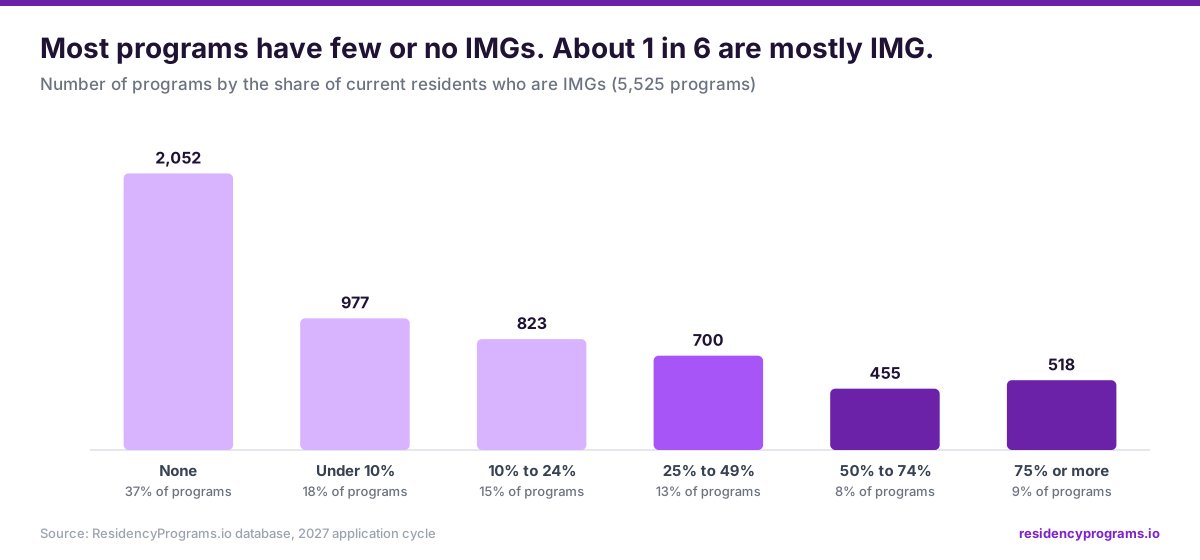
This is the most useful chart in the article. More than a third of programs have no IMG residents at all, and another 18% have fewer than one in ten. At the same time, 518 programs have residents who are at least 75% IMGs.
In practice, your realistic list as an IMG is a few hundred programs, not six thousand. Sending applications to programs with no IMG history is usually money spent for very little return, unless you have a specific connection to the program.
The most IMG-friendly programs in nine specialties
These are the programs with the highest IMG share of current residents, among programs with at least four first-year positions. Where programs tie at 100%, the larger ones come first. Many more programs are close behind, so treat these as a starting point.
| Program | Location | IMG share | Positions | Visas |
|---|---|---|---|---|
| Internal Medicine | ||||
| Jamaica Hospital Medical Center | Jamaica, NY | 100% | 30 | None |
| Capital Health Regional Medical Center | Trenton, NJ | 100% | 25 | None |
| Woodhull Medical and Mental Health Center | Brooklyn, NY | 100% | 24 | J-1, H-1B |
| Piedmont Athens Regional | Athens, GA | 100% | 21 | J-1, H-1B |
| Jacobi Medical Center/North Central Bronx Hospital | Bronx, NY | 100% | 20 | J-1, H-1B |
| Family Medicine | ||||
| Larkin Community Hospital | South Miami, FL | 100% | 14 | J-1 |
| AdventHealth Florida (Ocala) | Ocala, FL | 100% | 8 | J-1, H-1B |
| Aiken Regional Medical Centers | Aiken, SC | 100% | 8 | None |
| Catholic Health/St Joseph Hospital | Bethpage, NY | 100% | 8 | J-1 |
| Conemaugh Memorial Medical Center | Johnstown, PA | 100% | 6 | J-1 |
| Pediatrics | ||||
| Lincoln Medical and Mental Health Center | Bronx, NY | 100% | 17 | J-1 |
| BronxCare Health System | Bronx, NY | 100% | 14 | J-1 |
| Brooklyn Hospital Center | Brooklyn, NY | 100% | 11 | J-1 |
| Saint Peter's University Hospital | New Brunswick, NJ | 100% | 8 | J-1 |
| New York Medical College (Metropolitan) | New York, NY | 100% | 7 | J-1, H-1B |
| Psychiatry | ||||
| One Brooklyn Health System/Interfaith Medical Center | Brooklyn, NY | 100% | 5 | J-1 |
| Larkin Community Hospital | South Miami, FL | 95% | 13 | J-1 |
| Icahn School of Medicine at Mount Sinai/NYC Health and Hospitals (Elmhurst) | New York, NY | 95% | 11 | J-1, H-1B |
| Citrus Health Network | Hialeah, FL | 92% | 4 | None |
| Harlem Hospital Center | New York, NY | 90% | 7 | J-1 |
| Neurology | ||||
| Louisiana State University (Shreveport) | Shreveport, LA | 100% | 5 | J-1 |
| Doctors Hospital at Renaissance | Edinburg, TX | 100% | 4 | J-1 |
| Old Dominion University | Norfolk, VA | 100% | 4 | J-1 |
| Larkin Community Hospital | South Miami, FL | 100% | 4 | J-1 |
| Larkin Community Hospital Palm Springs Campus | Hialeah, FL | 94% | 4 | J-1 |
| Pathology (Anatomic and Clinical) | ||||
| SUNY Downstate Health Sciences University | Brooklyn, NY | 100% | 7 | J-1 |
| Temple University Hospital | Philadelphia, PA | 100% | 4 | J-1, H-1B |
| Rush University Medical Center | Chicago, IL | 94% | 4 | J-1 |
| Louisiana State University (Shreveport) | Shreveport, LA | 93% | 4 | None |
| Hartford Hospital | Hartford, CT | 92% | 4 | J-1 |
| General Surgery | ||||
| Wyckoff Heights Medical Center | Brooklyn, NY | 82% | 4 | None |
| Maimonides Medical Center | Brooklyn, NY | 71% | 4 | J-1 |
| Desert Regional Medical Center | Palm Springs, CA | 67% | 4 | None |
| Cleveland Clinic Foundation/Florida (Weston) | Weston, FL | 67% | 4 | J-1, H-1B |
| HCA Healthcare/Mercer University School of Medicine/Trident | Charleston, SC | 67% | 4 | J-1 |
| Emergency Medicine | ||||
| Doctors Hospital at Renaissance | Edinburg, TX | 100% | 6 | J-1 |
| Rutgers Health/Newark Beth Israel Medical Center | Newark, NJ | 88% | 8 | J-1 |
| Catholic Health/Good Samaritan University Hospital | West Islip, NY | 82% | 10 | J-1 |
| Bayhealth Medical Center | Dover, DE | 82% | 6 | J-1 |
| Mercy Health St Rita's Medical Center | Lima, OH | 78% | 6 | J-1 |
| Anesthesiology | ||||
| New York Medical College at Metropolitan Hospital | New York, NY | 100% | 5 | J-1 |
| New York Medical College/St. Mary and St. Clare | Passaic, NJ | 72% | 6 | J-1 |
| Cook County Health and Hospitals System | Chicago, IL | 68% | 9 | J-1, H-1B |
| UMass Chan, Baystate | Springfield, MA | 56% | 6 | J-1 |
| Zucker School of Medicine at Hofstra/Northwell at South Shore University Hospital | Bay Shore, NY | 50% | 6 | J-1 |
IMG share: share of current residents who are IMGs. Positions: first-year positions offered. Visas: what the program reports sponsoring for the 2027 cycle ("None" means it reports no visa sponsorship).
A few patterns show up across the tables. New York City appears again and again, especially public and safety-net hospitals in Brooklyn and the Bronx. South Florida is the other cluster: Larkin Community Hospital appears in three specialties. And several programs with an all-IMG resident group report no visa sponsorship at all, which tells you their residents are mostly US citizens who studied abroad or permanent residents.
Surgery is the notable outlier. Even the most IMG-heavy surgery programs are well below the top programs in medicine, and most are small.
US IMG or non-US IMG: why the difference matters
"IMG" covers two groups whose odds are very different. In the NRMP's 2026 Main Residency Match report, US citizen IMGs matched to a first-year position at a rate of 70.0%. Non-US citizen IMGs matched at 56.4%, the lowest level in five years.
Across all programs in our data, about 10% of first-year positions are held by US IMGs and about 14% by non-US IMGs. The split varies a lot by program. If you are a non-US citizen, look for programs that both train many IMGs and sponsor your visa. A program can be 100% IMG and still be closed to you if it does not sponsor visas.
How to judge a program beyond the IMG share
A high IMG share puts a program on your list. These checks decide whether it stays there:
- Visa sponsorship. If you need a J-1 or H-1B, this comes first.
- Graduation-year limit. Many IMG-heavy programs, especially in family medicine and internal medicine, only accept applicants who graduated within a set number of years.
- Score cut-offs. Some programs screen on a minimum Step 2 CK score and treat it as strict.
- US clinical experience. Many programs that train IMGs expect a few months of hands-on US clinical work.
The ResidencyPrograms.io dashboard checks all of these against your profile and flags the programs you do not qualify for. Its Affinity Score shows how well each program matches your personal profile, based on the program's current residents. For a quick look first, the specialty pages list the IMG share and visa policy of every program.
About the data
Figures come from the ResidencyPrograms.io database for the 2027 application cycle, built from program-reported data and checked in October 2026. IMG share is the share of current residents who are US or non-US IMGs. Specialty averages count each program once, whatever its size, and include specialties with at least 40 programs. Some programs report shares slightly above 100% because of rounding; we show these as 100%. Program tables include programs with at least four first-year positions. Data can lag behind a program's latest class, so confirm details with the program.