

Community vs. University Residency Programs: Where IMGs Match
Community programs have three times the IMG share of university programs, but university programs sponsor visas more often and get fewer applicants per position. Here is how the three types of program compare.

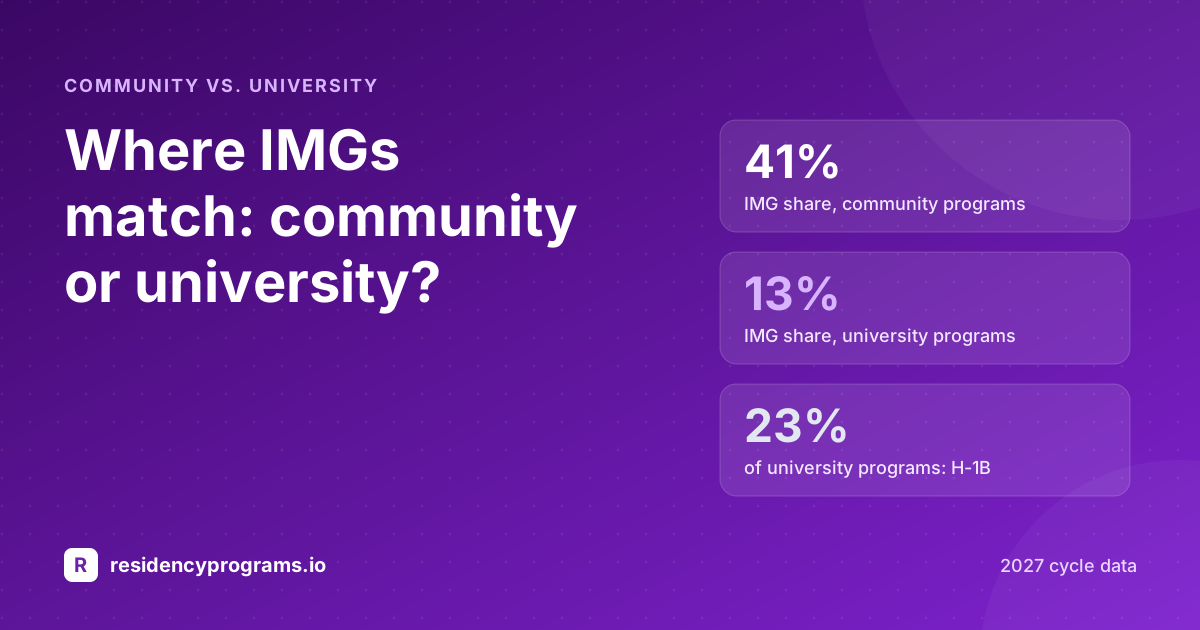
- Community programs have far more IMG residents. In community-based programs about 41% of residents are IMGs, against 13% in university-based programs.
- The middle group, community programs affiliated with a university, trains almost half of all IMG residents (48%). University-based and purely community programs train about 23% each.
- University programs are the better bet for visas: 86% sponsor the J-1 and 23% the H-1B, against 54% and 6% at community-based programs.
- University programs also get fewer applicants per position (76 against 143) and are less likely to list a graduation-year limit (33% against 54%).
- The best list for most IMGs mixes all three types, weighted by visa needs, graduation year and specialty.
"Apply to community programs" is one of the first pieces of advice most IMGs hear. It is not wrong, but it is incomplete. Community and university programs differ in more than their IMG share: they differ in visa policy, graduation limits, competition per position and the kind of training you get. Picking the wrong mix can cost you interviews you could have had.
We compared the three main types of residency program in the ResidencyPrograms.io database for the 2027 cycle: university-based, community-based with a university affiliation, and community-based. Here is who trains at each.
The three types of program
ACGME lists an institutional setting for each program. Three settings cover almost all of them:
| Type of program | Programs | Positions | Average size |
|---|---|---|---|
| University-based | 2,360 | 17,221 | 8.2 |
| Community-based, university-affiliated | 1,990 | 13,623 | 7.7 |
| Community-based | 955 | 5,681 | 6.8 |
University-based programs sit in academic medical centers, usually attached to a medical school. Community-based, university-affiliated programs are run by community hospitals with a formal link to a university, often for rotations, faculty or research. Community-based programs are run by community hospitals on their own. A further 700 or so programs are military, "other" or do not state a setting; we leave them out of the comparisons.
Where IMGs train
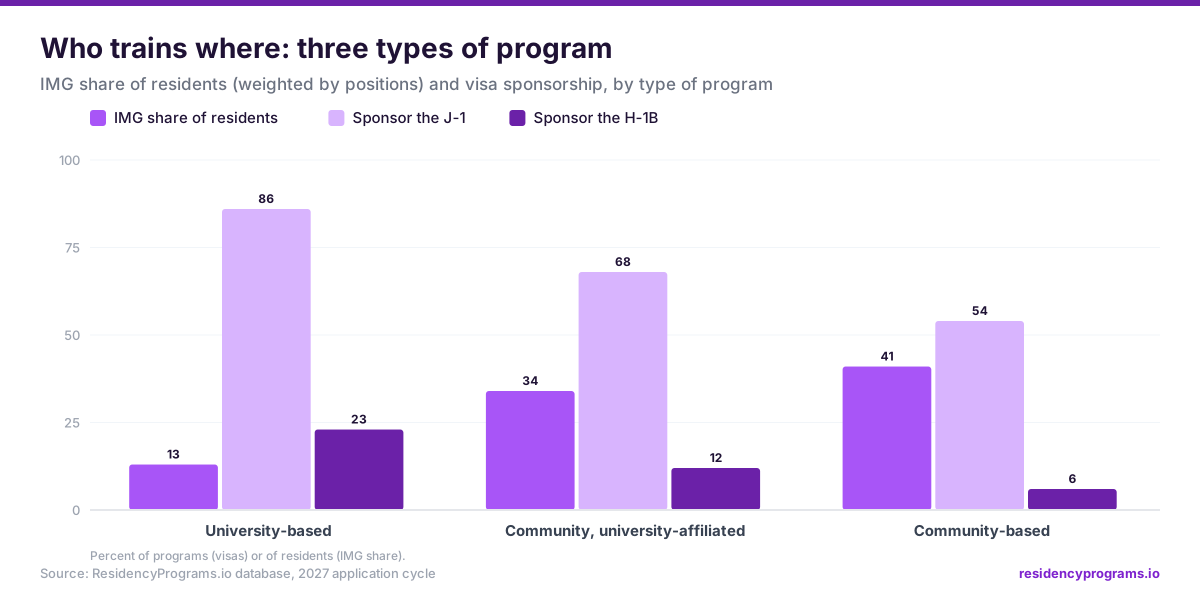
The IMG share rises steadily as you move away from the university. Weighted by the number of positions, IMGs make up 13% of residents in university-based programs, 34% in affiliated community programs and 41% in community-based programs.
The gap is even clearer at the extremes. Only 7% of university-based programs have a majority of IMG residents, against 25% of affiliated community programs and 31% of community-based ones. And 42% of university-based programs have no IMG residents at all.
But share is not the same as number. Because university programs are larger and more numerous, they still train a large share of all IMG residents:
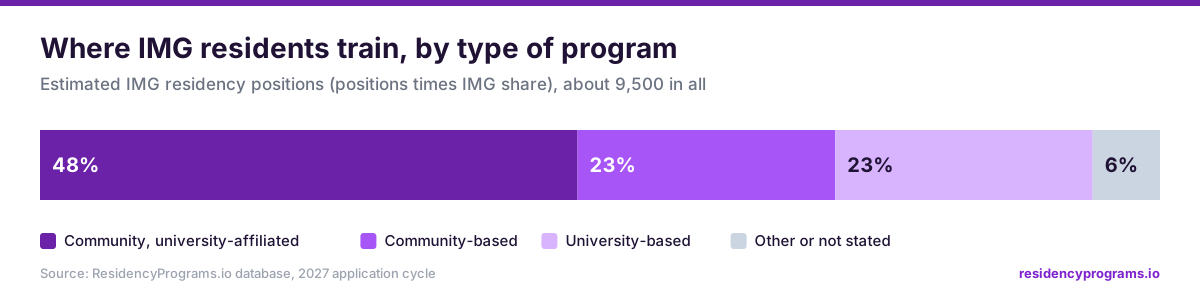
Community programs with a university affiliation are the real center of IMG training: they hold an estimated 48% of all IMG positions. University-based programs hold about as many IMG positions (23%) as community-based programs (23%), even though their IMG share is much lower. Writing off university programs means writing off about a quarter of the positions IMGs actually fill.
Visa sponsorship: the university advantage
Here the pattern reverses. University-based programs are the most likely to sponsor a visa:
| Type of program | Sponsor the J-1 | Sponsor the H-1B |
|---|---|---|
| University-based | 86% | 23% |
| Community-based, university-affiliated | 68% | 12% |
| Community-based | 54% | 6% |
Share of programs that report a visa policy for the 2027 cycle.
Large academic centers have legal and GME offices that handle visas every year, for residents, fellows and faculty. Smaller community hospitals often do not, and nearly half of purely community programs sponsor no visa at all. If you need a visa, a community program with a high IMG share may still be closed to you. Check the visa column before anything else.
If you need the H-1B in particular, the university side matters even more. Almost one in four university-based programs offers it, against one in seventeen community-based programs.
Competition and screening
The data also shows a difference in how crowded each type is:
| Type of program | Applicants per position | Average interview rate | List a graduation limit |
|---|---|---|---|
| University-based | 76 | 20% | 33% |
| Community-based, university-affiliated | 127 | 17% | 54% |
| Community-based | 143 | 17% | 54% |
Community programs receive almost twice as many applications per position as university programs. That makes sense: if every IMG adviser says "apply to community programs", community programs get every IMG application. The result is that IMG-friendly community programs are not easy. They are popular.
Community programs are also more likely to list a maximum time since graduation: more than half do, against a third of university programs. For an applicant several years out of medical school, a university program can be the more open door.
Specialty by specialty
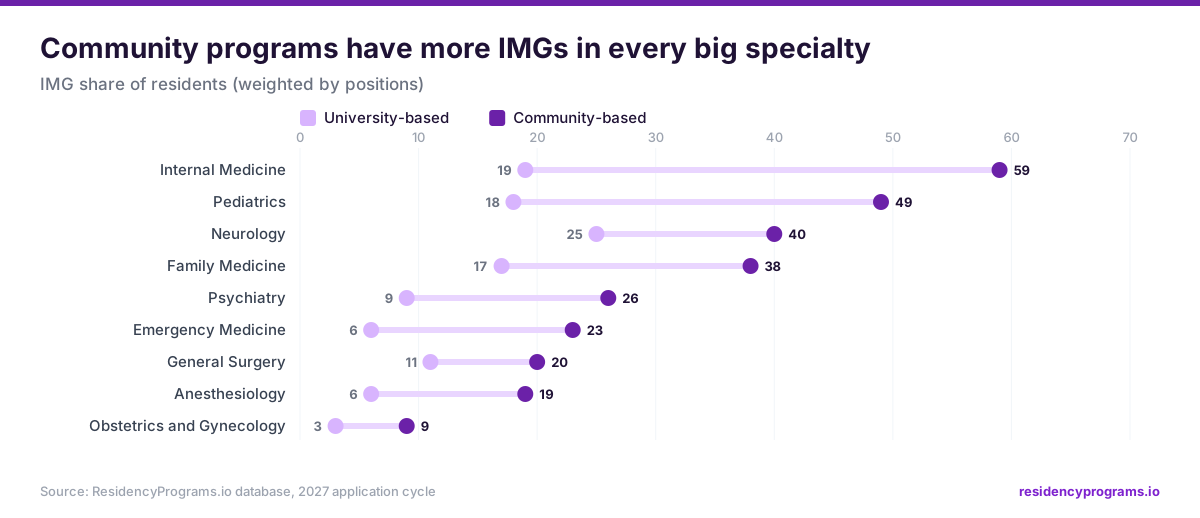
The community advantage holds in every large specialty, but its size varies:
- Internal medicine shows the biggest gap: 59% IMGs at community-based programs against 19% at university-based ones. Even so, university-based internal medicine has 4,148 positions, so 19% is still a lot of residents. Browse all of them on our internal medicine page.
- Pathology (not in the chart, as it has very few purely community programs) is IMG-friendly in every setting: 37% IMGs even at university-based programs, and most pathology programs are university-based.
- Neurology and pediatrics have meaningful IMG shares at university programs (25% and 18%), which is where most of their positions are.
- Psychiatry, emergency medicine, surgery and anesthesiology are community-leaning for IMGs: the IMG share at community-based programs is two to four times the university figure.
- Obstetrics and gynecology has few IMGs anywhere (3% to 9%).
What this means for your list
- Start with visas. If you need a visa, university and affiliated programs give you more options than purely community ones. If you need the H-1B, the university side is where most of the options are.
- Do not skip university programs. They hold about a quarter of all IMG positions, get fewer applicants per seat and are more open to older graduates. A university program with a 20% IMG share and J-1 sponsorship is a real option.
- Treat high-IMG community programs as competitive. They get the most applications per position. Apply to them, but do not build a list only from them.
- Think about what you want after residency. If you plan a fellowship or an academic career, a university or affiliated program usually gives you more research and fellowship contacts. If you want to practice in the community, a community program trains you in that setting.
- Use the data. Our specialty pages list every program with its IMG share and visa policy. The ResidencyPrograms.io dashboard adds your own profile and shows which programs fit it.
The fees add up quickly when a list grows, so plan its size before you apply. The ERAS fees calculator shows the cost of any list.
About the data
All figures come from the ResidencyPrograms.io database for the 2027 application cycle, checked in October 2026. Program type is the institutional setting the program reports to ACGME. IMG share combines US IMGs and non-US IMGs among current residents; the "weighted" share counts larger programs more, and estimated IMG positions are positions offered times IMG share. Visa figures cover programs that report a visa policy. Specialty comparisons include settings with at least 15 programs.